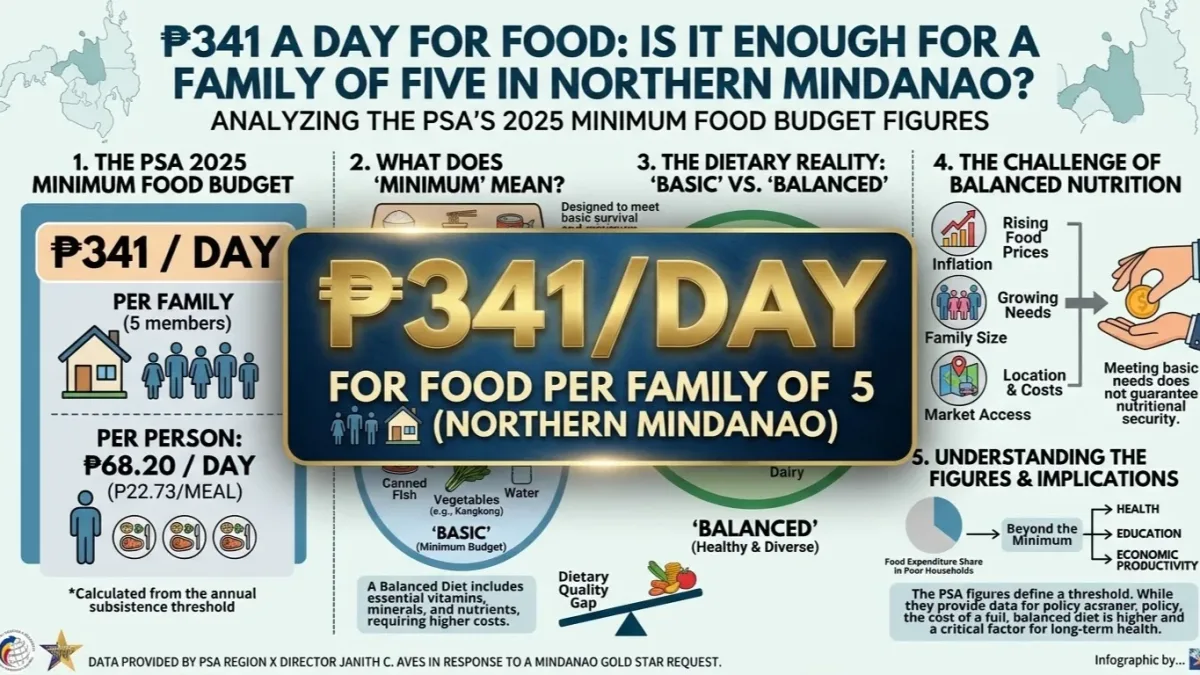
CAGAYAN de Oro City— A family of five in Northern Mindanao needs at least ₱341 a day for food to meet the minimum nutritional requirements set by the Philippine Statistics Authority (PSA).
But while the amount is used to measure food poverty, it does not necessarily mean families can afford a balanced and adequate diet.
Data and clarifications requested by Mindanao Gold Star from PSA Region X Regional Director Janith C. Aves showed that the daily food threshold for a family of five in Northern Mindanao rose by 7.3 percent, from ₱318 in 2023 to ₱341 in 2025.
The amount is equivalent to about ₱10,366 a month for food alone.
The overall poverty threshold, which covers both food and non-food needs, also increased to ₱491 a day for a family of five, or ₱14,938 a month.
This was higher than the ₱459 daily threshold, or ₱13,964 monthly, recorded in 2023.
The figures were part of the latest official poverty statistics released by PSA Regional Statistical Services Office X (PSA-RSSO X) on Oct. 23, 2026, in Cagayan de Oro City.
Minimum food needs, not an ideal diet
The PSA said its food threshold is based on a food bundle designed to meet minimum nutritional requirements established by the Food and Nutrition Research Institute.
The food basket is intended to provide 100 percent of the recommended energy and protein intake and 80 percent of the requirements for vitamins and minerals.
However, Aves’ clarification stressed that the threshold should not be mistaken for an ideal or comfortable diet.
“The food threshold represents the estimated minimum cost of meeting basic nutritional requirements. It is not intended to represent the ideal or preferred diet of a family,” the PSA said.
The agency also emphasized that the food basket is not a prescribed meal plan that poor families are expected to follow.
“Rather, it serves as a statistical reference for determining the minimum income needed to meet basic food requirements,” it said.
For a family of five, the ₱341 daily food threshold is equivalent to an average of about ₱68 per person.
In Region X, the average price of rice in 2025 was ₱44.30 per kilogram. An egg cost ₱9.30, while galunggong averaged ₱197.80 per kilogram.
Monggo, a common source of protein, averaged ₱116.80 per kilogram.
These prices are used together with the assigned quantities of food items in the provincial food bundle to compute the daily food threshold.
Poverty methodology still under review
The PSA said the methodology used for the 2025 official poverty statistics was still based on the system approved by its Board in 2011.
Although the agency reviews its methodology every 10 years to keep the poverty measurement relevant, the broader review remains ongoing.
The updated National Reference Food Bundle has already been approved through a PSA Board resolution. However, the food bundle used in Northern Mindanao's 2025 poverty estimates remained the same as the one used in 2023.
The PSA explained that the 2025 food threshold was updated using average provincial food prices collected from January to December 2025.
This means the latest figures reflect changes in food prices, but the underlying methodology has yet to be fully revised.
The agency said the Technical Committee on Poverty Statistics, composed of experts from government agencies, the academe, the private sector and international organizations, is responsible for developing and reviewing the methodology.
Among the issues being considered is whether the existing food basket continues to reflect the nutritional needs, food consumption patterns and prices faced by Filipino households.
What the poverty line does not tell us
The ₱491 daily poverty threshold for a family of five is an estimate of the minimum amount needed to cover food and non-food requirements.
At ₱14,938 a month, the amount must cover basic needs beyond food, including other essential household expenses.
However, being above the official poverty threshold does not necessarily mean a family can comfortably pay for medicine, school expenses, transportation, electricity and emergencies.
The PSA acknowledged this limitation, stressing that the food threshold is a statistical measure of minimum nutritional requirements.
The agency emphasized that it is “not a guarantee that a family can comfortably afford a balanced and varied diet.”
The distinction is important for families living close to the poverty line, particularly those relying on daily wages, informal work or irregular income.
While poverty statistics provide a basis for measuring deprivation and guiding government programs, the actual living conditions of households may be more difficult than the numbers suggest.
The latest figures show that the cost of meeting basic food and non-food needs in Northern Mindanao has increased.
But as the PSA continues its review of the poverty estimation methodology, a key question remains: Does the minimum amount used to measure poverty still reflect what families in the region need to live with dignity?