By Jigger J. Jerusalem, Correspondent .
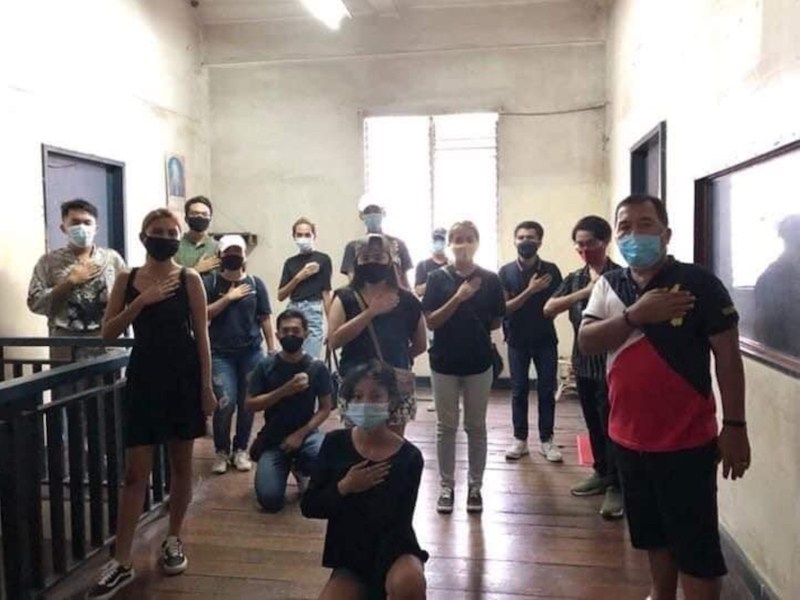
CIVIL society groups here have expressed their strong opposition to the newly signed Anti-Terrorism Act of 2020.
Instead of passing more relevant legislations to address the continuing threat of the coronavirus disease (Covid-19) pandemic, the government has misplaced its priority when it passed into law the anti-terrorism bill, a multi-sectoral collective said.
Accusing the Duterte administration as having no regard “to the clamor of people” by enacting the Anti-Terrorism Act of 2020 in the wake of the ongoing health emergency, the Philippine Misereor Partnership Inc. (PMPI) said the law has overshadowed pending Covid-19 measures and policies.
PMPI is a social development and advocacy network of more than 250 Philippine church and faith-based, non-governmental, and people’s organizations spread all over the country, in partnership with Misereor, a social development arm of the German Bishops based in Aachen, Germany.
“As we call for systematic, efficient, and humane solutions in this time of crisis, the nation was instead ‘gifted’ with this despicable bill, intended to control and manage the growing dissent of people for the government’s failure to address the problems of the poorest Filipinos during the pandemic,” said Yolanda Esguerra, PMPI national coordinator.
The group said it feared the new anti-terrorism law will subvert the people’s fundamental rights and liberties, paving the way for a much worse situation that the martial law period during the rule of the late dictator Ferdinand Marcos from the early ‘70s to the mid-’80s.
“The dark days of Philippine history will come to haunt us all over again with this legal measure. It will be like the Damocles sword hanging above us, ready to fall and chop-off our heads,” it said.
PMPI said it will join other groups who are calling for the repeal of the law and are questioning its constitutionality, as it condemns the signing of the Act.
“As part of a broader civil society movement that advocates for upholding our bill of rights contained in the fundamental law of the land, as well as laws protecting the rights of the vulnerable groups, we oppose this measure because its vagueness and over-broadness is prone to abuse and can be used to suppress dissent and our activism,” it added.
PMPI said: “We believe that this law will further assault whatever democracy is left in the country. A democracy which has been slowly eroded by this President and his minions in Congress since their assumption to power. This is an attack to our failing democracy. Almost a final nail to the coffin.”
The group said it although there is now an apprehension that the anti-terrorism law will affect their work at the grassroots, by way of red-tagging and other forms of harassment, PMPI has assured they will continue with their programs and projects in the country.
“Thus, even as we foresee that our work to journey and support the struggle of our partner mining affected communities, peasant and fisherfolk communities as well as the urban poor communities, and even our work to defend the environment, can be easily red-tagged or branded as acts of terrorism, we shall not waver at our commitments,” it said.
The group added it “will not be fooled by posturing of peace, compassion, and care for people nor be intimidated by violent and threatening language. We will not submit to fear. We will continue to fight for the rights of people and the environment specially in this crucial time.”
In an interview, Drieza Lininding, chair of the Marawi City-based Moro Consensus Group, said that with only four years under the Duterte administration, the human rights situation in the country is getting worse and the enactment of the anti-terrorism law further threatens the very fundamentals of democracy.
“With [anti-terrorism bill] now a law, nobody can guarantee that this will not be abused considering our past experiences with government enforcers,” he said.
Lininding has expressed fear that the Moro people will be gravely impacted by the law.
“By profile we are already suspects and they can conduct surveillance or detain any of us,” he said, adding that they will support all peaceful means to repeal the law.
Meanwhile, the Samahan ng mga Ex-Detainees Laban sa Detensyon at Aresto (Selda), a group of former political detainees, has denounced the anti-terrorism law.
“Clearly, the safety of the country is not the priority of the government,” said Danilo dela Fuente, Selda spokesperson, in a statement.
“Amid the ballooning number of Covid-19 patients and worsening economic slump, not to mention the blatant protocol violations of government officials such as PNP-NCR chief Debold Sinas and Sen. Koko Pimentel, the Duterte administration has put more importance in signing this problematic measure, notwithstanding the massive opposition and protests due to its unconstitutional and anti-people provisions,” dela Fuente said.