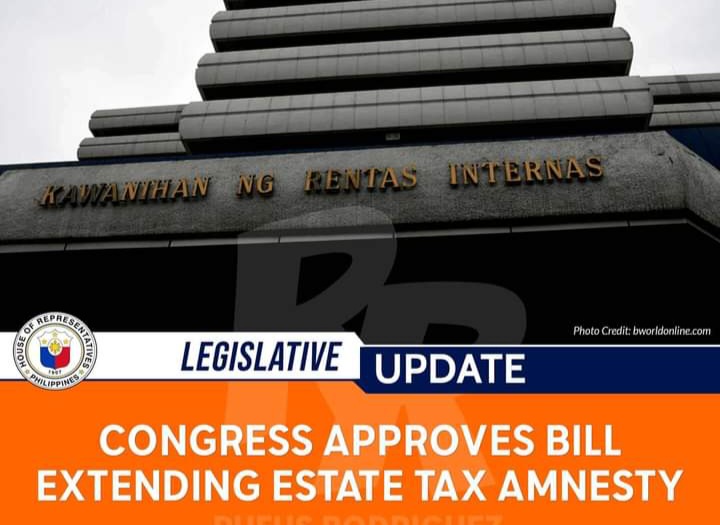
DURING a plenary session, a total of 259 lawmakers voted to approve House Bill 7909, extending the coverage and period of availing the Estate Tax Amnesty from June 14, 2023 to June 14, 2025. No lawmaker voted against the measure or abstained from voting.
CAGAYAN de Oro City 2nd District Rep. Rufus Rodriguez said he is for the passage of this bill to provide relief to the families of deceased individuals in settling the estate tax obligations.
“This measure is important to ease the burden on taxpayers in settling their taxes, especially during these difficult times when the country is still grappling with the effects of the COVID-19 pandemic,” said Rodriguez.
The bill seeks to encourage taxpayers to avail of the estate tax amnesty, which offers lower tax rates and waivers of surcharges, interest, and penalties.
It also enables the government to collect unpaid estate taxes, generate additional revenues, and address tax evasion.
According to Rodriguez, the extension of the period and coverage of the estate tax amnesty is necessary to provide relief to taxpayers who may have missed the previous deadline due to circumstances beyond their control.
“It also aims to encourage more taxpayers to avail of the amnesty and to increase government revenues,” said Rodriguez.
During the deliberations, the House Committee on Ways and Means favored the passage of the bill, noting that it would benefit both taxpayers and the government.
The committee stressed the need to address the backlog of pending estate tax cases, saying that the amnesty would help reduce the number of cases and enable the Bureau of Internal Revenue to focus on other priority areas.
The bill also received support from various business groups, who lauded its passage by the House of Representatives, according to Rodriguez.
The groups commended the efforts of Rodriguez and other lawmakers for their commitment to promoting good governance and fiscal responsibility.
The extension of the estate tax amnesty period is expected to provide a more flexible and practical solution for taxpayers, particularly those who have been impacted by the COVID-19 pandemic.
Rodriguez is also hoping that the measure will encourage more taxpayers to come forward and settle their estate tax obligations, ultimately helping to boost government revenues.
“The bill now heads to the Senate for further deliberations before it can be signed into law by the President,” said Rodriguez.
He said it is expected that the Senate will give its nod to the measure, given its significance in providing relief to taxpayers and generating additional revenues for the government.
“If the bill is passed into law, it will bring much-needed relief to the families of deceased individuals who are struggling to settle their estate tax obligations, Rodriguez reiterated.
It will also provide a good opportunity for taxpayers to avail of the amnesty and enjoy its benefits, including lower tax rates, waivers of surcharges, interests, and penalties, and reduced liabilities.
He maintained that with the extension of the estate tax amnesty, taxpayers will have more time to settle their obligations, while the government can generate additional revenues to support its programs and projects.
“This measure will also help improve compliance with tax laws and regulations and promote a culture of transparency and accountability in the tax system,” said Rodriguez.
Overall, according to him, the extension of the estate tax amnesty period is a positive development for taxpayers and the government alike.
House Bill 7909, principally authored by Rodriguez, extending the coverage and period of availment of the estate tax amnesty was approved by the House of Representatives on third and final reading.
He also said, the bill seeks to amend Republic Act 11213 or the Tax Amnesty Act.
Consequently, the Senate version of the bill (Senate Bill 2219) was unanimously adopted by the House of Representatives last May 29, 2023.
The bill extends the coverage of availing tax estate amnesty to those who died on or before May 31, 2022, from December 31, 2017 as originally stated in RA 11213.
It also extends the period of availing estate tax amnesty by two (2) years, by postponing the application deadline from June 14, 2023 to June 14, 2025.
“We are pushing for the approval of this bill because it will help individuals and families in difficult or extraordinary circumstances time to settle estate tax liabilities affordably,” Rodriguez said.
Meanwhile, according to the Department of Finance, the national government has collected P7.41 billion from 133,860 beneficiaries who availed of the estate tax amnesty from the enactment of the Tax Amnesty Law in 2019 until March 2023.