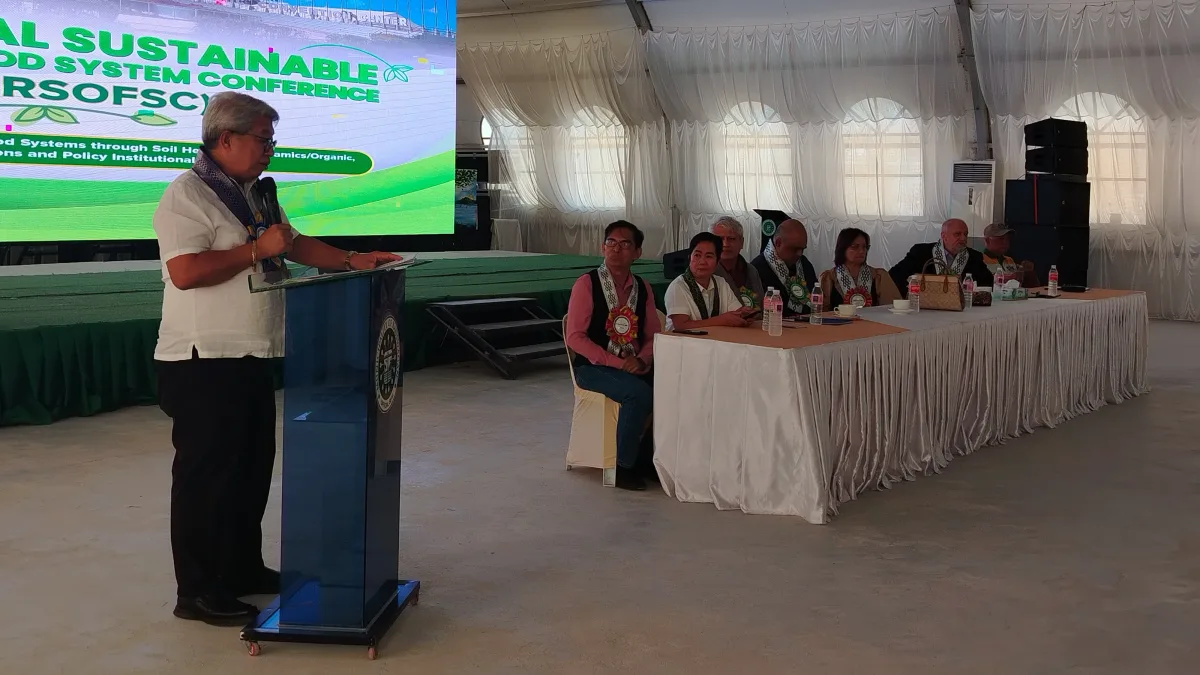
KAUSWAGAN, Lanao del Norte — Kauswagan officials are seeking stronger national government support for organic farming, warning that inadequate funding for food production could worsen hunger and undermine peace in rural communities.
Vice Mayor Rommel C. Arnado appealed to Agriculture Secretary Francisco P. Tiu Laurel Jr. to ensure the full release of the two-percent budget allocation for organic agriculture, saying municipalities committed to sustainable farming need more resources to increase food production.
"If there is a two-percent allocation for organic agriculture, give the full allocation to municipalities that are seriously pursuing organic farming," Arnado said.
He claimed that only about one percent or less of the intended funding reaches the organic agriculture sector, limiting assistance to local governments.
Arnado said about 95 percent of Kauswagan's organic farming initiatives rely on local government resources, leadership, and farmers' efforts.
Among the municipality's urgent needs are irrigation facilities, farm inputs, and equipment and materials to produce organic fertilizers such as compost, bokashi, and vermicast.
He said existing facilities can no longer keep up with demand, despite efforts to encourage farmers to produce their own organic fertilizers.
Food security and peace
Arnado stressed that reliable food production is essential to reducing poverty and sustaining peace, particularly in communities affected by conflict.
"For us, hunger is the beginning of conflict. If a person's stomach is empty, that person cannot think properly," he said.
He cited Kauswagan's agricultural livelihood programs, which also support members of the Moro Islamic Liberation Front (MILF) community.
The municipality has expanded its farming and fisheries enterprises through contract farming and value-added products, including boneless bangus, bottled bangus sardines, bangus sisig, and other processed fish products.
Arnado said these initiatives provide livelihood opportunities for farmers, fisherfolk, and women while increasing the market value of local produce.
DA cites P21-million funding
Meanwhile, Department of Agriculture (DA)-10 Officer-in-Charge and Regional Technical Director for Research and Regulations Viralou Tuquib said the regional office has a P21-million allocation for organic agriculture programs across Northern Mindanao.
Available interventions include free biological pest-control agents through the Regional Crop Protection Center, livestock dispersal, poultry equipment, bee colonies, and mobile soil laboratory services.
DA-10 Organic Agriculture focal person Marnie S. Suarez also cited assistance previously provided to Kauswagan, including a hauling vehicle and farm inputs for the PGS Kauswagan Organic Farmers Association.
The municipality also received 50 cattle and 35 goats through earlier livestock dispersal programs.
Suarez said the regional office continues to provide production assistance and training, including mentoring for Participatory Guarantee System (PGS) groups. However, she acknowledged that funding remains limited and must be shared among municipalities across the region.
She encouraged local governments and farmers' organizations to apply for the Organic Agriculture Neighborhood Project, which offers eligible beneficiaries up to P5 million worth of production inputs and facilities.
Despite these interventions, Arnado maintained that stronger national government investment is needed to help municipalities expand organic farming and improve local food supplies.
"We have to go all organic. We should not be lazy when it comes to producing food," he said.