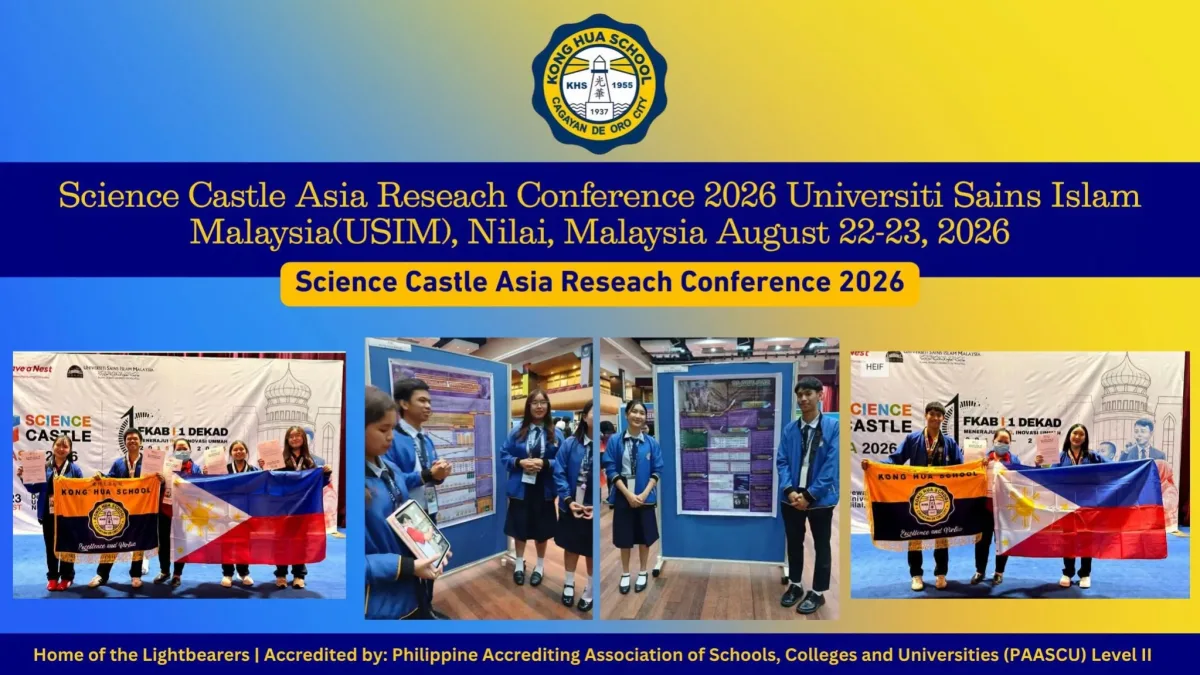
CAGAYAN DE ORO CITY — Student researchers from Kong Hua School secured both Silver and Bronze awards at the Science Castle Asia Research Conference 2026 held Aug. 22–23 at Universiti Sains Islam Malaysia in Nilai, Malaysia.
The international conference brought together young scientists from across Asia to present innovative research solutions to pressing environmental challenges.
Double Victory
Kong Hua School fielded two delegation teams to present microbiology and chemical engineering studies focused on plastic waste degradation.
The traveling delegates represented their co-researchers who contributed to the laboratory studies in the Philippines.
Silver Award
The research team of Carmela Julia Amata, Carlisle Zeus Calva, Mary Ivanna Shea Go, and Rian Alarice Puertas earned the Silver Award for their microbiology study.
Entitled Synergistic Degradation of Pre-Treated PET Using Putative Bacterial Co-Cultures, the research was co-authored with team members Jefferson Mark Lee and Cassandra Marie Mangabay.
The study investigated combining bacterial co-cultures with physical and chemical pre-treatments to accelerate plastic decomposition.
Bronze Award
Delegates Chloe Christine Dugenio and Francis Kyann Panelo captured the Bronze Award for their environmental chemistry research.
Their study, Photocatalytic Breakdown of PET and Polystyrene for Conversion into Sustainable Fuel Precursors, explored breaking down common plastics into renewable energy precursors.
The project was co-authored by student researcher Ceejig Lourain Balan, along with Mia Daniella Cuaton, Atrisha Hiljay Tingson, Cursive August Monsanto, and Kyle Francis Sagarino.
Research Vision
Balan emphasized the broader environmental goals of their plastic breakdown study and research journey.
"We hope our research encourages further investigation into microbial biotechnology and its potential environmental applications, particularly in addressing plastic pollution through innovative and sustainable approaches," Balan said.
School officials commended both research groups for advancing sustainable plastic management technologies on an international platform.
"In the long term, research in this field could contribute to the development of biological waste treatment facilities, where microorganisms are utilized as part of controlled plastic processing systems," Calva noted.
"We hope our research encourages further investigation into microbial biotechnology and its potential environmental applications, particularly in addressing plastic pollution through innovative and sustainable approaches," Calva added.