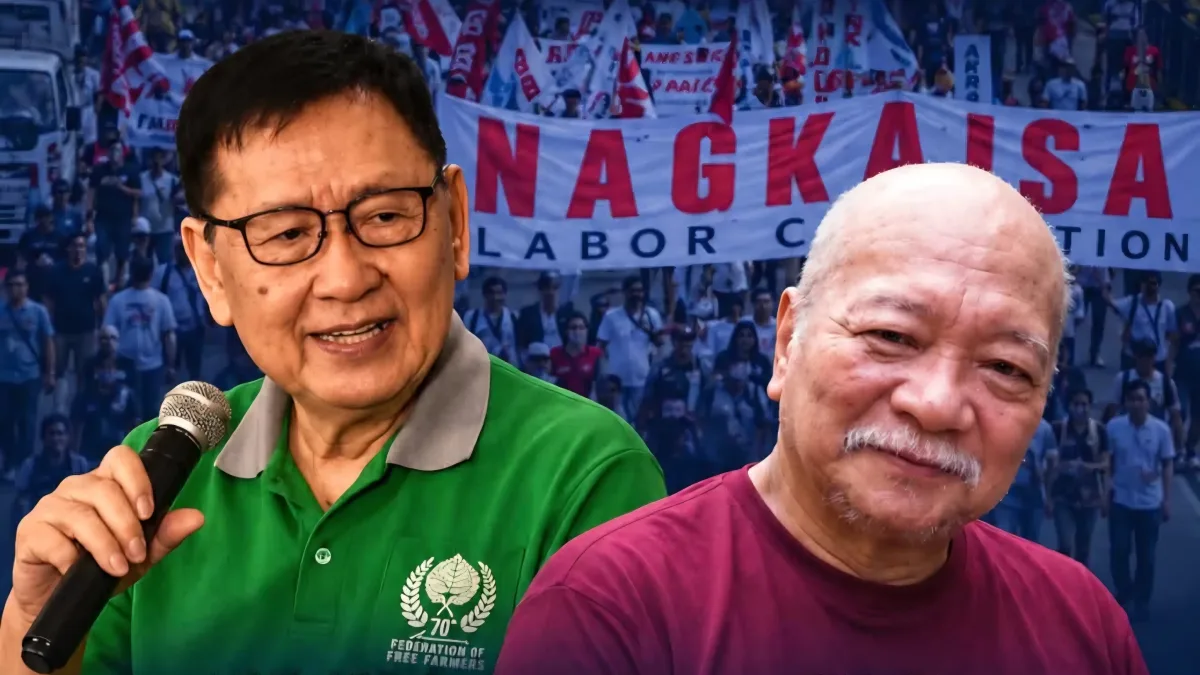
CAGAYAN de Oro City— A labor coalition has come to the defense of two individuals facing libel-related cases, warning that criminal complaints against people who speak out on public issues could discourage criticism and debate.
The NAGKAISA Labor Coalition has expressed support for former Agriculture Secretary Leonardo Montemayor and veteran journalist Philip Lustre Jr., both of whom are facing cyberlibel cases.
The coalition is also urging Congress to decriminalize libel and cyberlibel.
For consumers and farmers in Northern Mindanao, the controversy raises a broader question: how can people scrutinize issues affecting food prices and livelihoods without facing criminal prosecution, while also protecting individuals and businesses from false and damaging accusations?
“Bring out the documents—not the handcuffs,” NAGKAISA chairperson and Federation of Free Workers president Atty. Sonny Matula said in a statement dated Nov. 2.
Charges stem from separate complaints
Montemayor, who chairs the Federation of Free Farmers, faces one count of cyberlibel and two counts of oral defamation following complaints by agricultural firm Planters Products Inc. (PPI).
The complaints arose from his statements questioning PPI’s rice imports and describing the company as a government-owned or controlled corporation.
Makati Regional Trial Court Branch 148 issued an arrest warrant on Oct. 26. Montemayor subsequently posted bail, and his arraignment is scheduled for Nov. 24.
PPI has maintained that it is a private corporation whose shares are owned by private individuals and entities, not the government.
Its legal counsel, Atty. Czarina Quintanilla-Raz, said the case concerns alleged false and defamatory statements, not persecution.
“Freedom of expression does not give anyone the right to make defamatory statements or present unsupported allegations as established facts,” Quintanilla-Raz said.
Lustre, meanwhile, was arrested in Quezon City on Oct. 24 under a cyberlibel warrant issued by a Davao court.
His lawyer said the complaint was filed by Atty. Manases “Mans” Carpio over a Facebook post. Lustre said he was unaware of any complaint against him. He has also posted bail.
Both men are presumed innocent. The filing of criminal charges does not establish guilt.
Public criticism and legal limits
Matula said the cases could discourage journalists, farmers’ advocates and ordinary citizens from questioning matters of public interest.
He cited Supreme Court rulings recognizing constitutional protection for fair comment and criticism, including Borjal v. Court of Appeals and Guingguing v. Court of Appeals.
In Philippine Daily Inquirer, Inc. v. Enrile (2021), the high court also recognized that a matter does not lose its public importance simply because a private individual or company is involved.
However, these protections do not give anyone blanket immunity for defamatory statements. Their application depends on the facts and evidence in each case.
NAGKAISA acknowledged that public interest does not excuse false accusations or automatically remove a complainant’s right to protect a reputation.
The coalition's position is that questions about rice imports and corporate accountability should be answered with documents and evidence, while claims of defamation should be resolved through a fair legal process.
Coalition seeks changes to libel laws
NAGKAISA is calling on Congress to decriminalize libel and cyberlibel and review the criminalization of oral defamation.
It wants civil remedies retained to protect reputations, along with safeguards against lawsuits intended to silence public participation.
The coalition also cited People v. Soliman (2023), in which the Supreme Court affirmed that courts may impose a fine instead of imprisonment in appropriate online libel cases.
However, the ruling did not remove imprisonment as a possible penalty.
The Court clarified that judges must consider the circumstances of each case when deciding whether a fine alone would serve the interests of justice.
Other countries, including New Zealand and Ireland, have abolished criminal libel while retaining civil remedies, NAGKAISA noted.
The debate has also reached Congress.
Lawmakers have expressed support for reviewing libel and cyberlibel laws following Lustre’s arrest, including a proposal to decriminalize the offenses.
For workers, farmers and consumers, the issue goes beyond the cases involving Montemayor and Lustre. It concerns the space people have to question decisions affecting their livelihoods and public welfare—and the responsibility to support those questions with verifiable facts.
As Matula put it, “Answer criticism with facts—not handcuffs.”