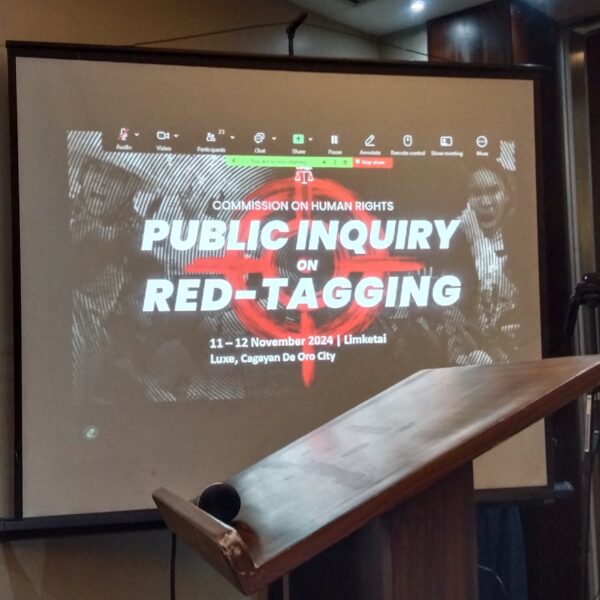
THE Commission on Human Rights has started its inquiry on red-tagging in Mindanao where more than a hundred individuals and organizations were labeled as communist sympathizers or terrorists without substantial evidence.
CHR Commissioner Beda Epres said the inquiry is based on the July 4, 2023, Supreme Court ruling declaring red-tagging a threat to people’s lives, liberty, and security.
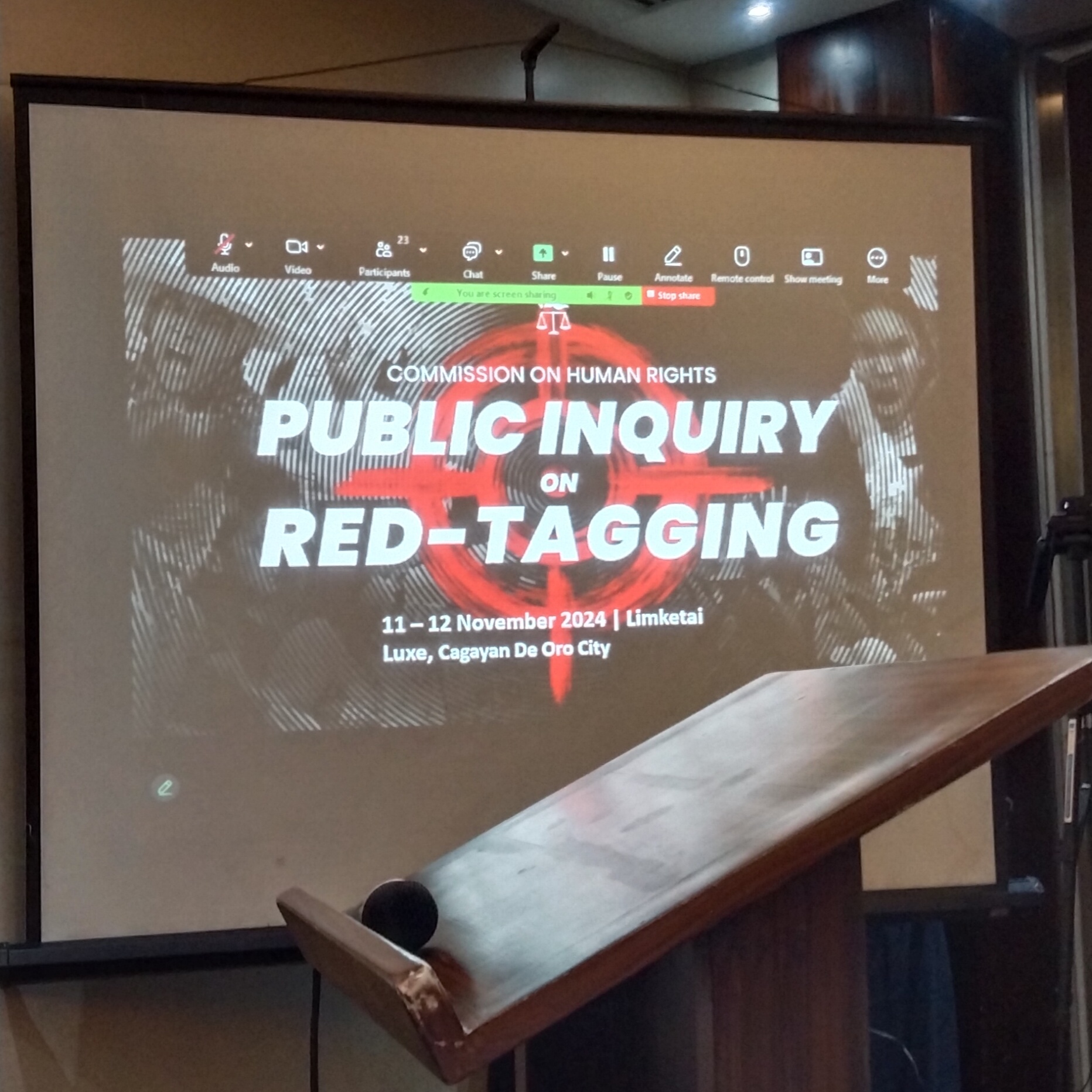
At least a hundred individuals or organizations are expected to share their gripping stories of harassment from state forces to the two-day closed-door CHR inquiry held at a downtown hotel here last Monday and Tuesday.
Many testimonies were made online by respondents who feared traveling to Cagayan de Oro for security and economic reasons. However, according to a CHR staff member who asked not to be identified, only four witnesses came to present their testimonies.
The CHR has already completed its investigation in Manila and Cebu. Cagayan de Oro is the final leg of their nationwide investigation on red-tagging
CHR Region 10 Jeanne Abrina said the CHR will prepare its final report on red-tagging after collating all of the testimonies.
All of the respondents blamed the National Task Force to End Local Communist Armed Conflict, created by former President Rodrigo Duterte, the Armed Forces of the Philippines, and the Philippine National Police.
“This is too organized and well-funded not to be state-sponsored,” Lawyer Beverly Selim-Musni, a member of the National Union of People’s Lawyers said.
Musni and her daughter, Charina, also a human rights lawyer, were subjected to red-tagging—their pictures plastered in posters and tarpaulins distributed all over Cagayan de Oro City and towns in Misamis Oriental.
During the inquiry on Monday, Musni said the CHR commissioners were able to hear testimonials of bullying against individuals and organizations including an LGBT organization in Zamboanga City and farmers protesting against a palm oil corporation ho forcibly took over their lands in Agusan del Sur.
“The LGBT organization was red-tagged for organizing beauty and makeup classes among gays. That is how ridiculous they are,” Musni said.
In her case, Musni said she was shocked to see her picture on a pamphlet labeling her as a communist sympathizer being distributed outside a church in Cagayan de Oro City.
Cong Corrales, editor-in-chief of Mindanao Gold Star Daily said journalists are not spared by red-tagged bullying by the AFP and PNP.
Corrales, who is frequently being tagged as a communist sympathizer narrated how he and other journalists were red-tagged after they staged a protest rally against the closure of TV station ABS-CBN in 2020.
“When we got back to the ABS-CBN station, we found a funeral wreath with my name and other journalists on it. Later flyers were also distributed around the city,” Corrales said.
Corrales said red-tagging can have a chilling effect that impacts journalists and their ability to report freely especially if they are vilified in public,
“When journalists are silenced, democracy weakens, and the public is left in the dark. Red-tagging violates a core democratic principle: the freedom of the press. It discourages journalists from tackling challenging stories, preventing the public from accessing information essential to a healthy democracy,” Corrales told the CHR commissioners.
Among those invited by the CHR are the Iglesia Filipina Independiente (IFI) whose bishops and clergy were among the most red-tagged organizations in Mindanao.