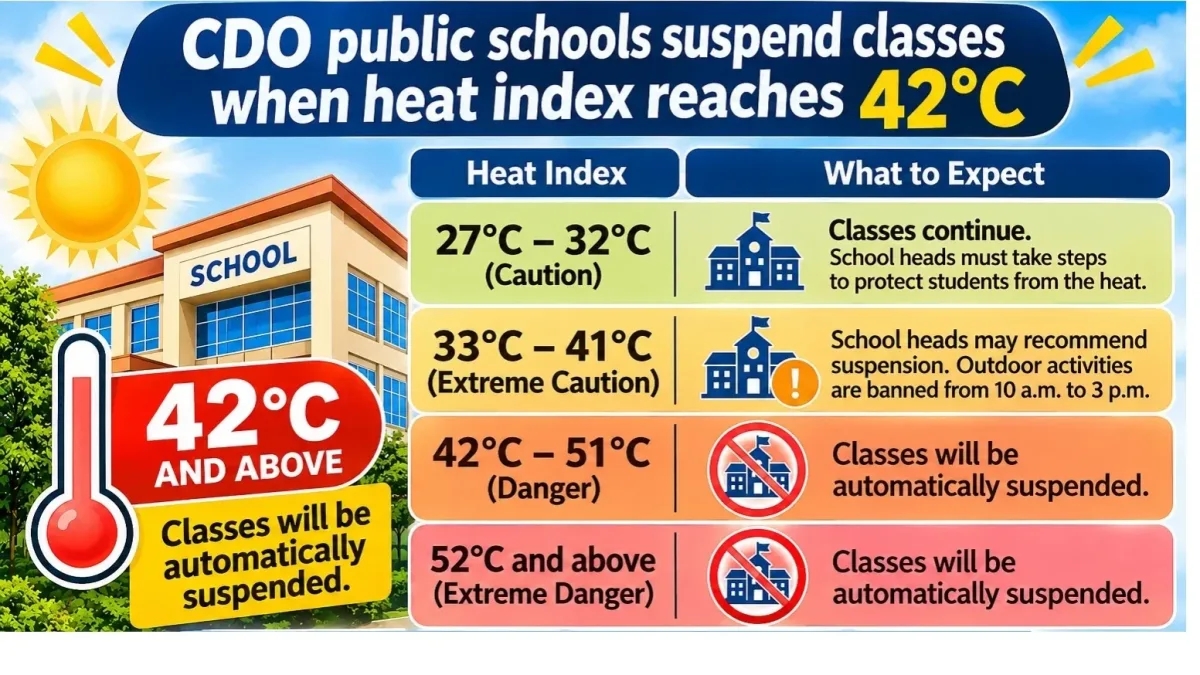
CAGAYAN de Oro City — Public school classes in Cagayan de Oro will be automatically suspended when the heat index reaches 42°C under new city government guidelines issued ahead of the expected Super El Niño.
However, school heads may also recommend suspending face-to-face classes when temperatures are lower but still pose health risks to students.
Mayor Rolando “Klarex” Uy signed Executive Order No. 391-2026 on Aug. 25, setting heat index levels for suspending face-to-face classes in public schools from preschool to senior high school.
The order uses the daily Computed Heat Index Monitoring Report of the PAGASA-Mindanao Regional Services Division, based on readings from its monitoring station at Laguindingan Airport in Misamis Oriental.
Under the guidelines, schools will follow four heat index levels:
Caution (27°C to 32°C): Classes will continue. School heads must take steps to protect students from the heat. Outdoor activities may proceed but should preferably be held in covered areas.
Extreme Caution (33°C to 41°C): School heads may recommend suspending face-to-face classes.
They must submit their request to the city mayor, who will issue an executive order if the suspension is approved. Outdoor activities are prohibited from 10 a.m. to 3 p.m.
Danger (42°C to 51°C): Face-to-face classes will be automatically suspended.
Extreme Danger (52°C and above): Face-to-face classes will also be automatically suspended.
The guidelines also cover private schools and higher education institutions.
However, their administrators will decide whether to suspend face-to-face classes.
The city government is encouraging them to follow the same heat index levels.
When classes are suspended, the Department of Education's City Schools Division must prepare alternative learning arrangements, including online and modular lessons, to prevent disruptions to students' education.
The City Disaster Risk Reduction and Management Department will monitor compliance with the order in coordination with barangay disaster teams, the City Social Welfare and Development Department, the Local School Board, DepEd and the Commission on Higher Education.
The guidelines aim to protect students, especially young children who are more vulnerable to heat-related illnesses, while ensuring that learning continues even when classroom activities are suspended.