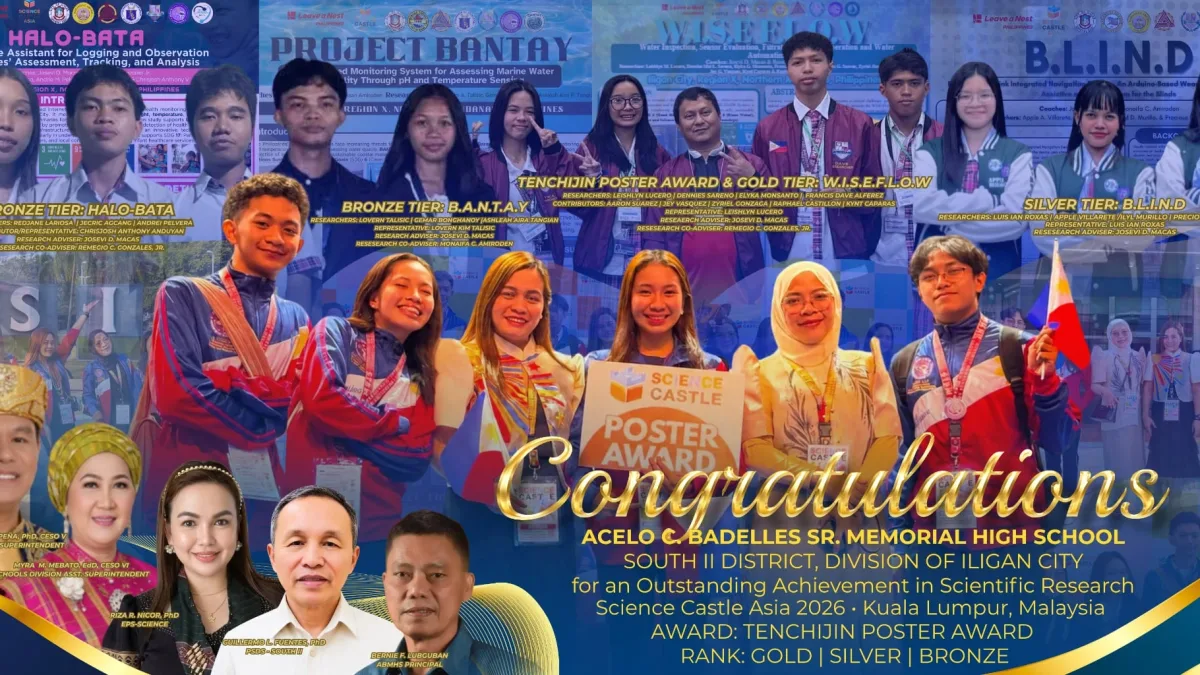
ILIGAN CITY — Defying severe financial constraints and administrative demands, student researchers from Acelo C. Badelles Sr. Memorial High School (ABMHS) brought honor to the Philippines after securing multiple awards at the Science Castle Asia competition held at Universiti Sains Islam Malaysia.
Competing against roughly 150 elite student research teams from across Asia, the young innovators from Barangay Tipanoy earned the prestigious Tenchijin Award, along with Gold, Silver, and Bronze tier recognitions.
Overcoming financial roadblocks
The path to Malaysia was fraught with financial uncertainty. The school had previously received international invitations to South Korea and Singapore, but both opportunities were passed up due to a lack of travel funds.
The head coach recalled the emotional toll during the months leading up to the competition when financial realities almost stalled the trip again. "I witnessed students break down in tears because they wanted so badly to represent the country in Malaysia but were worried about becoming a burden to their families," the head coach said.
Despite the mounting challenges, the team refused to abandon the goal. "If they continued to believe that their dreams were possible despite all the obstacles, then who was I to give up on them?" the coach added.
Rallying grassroots support
Grassroots community backing ultimately made the trip possible. Local leaders, alumni, parents, and community partners rallied behind the school to cover travel costs. "The financial burden that had kept so many of us awake at night became lighter because people chose to believe in the dreams of these young researchers," the head coach noted.
Innovating for local needs
The projects were designed to solve pressing real-world issues in Northern Mindanao. WISE-FLOW team representative Leishlyn M. Lucero explained that their water quality monitoring project grew out of direct engagement with residents in Barangays Abuno and Mirador.
"Hearing these stories made us realize that the problem was not simply something we could discuss in a research paper," Lucero said. "It affected people’s everyday lives and, in some cases, their health and livelihood."
Lucero added that the team funded their early prototypes through personal sacrifices. "A lot of the components we used were bought from our own pockets, even from the school allowances we had saved," she said. "Every time we bought another component, it felt like a small sacrifice, but we kept doing it because we believed the project was worth building."
Other award-winning innovations included B.L.I.N.D., a mobility device designed to aid visually impaired individuals. Student researcher Luis Ian Roxas highlighted how the project was rooted in local needs. "In Iligan, we often see visually impaired persons, including blind massage therapists, navigating through places and depending on others or each others for assistance," Roxas said. "Knowing that our research could potentially help a visually impaired person navigate more safely, especially during emergencies, made me feel that all the time, effort, and struggles we experienced while building it were worth it."
Redefining student research
Student researcher Lovern Talisic, whose team developed the coastal water monitoring project BANTAY, recalled how the experience shifted their understanding of scientific work. "At first, I honestly thought research was just about grades, competitions, deadlines, stress, and trying to win," Talisic said. "I realized that research should not simply be something we do for grades, recognition, or medals. It should be something we do because there is a problem that needs to be solved, a community that needs help, or a future that we want to protect."
Representing the HALO-Bata infant health monitoring project, Chrisjosh Anthony V. Anduyan emphasized that limited resources should not hold back student innovators. "You don't need to have everything at the beginning, you just need the courage to start," Anduyan said. "Coming from a local public high school and reaching an international stage taught us that your background does not define how far your dreams can go."
A lasting transformation
For the faculty, the international recognition proved secondary to the personal growth of the students. Co-coach Monaifa C. Amiroden reflected on their evolution over the two-year journey.
"What started as a Practical Research 1 output became a journey that shaped not only their skills as young researchers, but also their confidence, discipline, and perseverance," Amiroden said. "Lastly, this is where I am reminded of one of the greatest roles of a teacher: to transform the lives of our students."