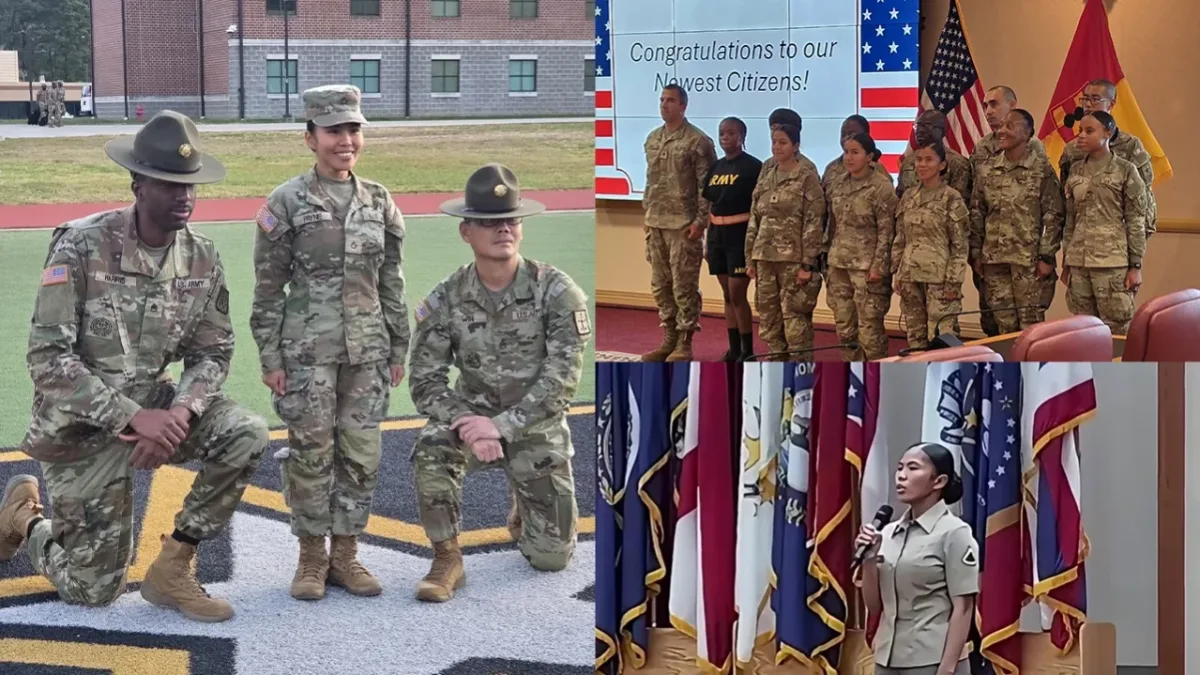
CAGAYAN de Oro City — A young girl from a farm in Mindanao once dreamed of simply riding an airplane, yet years later, 31-year-old Filipina artist Mia Vine became a U.S. citizen and graduated from U.S. Army basic combat training on back-to-back days.
The Filipina artist—whose Army name tape bears her married name, Payne—also sang the U.S. national anthem during the ceremony, fulfilling a childhood dream that began with wanting to ride an airplane.
Her journey reached a high point at Fort Sill, where she took the Oath of Allegiance to become a US citizen before graduating from Army basic training the following day. She was also chosen to sing the US national anthem during the ceremony.
For Mia, the achievement marked years of hard work, sacrifice and determination, beginning in the Philippines and taking her across several countries before reaching the US military.
From farm life to a bigger dream
Mia said growing up on a farm in Mindanao taught her to work hard and endure difficult situations.
She credited her father for instilling in her the discipline and work ethic that later helped her face the physical demands of military training.
“Growing up on a farm, my dad taught me that life wasn't always easy, and I was used to doing physical work. I think that helped me a lot during basic training because I already knew what it felt like to push through difficult days,” she said.
She added that her childhood taught her to work for what she needed rather than expect everything to come easily.
Her life took a different direction after she met her husband, US Army veteran Carl, also known as Monami, in December 2014.
Their relationship eventually brought them across seven countries and into a long journey toward building a life together in the United States.
Three years of waiting
Before Mia could begin her new life in the US, the couple went through three years of separation while processing immigration documents.
The process involved filings with the US Citizenship and Immigration Services (USCIS), pandemic-related delays and the need to rebuild their application after mistakes by a hired agency.
Mia said the long separation from her husband was emotionally difficult, but they remained committed to their plans.
“There were times when I felt frustrated and wanted to cry, but we never gave up on each other. We knew what we wanted, and we just kept reminding ourselves that all the waiting would be worth it,” she said.
Monami said their experience involved hundreds of pages of paperwork and repeated setbacks that people rarely see when they hear stories about couples building lives across borders.
“Success doesn't look that pretty while you're in the middle of it,” he said. “It looks like paperwork, it looks like waiting, it looks like disappointment, it looks like getting told no over and over again.”
Small in stature, strong in training
About two years ago, Mia made the decision to enlist in the US Army.
She spent months preparing for the Armed Services Vocational Aptitude Battery (ASVAB) examination and improving her physical fitness before entering basic training in her 30s.
At 4 feet 9 inches to 4 feet 10 inches tall and weighing about 92 pounds, she was the smallest recruit in her unit.
One of her toughest challenges was completing a 32-mile march while carrying 60 to 80 pounds of tactical gear.
She said keeping pace with taller recruits was difficult, but thoughts of her family helped her push through.
“Honestly, my little legs were struggling! Everyone was so much taller than me, and I had to work twice as hard to keep up,” she said.
“When I felt like my body couldn't take it anymore, I just thought about my kids and my husband waiting at the finish line, cheering for me and saying, 'Go, Mommy, you got this!' That's the strength that kept me going,” she added.
Monami said he was proud to see his wife complete the same training standards as the other recruits despite her size and the challenges of communicating in a language that was not her first.
He recalled watching her in uniform and realizing how far she had come from her life in the Philippines.
“I stood there staring at my wife, this tiny woman who came from the Philippines, standing there wearing a United States Army uniform,” he said.
“And watched her become an American citizen. Then the very next day, I watched her graduate from Army basic training.”
A citizen, a soldier and a Filipina
The two ceremonies made the achievement even more meaningful for Mia.
Taking her citizenship oath and singing the US national anthem in her Army uniform were moments she never imagined experiencing while growing up on a farm in Mindanao.
“It was honestly an emotional moment for me. I never imagined that a girl from a small province in the Philippines would one day become a US citizen and sing the national anthem in an Army uniform,” she said.
She said she was proud to serve as an American soldier but would always carry her Filipino identity with her.
Monami shared the same sentiment, saying citizenship would not change the person his wife had always been.
“She's always gonna be Filipina. She's still going to speak her language and love her family. She is who she is,” he said.
He described her new chapter as a combination of the roles she has embraced as a Filipina, wife, mother, soldier and American citizen.
Mia is now preparing to move on to Advanced Individual Training (AIT), the next stage of her military career.
A message to young Filipinas
Looking back on her journey, Mia encouraged young Filipinas not to let their backgrounds or circumstances limit their ambitions.
She said her experience showed that even a simple dream could lead to opportunities she never imagined.
“I would tell them to never underestimate themselves or let where they came from limit their dreams. I grew up on a farm, and I never imagined I'd be where I am today,” she said.
“Just believe in yourself, work hard and don't be afraid to try something new. You never know where life might take you.”
Monami also advised couples pursuing opportunities across borders to prepare for lengthy paperwork, cultural adjustments and periods of uncertainty.
For him, success requires patience and the willingness to keep going even when progress seems slow.
“You gotta survive the boring part. You gotta embrace the suck, and yes, you have to get through the paperwork,” he said.
“But most importantly, you have to keep moving forward even when you feel like it's not worth it, because at the end of that tunnel, I promise you it's very much worth it.”