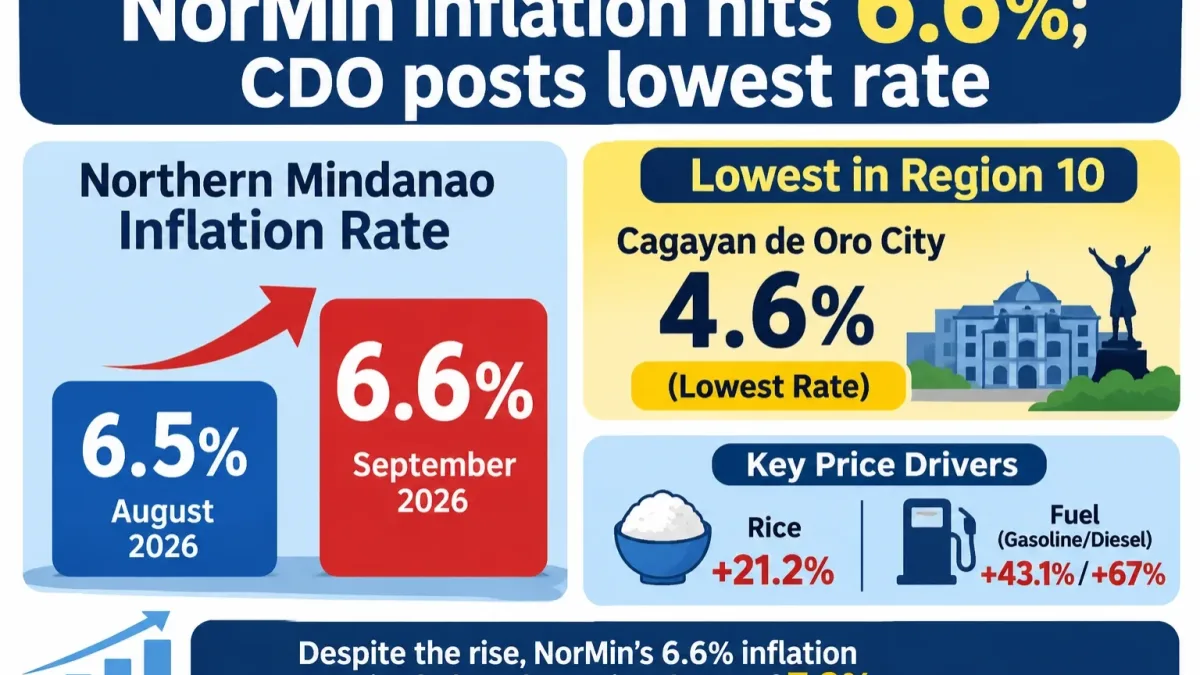
Cagayan de Oro recorded the lowest inflation rate in Northern Mindanao in September, even as rising prices of rice, fuel and other basic commodities pushed the region’s overall inflation to 6.6 percent, the Philippine Statistics Authority (PSA) reported.
The region’s inflation rate edged up from 6.5 percent in August and was significantly higher than the 0.1 percent recorded in September 2025.
Rice prices increased by 21.2 percent year-on-year, while gasoline and diesel prices rose by 43.1 percent and 67 percent, respectively, adding pressure on household budgets.
CDO posts lowest inflation in Region 10
Cagayan de Oro registered a 4.6 percent inflation rate, the lowest among Northern Mindanao’s provinces and highly urbanized cities.
Lanao del Norte recorded the highest rate at 8.7 percent, followed by Iligan City at 8.5 percent and Bukidnon at 8.1 percent.
Other areas posted the following inflation rates in September:
Misamis Occidental – 6.8 percent
Misamis Oriental – 5.4 percent
Camiguin – 5.2 percent
Despite the increase, Northern Mindanao’s 6.6 percent inflation remained below the national rate of 7.2 percent.
Rice and fuel drive price increases
The PSA identified food and non-alcoholic beverages and transport as the main sources of the region’s inflation acceleration.
Food and non-alcoholic beverages recorded 6.1 percent inflation in September, up from 5.7 percent in August. Rice and other cereal products were among the major contributors, with cereals posting 17.9 percent inflation.
Transport inflation also accelerated to 20 percent from 19.2 percent in August, largely due to higher gasoline and diesel prices.
Housing, water, electricity, gas and other fuels also contributed to the increase, recording 5.6 percent inflation.
The PSA identified rice, gasoline, rentals, corn and other passenger transport by road as the five commodities that contributed most to overall inflation in September.
Rice accounted for a 1.91-percentage-point contribution to inflation, followed by gasoline at 0.94 percentage point, rentals at 0.60, corn at 0.50 and other passenger transport by road at 0.36.
Household budgets remain under pressure
For families, rising inflation means spending more to maintain the same level of consumption.
Higher rice prices directly affect food expenses, while increasing fuel costs can add to transportation expenses and the cost of moving goods to markets.
Inflation measures the rate at which prices of goods and services increase over time. As prices rise, the purchasing power of the peso declines, leaving households with less money for other needs.
The PSA released the September 2026 inflation report on October 12, based on its Consumer Price Index monitoring.