By NITZ ARANCON
and JIGGER J. JERUSALEM
Correspondents
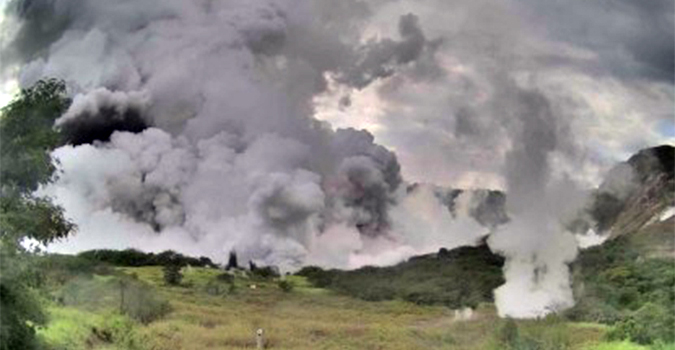
TAAL Volcano’s ashfall poses no threat to Mindanao and even if it spews out more, the Amihan would likely serve as its shield, the Philippine Atmospheric, Geophysical and Astronomical Services Administration (Pagasa) said yesterday.
Pagasa and the Philippine Institute of Volcanology and Seismology (Phivolcs) said people in Mindanao have nothing to worry about.
The skies here have remained clear, and this means the planes can take off or land at the Laguindingan airport in Misamis Oriental.
“Clear visibility,” said Pagasa weather specialist Luz Mercado of Cagayan de Oro’s and Misamis Oriental’s skies.
“Walay atong makita nga aso kay dili man kita affected dinhi sa pagboto sa Taal Volcano,” said Mercado, adding that people here do not need to wear face masks and other respiratory devices.
But even if the situation in Batangas worsens, Mercado said, it would be unlikely for Taal Volcano’s smoke and ashfall to reach Mindanao because of the Amihan or Northeast monsoon.
The Amihan is a cool and dry northeast wind blown down to Southeast Asia from China and Siberia. Slight to moderate rainfall, cold wind, relatively low humidity, and less-threatening sunshine characterize the season of the Northeast monsoon that usually occurs from October to March.
“Kon dunay aso o abog nga madala sa hangin, didto ra kini mopaingon sa Palawan, dili dinhi sa Mindanao,” Mercado said.
She said people should monitor public notices of the Department of Health (DOH).
“Kon mo-ingon ang DOH nga maggamit og gas mask, dili na pud clear visibility ang atmosphere anang panahona. Pero karon kay clear man ang atong atmosphere, walay angay kabalak-an,” Mercado said.
Instead of worrying that the ash fall from the Taal Volcano eruption would reach Mindanao, people here should start thinking about helping out those who were displaced in Batangas, a Phivolcs official said.
“The people here can help those affected by the Taal Volcano eruption. Those affected are the ones suffering, while we are not. They need our help,” said Marcial Labininay, Phivolcs-10 officer-in-charge.
Since residents in Mindanao are in no immediate danger of being affected by the eruption, he said the best thing to do is to donate essential items to those who flee their homes due to the calamity.
“We should extend our help, even if we have no relatives living there. Donating an essential commodity like drinking water is already a big deal for them as most of the displaced persons’ water sources have already been contaminated,” Labininay said.
Based on the latest data, Taal Volcano’s activity has weakened and the ash and lava it is spewing will not reach a larger area or beyond its current radius, said Labininay.
Unless Taal Volcano discharges a huge volume of ash coupled with a strong wind going in the direction of Mindanao, Labininay said the country’s southern parts would not be enveloped in ash like what happened to Batangas and its surrounding areas.
Meanwhile, Labininay said the volcanoes in Mindanao, particularly in Northern Mindanao, have been dormant in spite of the Taal eruption.
“Our Mindanao volcano alert level is zero, meaning, we have not recorded volcanic activities for quite some time now,” Labininay said.
But he said Phivolcs-10 is not taking any chances as they are monitoring the situation on the ground through their satellite stations all over the region round the clock.
Phivolcs-10 has four satellite stations in Camiguin, all located in Mambajao town, with one station each in Musuan, Bukidnon; Bacolod, Lanao del Norte; and in Malasag, Cugman, Cagayan de Oro.
Labininay said the satellite stations are run by solar power and their monitoring equipment are fully automated, without any Phivolcs-10 personnel. Only a caretaker maintains the station’s cleanliness.
He said he inspects the stations every three months and will report to the Phivolcs-10 technical team if one of the machines bog down.
On Tuesday, the nongovernment organization Balay Mindanaw Foundation Inc. donated 3,000 pieces of N95 masks to the affected persons, while Xavier University’s Biophilic Society based in this city has launched a donation campaign for the eruption survivors.
In an appeal, it posted on social media Jan. 14, the Biophilic Society is asking for N95 masks, canned goods, beddings and blankets, toiletries, clothes, medicines, leash and collars for animals, and dog and cat food, as well as monetary donations, from generous individuals.
The society has assured that “all proceeds will go directly to evacuees at the Taal Evacuation Centers.” Donations may be given in Room 206, 2nd floor of the Science Center, Xavier University.