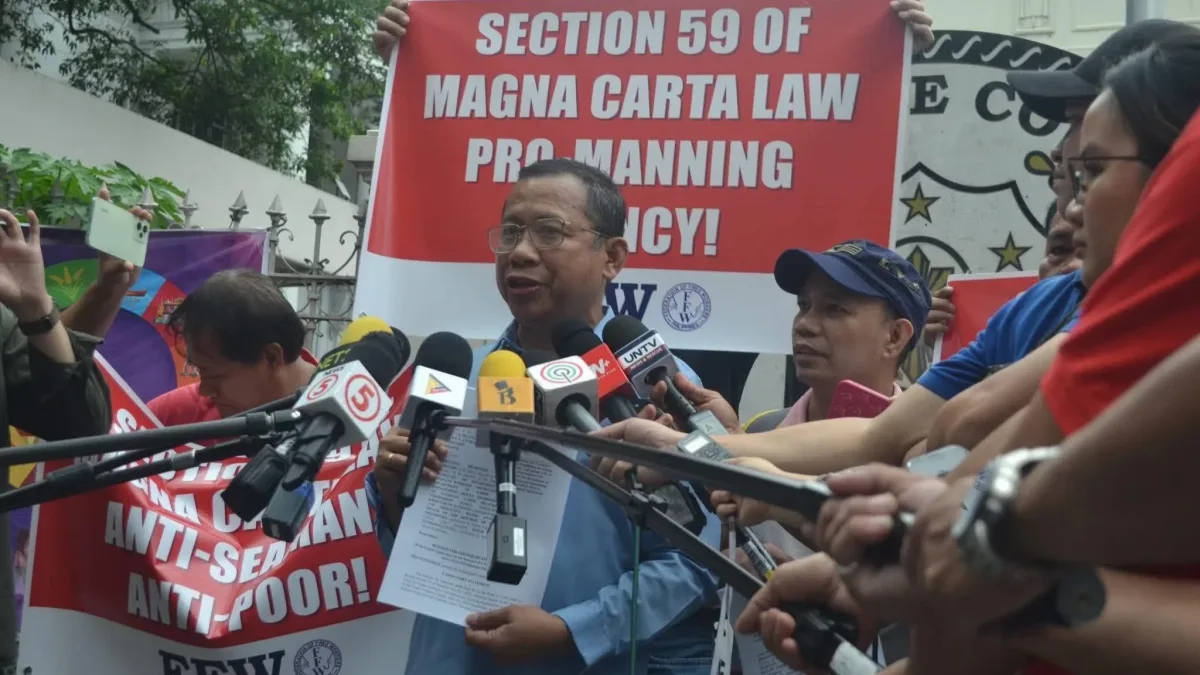
CAGAYAN de Oro City - Filipino seafarers who win labor cases will no longer need to post a bond to collect disputed monetary awards while their employers appeal, following a Supreme Court ruling that struck down a key provision of the Magna Carta of Filipino Seafarers.
The Supreme Court (SC) En Banc declared the bond requirement under Republic Act No. 12021 unconstitutional, ruling that it placed an unfair financial burden on seafarers seeking to enforce favorable labor judgments.
The decision, released on Nov. 16 and written by Associate Justice Maria Filomena D. Singh, partially granted five consolidated petitions challenging provisions of the law and its implementing rules.
The ruling followed the Court’s Nov. 11 session.
Under Section 59 of the Magna Carta, seafarers could collect undisputed monetary awards, including wages and statutory benefits, while disputed amounts and damages required a bond during an appeal or judicial review.
The Court found that the requirement violated the constitutional guarantees of due process and equal protection, as land-based workers were not subjected to a similar burden.
For seafarers who have already won labor disputes, the ruling removes the need to raise additional money before collecting disputed awards.
The SC also struck down the provision allowing the Department of Migrant Workers (DMW) to use its Agarang Kalinga at Saklolo Para sa mga OFW na Nangangailangan (AKSYON) Fund to pay bond premiums, citing constitutional restrictions on the use of public funds.
Limits on lawyers’ fees voided
The Court also invalidated provisions of the law restricting lawyers’ fees to 10 percent and requiring notarized certifications and undertakings for legal representation.
It said Congress cannot regulate the practice of law, which falls under the Supreme Court’s exclusive constitutional authority.
While lawmakers may adopt measures to protect seafarers from abusive legal practices, the Court said these must not encroach on its power to regulate lawyers and their professional conduct.
The ruling was welcomed by the Federation of Free Workers (FFW) and the NAGKAISA! Labor Coalition, which supported the petitions.
FFW president and petitioner Atty. Sonny Matula said the decision addressed two constitutional issues raised by the group and three Filipino seafarers — Joy R. Martinez, Julius E. Claramon and Arnaldo O. Borromeo.
“Ang employer ang umapela, pero ang marinong nanalo ang kailangang maghanap ng pambayad sa bond. Bakit kailangang mangutang para masingil ang para na sa inyong panalo?” Matula said.
He described the ruling as a victory for workers, particularly injured seafarers and their families who need money for medical expenses.
Matula also said the decision affirmed that Congress must respect constitutional limits even when both chambers agree on a measure.
Maritime training rules upheld
The SC, however, upheld provisions regulating maritime education and training, rejecting claims that the transfer of regulatory authority to the Maritime Industry Authority (MARINA) violated the academic freedom of maritime schools.
The Court said enrollment requirements, shipboard training standards and related regulations were reasonable measures to ensure students receive adequate practical training and meet international standards.
It also upheld the prohibition on charging tuition or matriculation fees for shipboard training conducted by third-party providers.
The Court further voided an implementing rule that extended the bond requirement to monetary awards arising from complaints filed after the law took effect, saying it contradicted protections for seafarers’ previously acquired rights and benefits.
Magna Carta remains in force
The SC rejected challenges to the legislative process behind Republic Act No. 12021, ruling that Congress complied with constitutional requirements in passing the measure.
President Ferdinand Marcos Jr. signed the Magna Carta of Filipino Seafarers on Sept. 23, 2024. It took effect on Oct. 11, 2024, to strengthen seafarers’ rights and improve maritime education and training.
The Court stressed that the law remains valid and enforceable, except for provisions expressly declared unconstitutional or void.
For seafarers pursuing labor claims, the decision removes financial and legal obstacles to collecting awards while preserving the law’s other protections and training standards.