CAGAYAN DE ORO CITY — In a densely populated urban poor neighborhood in Barangay Camaman-an here, privacy is a luxury few can afford. Houses stand so close together that neighbors usually know the daily routines of every household.
Yet little attention is paid to the activities of a middle-aged woman and her 12-year-old niece inside a modest house whose front window is covered by a weathered tarpaulin from a political campaign three elections ago.
Inside the cramped room, the floor is rough concrete, swept clean. There is little furniture. The most expensive item in the space is not a sofa or television, but a white prepaid home Wi-Fi router perched atop a plastic cabinet, its blinking green lights signaling a steady internet connection.
In a community where daily life unfolds in plain sight, silence surrounds the parabolic antenna mounted on that roof.
According to the woman, neighbors assume she is either selling products online or chatting with a foreigner in hopes of securing a visa.
But she runs a different kind of business.
Sitting on a monoblock chair while stirring instant coffee in a chipped mug, the woman told the Inquirer that work usually begins between 2 a.m. and 3 a.m., when her foreign clients log on. Using an Android phone, she negotiates with customers overseas.
When a deal is reached, she signals her niece to take her place on a thin foam mattress illuminated by a ring light. There, the child performs sexual acts livestreamed to paying viewers who transfer money in dollars or euros.
In homes where poverty is a constant companion, internet connectivity has become more than a tool for information—it has opened a doorway for predators into the very spaces meant to protect children.
READ: Child rights group, Army clash over military base tours for Bukidnon kindergartners
Staggering increase
Scenes like this are playing out across the country with alarming frequency, fueled by the rapid expansion of internet access that now reaches even remote communities.
In 2023, the CyberTipline operated by the National Center for Missing and Exploited Children (NCMEC) in the United States received over 2.7 million reports linked to the Philippines involving suspected child sexual exploitation.
This was a dramatic rise from about 1.3 million reports in 2020 and just over 42,000 reports in 2017.
While these reports represent potential leads rather than confirmed cases, the figures highlight the scale of the problem and have placed the Philippines among the countries with the highest number of reported incidents of online sexual abuse and exploitation of children (OSAEC).
“The production of child sexual exploitation material is an issue that plagues communities worldwide. Yet the Philippines has been identified as a global epicenter for financially motivated child sexual exploitation material production, especially through livestreaming,” according to the Scale of Harm report released by the International Justice Mission (IJM) in 2023.
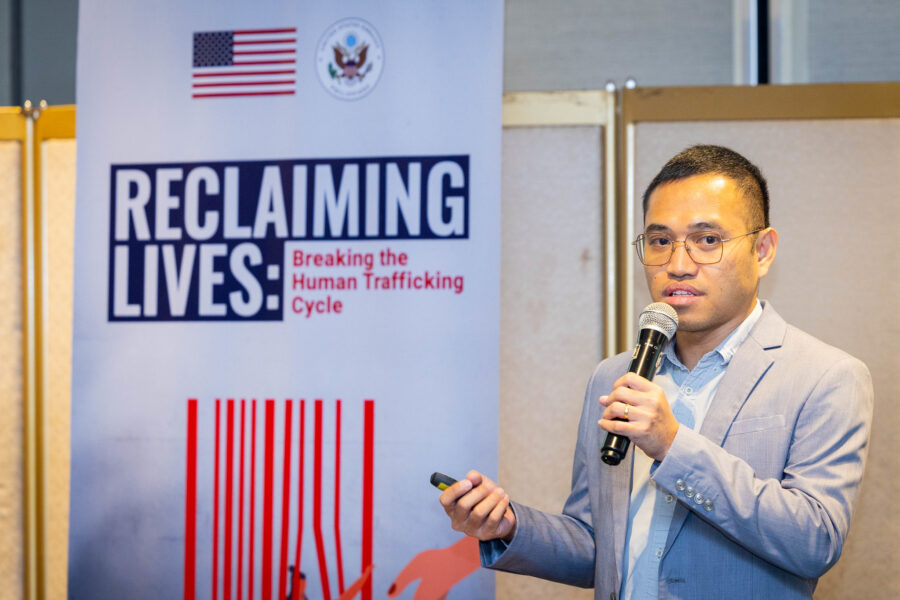
The study estimated that as many as 500,000 Filipino children may have experienced OSAEC in the previous year alone.
“It is an appalling statistic,” President Ferdinand Marcos Jr. said during a conference addressing the issue in 2024.
“We must do more,” the President urged government agencies, describing OSAEC as a “horrible scourge” that strikes at the heart of society.
Justice innovations
Recognizing the gravity of the problem, the Justice Sector Coordinating Council (JSCC)—a collaboration between the Supreme Court, Department of Justice, and Department of the Interior and Local Government—launched Special Justice Zones on Anti-OSAEC on September 3, 2024.
The pilot areas include the Northern Mindanao cities of Cagayan de Oro, Iligan, and Ozamiz, where authorities have recorded a high number of operations and convictions.
Chief Justice Alexander Gesmundo said OSAEC is an evolving crime driven by technology.
“Because it is technology-facilitated, it changes quickly, making it difficult for laws and procedures to catch up,” he said.
The justice zones function as “pockets of efficiency,” where police, prosecutors, and social workers follow streamlined protocols to accelerate investigations and case build-up.
Digital forensic facilities within the zones allow cybercrime units to extract data from seized devices locally instead of sending them to Manila, significantly speeding up prosecution.
From streets to cyberspace
Prosecutors and social workers in Cagayan de Oro say the fight against trafficking has shifted dramatically over the past decade.
Previously, most cases involved traditional crimes such as illegal recruitment, prostitution, or forced labor. Today, exploitation often occurs behind encrypted messaging platforms and private livestreams.
City Prosecutor Charisse Galarrita-Bitoon recalled one of the earliest and most notorious cases linked to the region—the operation of Australian national Peter Gerald Scully, who trafficked children and produced extreme abuse videos for an international audience.
Scully was arrested in Bukidnon in 2015 and later convicted by Philippine courts, receiving multiple life sentences for trafficking and rape.
“That case showed us the depths of this crime,” Bitoon said.
Today’s trafficking operations are often smaller and less visible than Scully’s network, intelligence officers said. With fast internet now available even in rural villages, perpetrators no longer need to move victims to urban areas.
Technology has effectively lowered the barriers to operating illegal online sex trafficking activities.
Piercing the silence
“It is deeply saddening that the internet, a tool meant to enhance our lives, has become a platform for exploiting children,” said Ramel Jamen, regional director of the Department of Social Welfare and Development (DSWD) in Northern Mindanao.
Investigations show that the perpetrators are often people within the victims’ own households.
According to IJM, 41 percent of traffickers in OSAEC cases are biological parents, while 42 percent are other relatives. The average victim is 11 years old.
Some parents involved in the trade attempt to portray livestreamed sexual abuse as harmless “online content creation,” said Evelyn Pingul, IJM Philippines’ director for community engagement.
“But OSAEC is not just a show or online content,” Pingul stressed. “It is real abuse with lifelong consequences.”
For social worker Grace Dael of DSWD-10, cases are particularly difficult to uncover because exploitation happens behind closed doors and within families.
Breaking these cases often requires overcoming the silence imposed by fear, shame, and economic desperation.
Yet authorities say community vigilance remains a crucial defense.
(This story was produced with grant support from the Philippine Center for Investigative Journalism.)