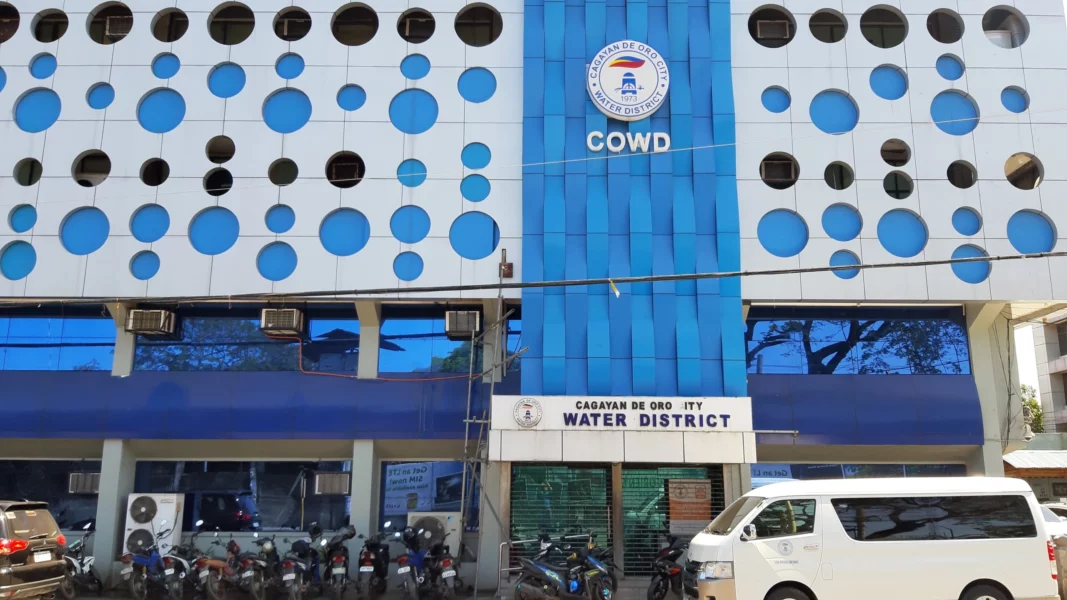
CAGAYAN DE ORO CITY — Local residents are paying increasingly high utility bills for clean water that heavily leaks into the ground before ever reaching household kitchen taps.
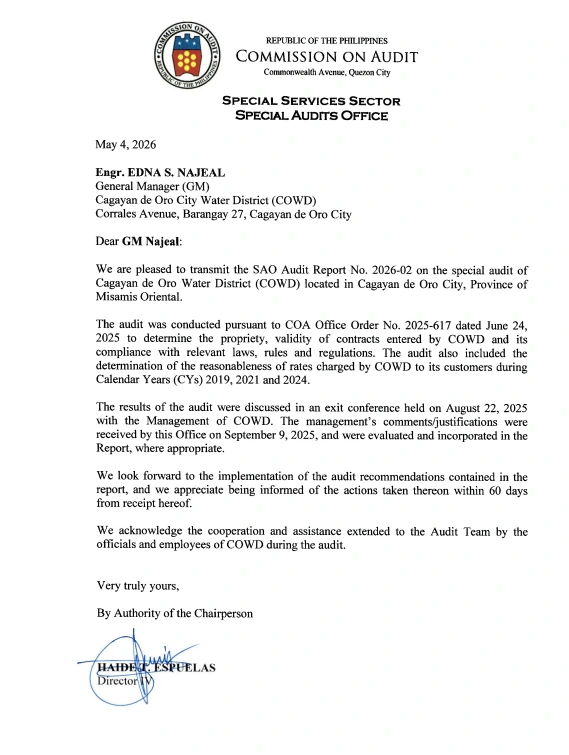
A special audit report, designated as report No. 2026-2 and issued on May 6, 2026, by the state's Commission on Audit, has detailed the exact administrative and structural failures driving the Cagayan de Oro City Water District into a severe crisis. The state review reveals that the local utility consistently bleeds nearly half of its treated water supply to decaying pipelines and theft, while a shifting corporate procurement framework has nearly doubled wholesale commodity costs for local consumers.
The Waste issue
COWD has spent five years bleeding water and revenue.
The so-called non-revenue water—the explicit metric denoting treated water lost to subterranean pipeline leaks or siphoned by unauthorized, illegal connections—registered at 54.84% in 2019. By 2024, that system deficit dropped slightly, at 49.50%.
Under the Local Water Utilities Administration (LWUA) rules, water districts are strictly capped at a 20% loss rate. You may also like: Consumers pay more, COA flags COWD, COBI water deal
State auditors blamed decades of pipeline decay for the waste, pointing directly to severe leaks in the city’s East service area.
Basically, COWD must pay private suppliers to produce or purchase bulk water it can never legally bill to consumers; the utility is trapped in a funding squeeze, leaving it with no capital to fix its broken network.
A 20-Year Legal Mess
Today's pricing problems stem from a long-standing legal battle between city water officials and private suppliers.
In 2004, COWD finalized a bulk water procurement plan with Rio Verde Water Consortium Inc. to deliver treated water at a baseline rate of P10.45 per cubic meter. By 2005, a secondary supplemental agreement bumped that procurement rate upward to P11.52 per cubic meter. However, utility management executed this price adjustment without securing mandatory approval from the LWUA board.
The deal fell apart in 2008 when state auditors stepped in with a formal Notice of Disallowance (ND) No. COWD-2008-51 on September 23, 2008. The ruling officially disallowed the disbursement of P132,414,165.40 in 2007, and declared Rio Verde a "non-responsive bidder" and ruled subsequent public payments illegal.
Despite the multi-million-peso disallowance, COWD management continued paying Rio Verde for water deliveries, justifying the unapproved spending based on the "paramount public need" for continuous, 24/7 water access. The water district filed an official appeal in 2009, which was resolve on April 27, 2021 under G.R. No. 213789.
According to COWD management records, a primary objective for entering into a subsequent 2017 Joint Venture Agreement with Metro Pacific Water Investments Corporation was to finally "correct" these outstanding legal stalemates and resolve the long-standing COA disallowances.
The Cost of a Middleman
The new partnership formed Cagayan de Oro Bulk Water Inc., or COBI. The original plan promised a massive fix: building an independent, ₱2.4 billion water treatment plant to give the city its own reliable supply.
But the final contract changed the rules. Revisions gave the new company the option to skip construction and simply buy water from existing third-party vendors.
Instead of building the P2.4 billion plant, the joint venture chose to buy water from Rio Verde—the exact supplier previously utilized by the city.
The move effectively turned COBI into an administrative middleman. By adding corporate overhead and pre-scheduled annual rate hikes to Rio Verde’s baseline cost, the price charged back to COWD jumped to P21.60 per cubic meter by 2024. State auditors concluded that the altered framework creates a severe structural disadvantage for the municipality, directly shifting the financial burden of the corporate markup onto local families.