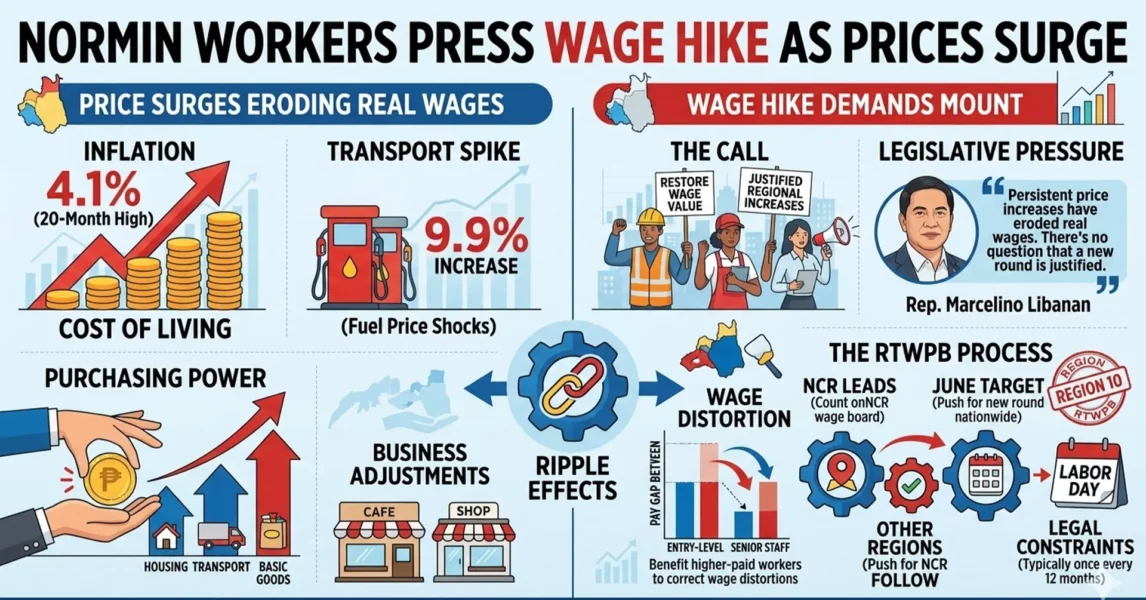
CAGAYAN DE ORO CITY — With inflation climbing to a 20-month high of 4.1 percent and transport costs spiking, pressure is mounting on regional wage boards to grant relief ahead of Friday’s Labor Day.
For minimum wage earners in Northern Mindanao, rising prices are already biting hard. A 9.9 percent increase in transport costs—driven by fuel price shocks linked to tensions in the Middle East—has sharply reduced workers’ daily purchasing power.
This reality is echoed in a 2024 study published in Sustainability, which found that wages often fail to keep pace with the rising costs of housing, transport, and basic goods. The study warned that stagnant pay continues to leave many workers struggling to meet basic needs.
Amid these concerns, House Minority Leader and 4Ps party-list Rep. Marcelino Libanan is pushing for a new round of wage hikes across the country’s 17 regional wage boards starting this June.
“There’s no question that a new round of regional wage hikes is justified, mainly due to the inflationary impact of elevated fuel prices,” Libanan said.
He stressed that restoring the buying power of the country’s 5.2 million minimum wage earners is key to sustaining consumer spending and supporting the broader economy.
“Persistent price increases have eroded real wages. Many workers are effectively earning less today than before, despite previous pay adjustments,” he added.
Regulatory limits
Despite growing calls, wage adjustments face legal constraints. Under Department of Labor and Employment rules, Regional Tripartite Wages and Productivity Boards (RTWPBs) can grant increases only once every 12 months—unless “supervening conditions” justify an earlier move.
Traditionally, the National Capital Region (NCR) leads the cycle. After its last ₱50 wage hike, other regions followed with their own adjustments over the next several months.
“We are counting on the NCR wage board to kick off the next round this June,” Libanan said.
Ripple effects
Any wage hike in Region 10 would extend beyond minimum earners. Businesses—from cafes in Uptown Cagayan de Oro to shops in Centrio—may need to adjust salaries across the board to address “wage distortion,” where pay gaps between entry-level and senior staff narrow.
“Minimum wage hikes are also likely to benefit higher-paid workers, as employers move to correct wage distortions,” Libanan noted.
As Labor Day nears, workers across Northern Min
danao are watching closely, hoping wage relief arrives before the cost of living climbs further.