CAGAYAN DE ORO CITY — A decade after a wave of killings targeting trade union leaders began surfacing in the Philippines, none of the 105 documented cases since 2016 has moved forward in court, according to a new labor rights report released Wednesday.
The 2025 State of Freedom of Association in the Philippines Report, presented by the Federation of Free Workers (FFW) and the Danish Trade Union Development Agency (DTDA), warns that the absence of prosecutions reflects systemic inaction and weak political will to protect workers’ rights.
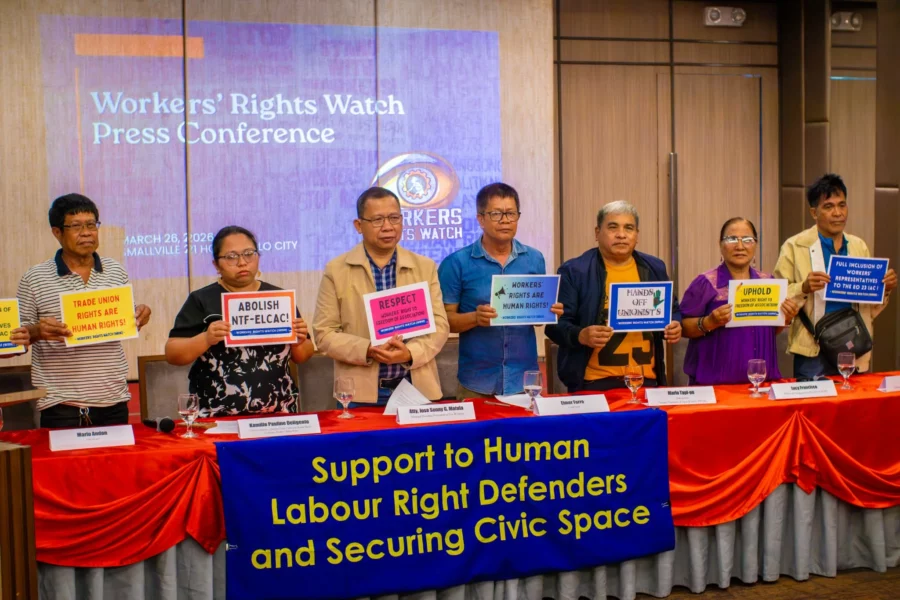
The findings were presented during a forum in Iloilo City.
Executive orders without enforcement
While labor advocates welcomed reforms initiated by the administration of Ferdinand Marcos Jr., union leaders said policy declarations have yet to translate into justice for victims.
“We lauded the President when he signed Executive Order No. 23 recognizing freedom of association as a fundamental right,” said Jose Sonny G. Matula, national president of FFW. “But an executive order cannot do the walking if the government will not move its feet.”
Read also: Labor coalition warns: Marcos energy emergency ‘prone to abuse’ without clear plan
Matula said the absence of legal progress in the killings illustrates a deeper problem: policies exist on paper, but accountability mechanisms remain weak or unused.
“The sad truth is this: there is still no visible progress in the 105 documented cases of killing of workers,” he added. “Rights on paper are good. Justice in practice is better.”
Violations persist weekly
The report, produced under the Workers’ Rights Watch (WRW) monitoring initiative, documents continuing labor rights violations averaging at least one case every week in 2025.
These incidents include killings, harassment and intimidation, illegal arrests, surveillance, and red-tagging of union organizers.
The report notes that violations are often linked to state security frameworks and, increasingly, private sector actors involved in labor disputes.
Government mechanisms under scrutiny
Labor advocates also questioned the effectiveness of the government’s Inter-Agency Committee on Freedom of Association, created under Executive Order No. 23.
According to the report, the committee has failed to produce concrete outcomes, including the prosecution of suspects in high-profile cases of violence against union leaders.
The continued funding of the National Task Force to End Local Communist Armed Conflict (NTF-ELCAC) was also cited as a factor that has intensified threats and red-tagging against labor organizers and human rights defenders.
Weak union presence
Beyond the killings, the report also highlights structural weaknesses in the Philippine labor movement: Union density remains at only about 4% of the workforce; collective bargaining coverage is around 1%. Despite a workforce participation rate of roughly 60%, only a small fraction of workers are organized.
Labor advocates say these figures leave millions of workers without protection mechanisms against abusive labor practices.
Voices from the ground
Labor groups representing vulnerable sectors echoed the report’s findings. Mario Tapi-on, spokesperson of the National Federation of Sugar Workers, said sugar workers continue to face wage issues and harassment when they organize.
“Our movement began because sugar workers are receiving less than what the law says they should earn,” Tapi-on said. “But when we demand a living wage, the response is red-tagging and accusations of terrorism. We only want respect for our rights.”
Women workers also face unique challenges, according to Lucy Francisco of Kilusan ng Manggagawang Kababaihan. She said reproductive health needs and care responsibilities are often ignored by employers and policymakers, and sometimes used as grounds for workplace discrimination.
“Women’s rights are workers’ rights. These must be protected as part of human rights,” Francisco said.
Monitoring violations
The Workers’ Rights Watch initiative was launched to independently track labor rights violations, train worker-paralegals, and strengthen grassroots documentation of abuses.
Julius Cainglet, FFW vice president for research, advocacy, and partnerships, said the initiative has empowered union leaders to document violations and pursue justice. However, he acknowledged the monitoring network still faces gaps in regional coverage, data systems, and sector participation.
“We will sustain efforts and deepen collaboration across the country so that no worker is harmed while pushing the government to comply with international labor standards,” Cainglet said.
Call for structural reforms
Lotte Ellegaard, head of DTDA’s Asia office, said protecting labor rights requires cooperation among government, employers, unions, and civil society.
“The Workers’ Rights Watch encourages everyone—not just unions but the government and civil society—to become defenders of labor rights,” she said.
The full report will be released later this year. For labor groups, however, the message is already clear: without stronger enforcement, worker-centered legislation, and accountability for violence, freedom of association in the Philippines will remain largely symbolic.