CAGAYAN DE ORO CITY — Philippine Movement for Climate Justice (PMCJ) on Thursday opposed the government’s planned privatization of the Agus-Pulangi hydropower complex in Mindanao, warning that transferring the state-owned facility to private conglomerates could lead to higher electricity costs and weaken public control over a key energy asset.
The group said privatization would reduce the government’s capacity to shield consumers from volatile electricity prices and may not guarantee improved service.
“This move will have a significant impact on consumers in Mindanao and the country as a whole, as electricity rates will certainly increase in the guise of better service,” said Edwin Tesaluna, PMCJ senior renewable energy officer.
PMCJ argued that the country’s renewable energy sector has increasingly favored large corporations linked to established power players.
Tesaluna cited geothermal facilities operated by subsidiaries of First Gen Corporation as examples, saying their output largely serves corporate buyers under the Department of Energy’s Green Energy Option Program.
The group also referenced the Bacon-Manito geothermal complex in southern Luzon, operated by Energy Development Corporation. According to PMCJ, Energy Secretary Sharon Garin visited Sorsogon province in August 2025 following complaints from residents about high electricity rates despite hosting energy facilities.
PMCJ linked its opposition to the broader restructuring of the power sector under the Electric Power Industry Reform Act (EPIRA), which created Power Sector Assets and Liabilities Management Corporation (PSALM) to privatize government-owned power assets and manage debts from National Power Corporation.
“The industry-wide restructuring only had consumers bear the cost of capital investments, recovery and other charges through higher prices, but did not result in any improvement in service,” Tesaluna said.
Citing data from GlobalPetrolPrices.com, PMCJ said Philippine residential electricity rates rank among the highest in Asia, trailing only Singapore and Japan.
The group said local household rates are about 128 percent of the global average and more than 250 percent of the Asian average.
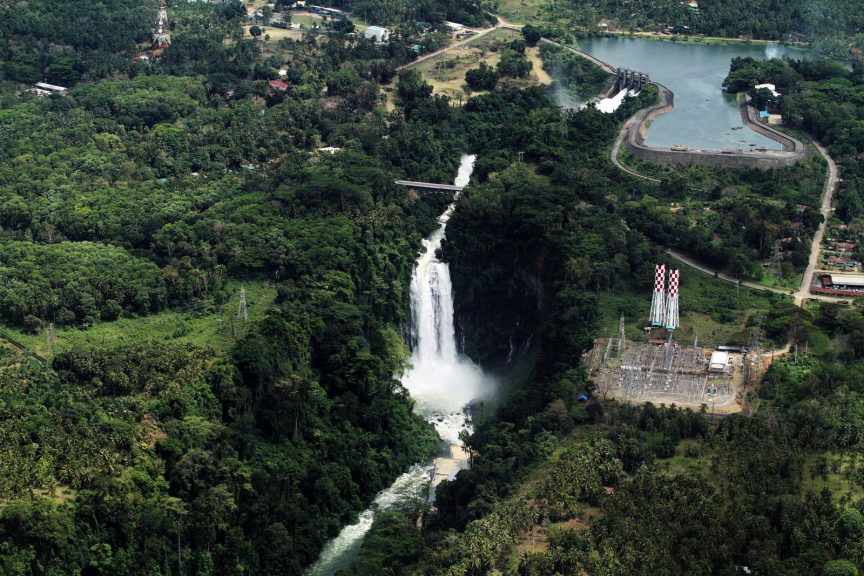
The Agus-Pulangi complex — a chain of hydroelectric plants along the Agus and Pulangi river systems — supplies a significant share of Mindanao’s electricity and remains one of the island’s largest renewable energy sources.
Lucita “Yadz” Gonzales, PMCJ Mindanao coordinator, said resistance to privatization dates back to 2010, when Mindanao faced a power crisis after drought conditions sharply reduced hydropower output.
“Back then, many lawmakers and church groups supported the campaign against APHC privatization. We have endured and managed to oppose this for years,” Gonzales said.
She described the facility as Mindanao’s “goose that is laying the golden eggs,” noting that it generates government revenue while helping moderate electricity costs in the region.
According to PMCJ, PSALM is targeting completion of the privatization process by 2026.
Gonzales said communities near the facilities fear insufficient consultation, rising power rates, and risks to local livelihoods.
PMCJ, together with Freedom from Debt Coalition and PALAG-Mindanao, urged the government to suspend privatization plans and instead invest public funds in rehabilitating and modernizing the hydropower facilities.
“It is high time that the state reasserts control and operation of this vital industry to protect consumers and ensure the national economy’s bloodline,” Tesaluna said.
“The lack of funds to oversee rehabilitation is not a valid argument. This should not be a matter of privatization, but of prioritization.”