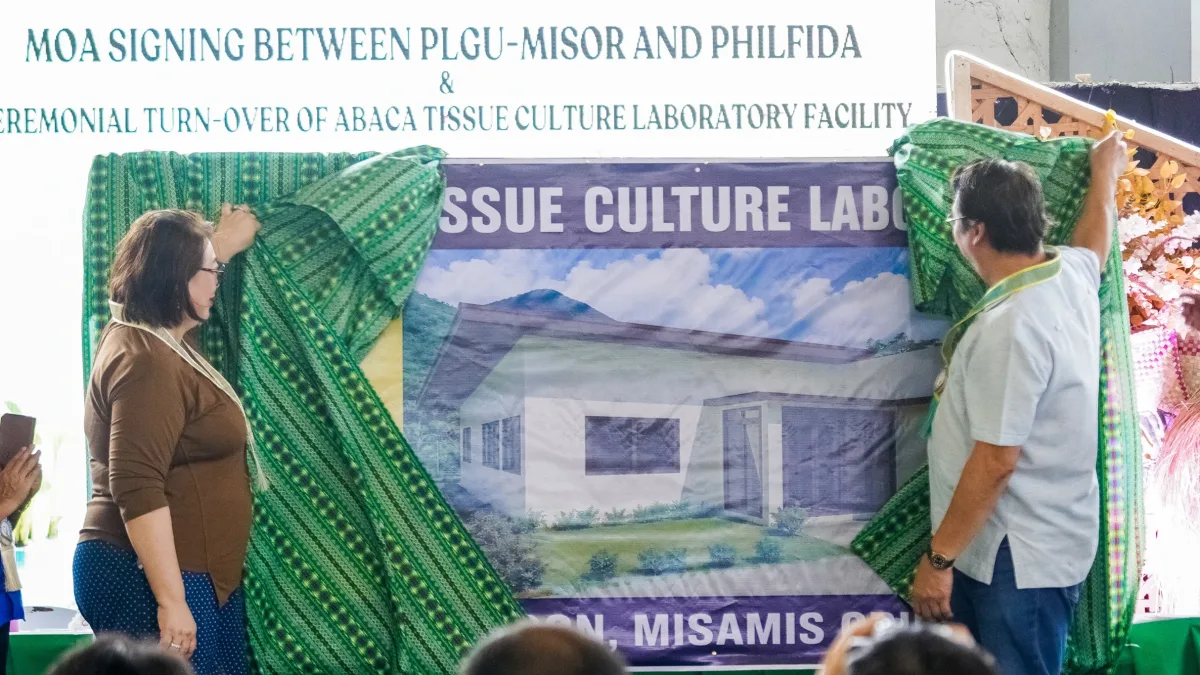
CAGAYAN de Oro City — Misamis Oriental abaca farmers could soon have better access to clean planting materials and new ways to earn more as the province moves to revive its idle Abaca Tissue Culture Laboratory.
The planned facility is expected to help farmers grow healthier abaca, while a wider industry program will support processing, product development and market access.
The project is a follow-up to efforts to strengthen the province’s abaca industry, giving farmers not only better planting materials but also opportunities to earn from finished products instead of selling raw fiber alone.
The Philippine Fiber Industry Development Authority (PhilFIDA) and the provincial government signed a memorandum of agreement on Aug. 18 for the repair and operation of the facility.
PhilFIDA Executive Director Undersecretary Arnold “Ali” I. Atienza said the laboratory will produce clean, disease-free planting materials, reducing the risk of bringing diseases into farms.
“Well, the advantage of this facility is hindi ka na maghahanap ng mga planting materials. And you are also assured na yung kukunin mo ay walang sakit,” Atienza said.
He explained that farmers sometimes get planting materials from different sources without knowing whether these are carrying disease.
From raw fiber to higher-value products
For farmers, the bigger opportunity may come after harvest.
Atienza said the Philippines supplies about 87% of the world’s abaca, but Filipino producers capture only about 10% of the estimated $1-billion global industry.
He said farmers need to receive a bigger share of the value created from abaca.
“Dapat palakihin natin ang kinikita ng ating farmers, kaya isa po sa mga pinagtutuunan namin ng pansin ay ang gumawa ng mga value-added products,” Atienza said.
PhilFIDA plans to train farmers’ spouses to make abaca bags, which can sell for about P1,200 each, while helping producers find local and international buyers.
The goal is to give farming families more income opportunities from the same crop—from planting and harvesting to processing and finished products.
Province eyes more processing
Governor Juliette T. Uy said the provincial government will explore investments in machinery and processing facilities to produce more abaca-based products, including plywood.
The province may also look at financing options to encourage more farmers to plant abaca and expand production.
“Kon daghan ang atong produkto, maningkamot lang ta nga dili moubos ang presyo, so kinahanglan mahimo gyud nato siya nga value-added nga mga produkto,” Uy said.
Uy urged farmers and their cooperatives to organize, undergo training and prepare for future processing opportunities once the needed technology and equipment becomes available.
What this means for farmers
The Sugbongcogon laboratory was established in March 2019 with support from national agriculture and science agencies. It was intended to produce clean planting materials, including abaca.
Once repaired and operational, the facility can give farmers a more reliable source of planting materials while supporting the province’s broader push to expand abaca production and processing.
Sugbongcogon Mayor Cheezee Salvador Lagbas said the project could bring agricultural technology closer to farmers and create additional livelihood opportunities for their families.
“For a small municipality like Sugbongcogon, this is a big opportunity for us,” Lagbas said.
Misamis Oriental 1st District Rep. Jennifer Karen Lagbas, represented by former Mayor Mildred Lagbas-Mondigo, also expressed support for continued coordination among the provincial government, PhilFIDA and other national agencies to secure funding and programs for farmers.
Atienza said farmers can also approach PhilFIDA for training and assistance as the industry develops.
“The farmers are there; we have to support them because without the farmers, there's no industry and there's no PhilFIDA,” he said.
For Misamis Oriental farmers, the planned revival of the facility could mean more than a new source of planting materials. It could open a path toward healthier plantations, new products and a bigger share of the money earned from abaca. (With a report from Shaun Alejandrae Y. Uy of PIA-10)