CAGAYAN de Oro City— Four days of work at the minimum wage are still not enough to pay the monthly electricity bill of a household using 200 kilowatt-hours (kWh), according to a labor coalition protesting high power rates on Friday, November 27.
At the Metro Manila non-agricultural minimum wage of ₱755 a day, a worker earns ₱3,020 in four days. But a household consuming 200 kWh would pay ₱3,110.20 under Manila Electric Co.'s (Meralco) November rate of ₱15.551 per kWh.
That leaves the worker short by ₱90.20 — even before paying for food, transportation, medicine, rent and children's school expenses.
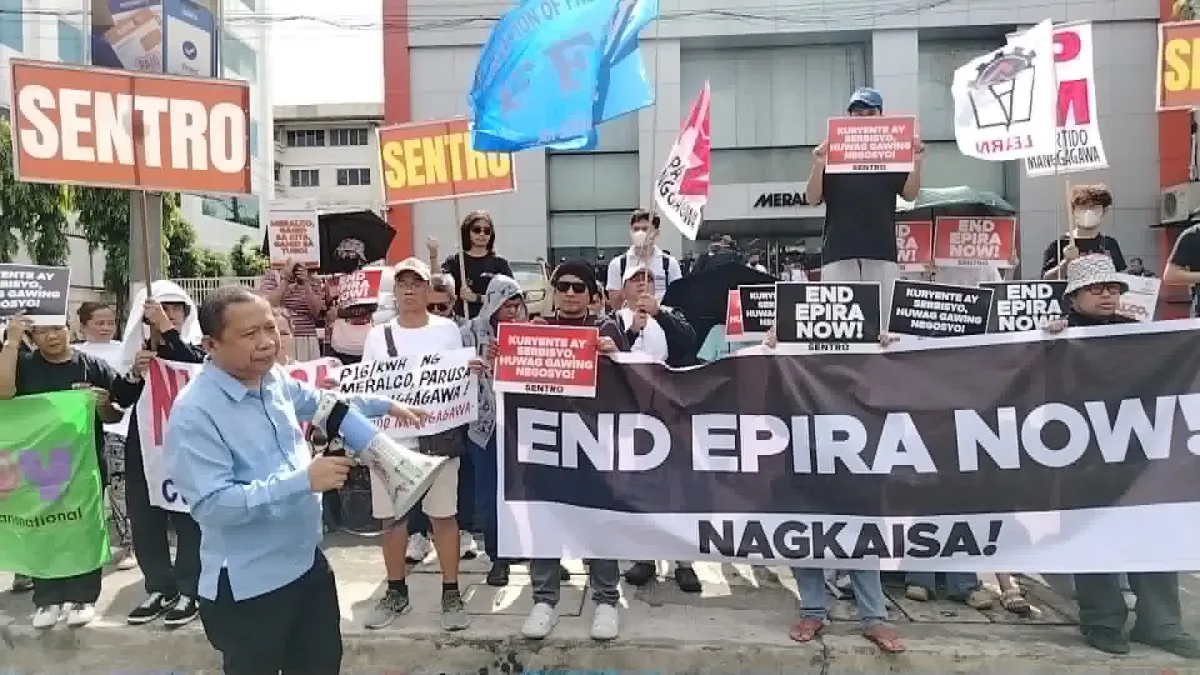
The figures were presented by NAGKAISA! Labor Coalition during a picket along Quezon Avenue, in front of Fisher Mall in Quezon City, where workers demanded lower electricity rates and greater government control over power companies.
Led by NAGKAISA! chairperson and Federation of Free Workers (FFW) president Atty. Sonny Matula, the protesters carried placards calling for the repeal of the Electric Power Industry Reform Act (EPIRA) of 2001.
Their message was direct: electricity is a basic need, not a luxury that workers should struggle to afford.
Electricity takes nearly 18% of wages
The coalition said a worker earning the Metro Manila minimum wage for 23 working days would receive ₱17,365 in gross pay.
At that income, a ₱3,110.20 electricity bill would consume nearly 18 percent of the worker's earnings.
The burden becomes heavier for families already spending most of their income on basic needs.
NAGKAISA! pointed out that a household using the same 200 kWh in October and November would pay an additional ₱97.90 this month.
Meralco's published rates confirm that its residential charge increased from ₱15.0615 per kWh in October to ₱15.5510 in November.
The company attributed the increase mainly to a higher generation charge, which rose by ₱0.4344 per kWh due to increased costs from power suppliers, among other factors.
For a family already budgeting every peso, the increase means finding additional money without necessarily using more electricity.
The coalition also noted that the ₱60 daily minimum wage increase under Wage Order No. NCR-28 is equivalent to less than four kWh at Meralco's November rate.
In effect, much of a worker's daily wage increase can easily be eaten up by electricity costs.
Poorer families face greater pressure
The rising cost of electricity comes as low-income households are also dealing with higher prices of other basic goods and services.
Philippine Statistics Authority data showed that inflation among the country's bottom 30 percent of income households reached 9.5 percent in October 2026, higher than the 7.8 percent national inflation rate.
The cost of housing, water, electricity, gas and other fuels for these households increased by 11.7 percent over the year.
These increases leave poorer families with fewer choices.
When electricity bills rise, some households may reduce their use of electric fans, refrigerators and other appliances. Others may have to borrow money or delay payments to cover their utility bills.
For families with children, cutting electricity use can also affect their comfort and ability to study at home, particularly during hot nights.
The problem also reaches small businesses that depend on electricity to operate.
Higher power costs can reduce earnings, force price increases or add pressure on businesses already struggling with operating expenses.
Philippines has high power rates despite low consumption
NAGKAISA! also questioned why Filipino households pay some of the highest electricity rates in the region despite using relatively little power.
Citing Department of Energy figures, the coalition said the Philippines had the highest average residential electricity rate in Southeast Asia in June 2026, at ₱12.43 per kWh.
It also cited 2024 electricity consumption figures showing that the Philippines averaged 988 kWh per person annually, compared with 1,086 kWh in Cambodia, 1,611 kWh in Indonesia and 2,756 kWh in Vietnam.
For the coalition, these figures raise questions about the affordability and accessibility of electricity in a country where many workers still struggle to pay their monthly bills.
The concern is not only about higher rates but also about whether ordinary consumers are getting fair value for what they pay.
Coalition questions power costs and corporate earnings
The labor group also called on the Energy Regulatory Commission (ERC) to disclose the prices Meralco pays its different power suppliers.
It wants the regulator to identify suppliers in which the Meralco Group has financial interests and explain the costs passed on to consumers.
Meralco distributes electricity to millions of customers, while its corporate group also has businesses in power generation and retail electricity supply.
NAGKAISA! said this makes the company's power purchasing arrangements a matter of public interest.
The coalition pointed to Meralco Group's ₱44.8-billion consolidated core net income for the first nine months of 2026, up 12 percent from the same period last year.
The figure covers the group's businesses, not just electricity distribution.
For the labor group, however, the earnings highlight the need for greater transparency and accountability in an industry where consumers have little control over the prices they pay.
Meralco, for its part, attributed its November rate increase mainly to higher generation costs from its power suppliers, citing the weaker peso and continuing developments in the Middle East.
The company also said its November rates reflected distribution tariff adjustments approved by the ERC.
Workers want EPIRA repealed
Beyond immediate relief, Matula and the coalition are calling for the repeal of Republic Act 9136, or EPIRA, which restructured the country's power industry in 2001.
The law opened electricity generation and supply to private companies and provided for the privatization of major government-owned power assets.
It was intended to encourage competition, attract private investment, improve power supply and make electricity more affordable.
But labor groups argue that more than two decades after its implementation, the promise of cheaper electricity has not been realized for ordinary Filipino households.
Under the EPIRA system, electricity bills include generation, transmission, distribution and other charges. Generation costs are influenced by the prices of fuel, electricity purchased from power plants and the electricity market.
Distribution and transmission charges cover the delivery of electricity to consumers, while other government-approved charges support different parts of the power system.
The coalition argues that allowing private companies to dominate the industry has not sufficiently protected consumers from high costs.
It wants stronger government regulation, lower electricity rates and public investment in renewable energy projects that communities and electric cooperatives can own and operate.
NAGKAISA! also proposed a progressive wealth tax on billionaires to help finance affordable electricity and essential public services.
The coalition's position puts the government before a difficult question: How can the country attract investments and maintain a reliable power supply without making ordinary workers shoulder an unreasonable share of the cost?
For Matula and the protesting workers, electricity must be treated as an essential public service, with consumers given the right to know how their money is being spent.
More protests planned on Bonifacio Day
The November 27 picket is part of a broader labor campaign against the rising cost of living, low wages and economic policies that workers say favor powerful business interests.
NAGKAISA! announced that workers would gather at 7:30 a.m. on November 30, Bonifacio Day, in front of Ramon Magsaysay High School along España Boulevard before marching toward Mendiola at 8 a.m.
Aside from affordable electricity, the protesters will demand a living wage, an end to contractualization or endo, and an end to political dynasties and oligarchic control of the economy.
Their rallying call: "Ibaba ang singil sa kuryente. Itaas ang sahod. Buwisan ang bilyonaryo."
For millions of Filipino workers facing rising household expenses, the issue goes beyond the monthly electric bill. It is about how much of their hard-earned wages remain after paying for the basic needs of their families.