CAGAYAN de Oro City — The Philippine Statistics Authority (PSA) is expanding its business surveys and improving how it compiles provincial economic data, but local governments and development agencies still need to translate the figures into programs that improve people’s lives.
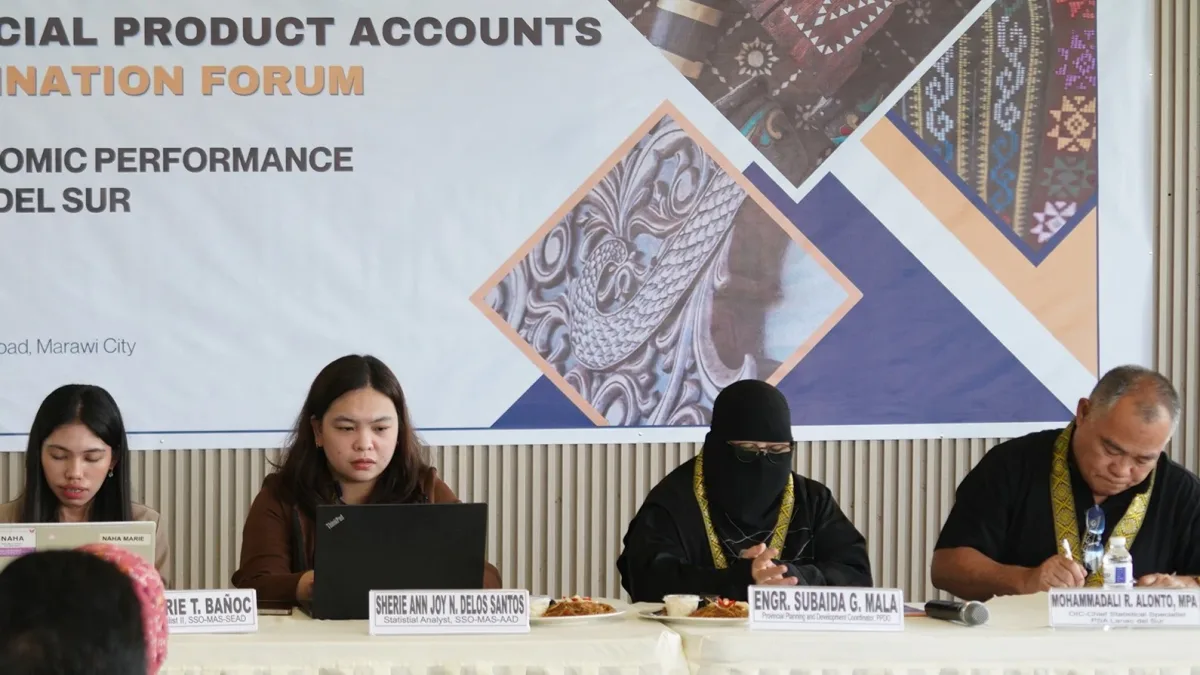
PSA Undersecretary Claire Dennis S. Mapa announced the initiatives in a video message during the 2025 Provincial Product Accounts (PPA) Data Dissemination Forum in Marawi City on Oct. 8.
Mapa said the institutionalization of the PPA in 2025 prompted improvements in statistical processes and data sources to make provincial economic estimates more reliable.
Among these initiatives is the Subnational Economic Account System, which modernizes the compilation of economic statistics below the national level.
The PSA has also expanded the coverage of its quarterly survey of Philippine business and industry to gather more information on business activity across provinces.
“These contribute to ensuring relevant and reliable Provincial Product Accounts estimates,” Mapa said.
The PSA released the 2025 PPA results on Aug. 28, 2026, covering all 82 provinces and 33 highly urbanized cities.
Mapa said the agency aims to release future results earlier so local officials and other stakeholders can assess economic developments and use the data in planning.
However, better statistics alone do not guarantee that economic growth will create jobs, reduce poverty or improve access to basic services.
These outcomes also depend on how government agencies use the figures to set priorities, allocate public funds and evaluate their programs.
Mapa said the PPA can support the Provincial Development Planning Framework launched by the Department of Economy, Planning and Development.
The accounts provide an economic baseline for checking whether local economic activity and industry performance are consistent with development targets.
He urged local government units, development partners and government agencies to use the PPA alongside other relevant data when monitoring projects and programs.
Economic growth must reach households
In Lanao del Sur, PSA data showed that the provincial economy grew by 2.7% in 2025, with gross domestic product (GDP) reaching ₱80.78 billion.
The province also recorded a per capita GDP of ₱63,839, above the Bangsamoro Autonomous Region in Muslim Mindanao (BARMM) average of ₱62,438.
These figures indicate the size and average economic output of the province, but they do not establish how income and economic opportunities are distributed among households or whether poverty has declined.
Yasrulah D. Shiek, senior statistical specialist and Community-Based Monitoring System (CBMS) focal person of PSA-Lanao del Sur, said combining PPA and CBMS data can help officials examine whether economic growth is improving living conditions.
The PPA measures provincial economic performance, while CBMS gathers information on poverty, employment, education, health, housing and access to basic services.
“When we put these two sources of data together, we gain a more complete understanding of the development in Lanao del Sur,” Shiek said.
For example, officials can compare growth in an economic sector with household-level information to identify whether communities are benefiting from new opportunities.
The data can also help identify areas that may need targeted assistance even when provincial economic indicators improve.
Shiek said provincial and municipal governments, national agencies, businesses, academic institutions and other stakeholders could use the combined information to identify priorities, guide resource allocation and design evidence-based programs.
“The data becomes meaningful when it is translated into action,” he added.
The next challenge is ensuring that local development plans and public spending respond to the needs revealed by the data.
While the PSA's expanded surveys and improved statistical system aim to provide a stronger basis for decisions, the effectiveness of these efforts will ultimately depend on how consistently officials use the information to monitor results and address gaps in jobs, services and household welfare. (With a report from Apipa Bagumbaran /PIA-10/Lanao del Sur)