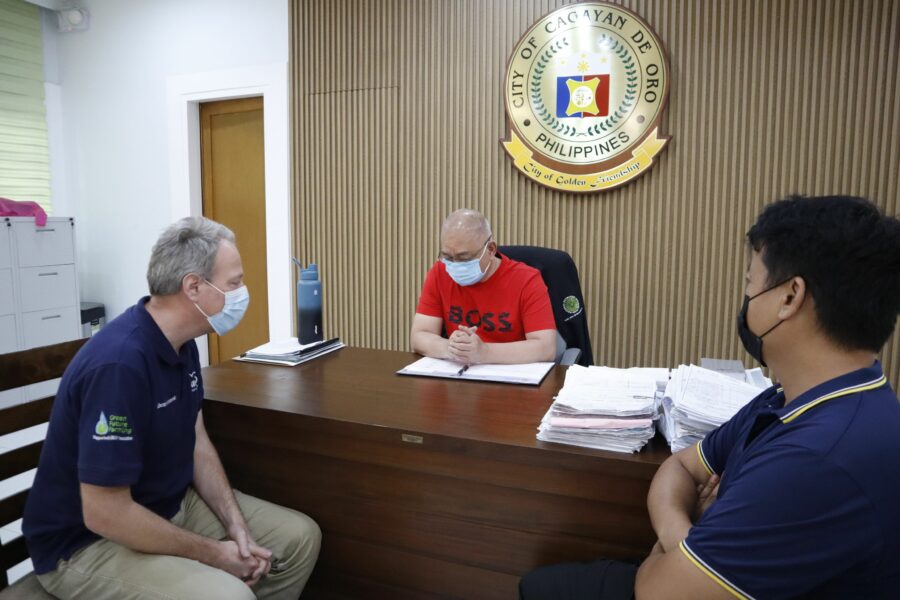
CAGAYAN de Oro City Mayor Rolando ‘Klarex’ Uy underscored measures to deal with floods being undertaken by the city government with the help of a group of Dutch experts.
The mayor created a group from the city government to look into and study the Dutch flood experts’ proposal on flood reduction and climate resilience for the city.
Last Friday, the Aid Environment of Netherlands sought an audience with the city mayor and expressed their willingness to help the local government craft measures to address persistent flooding.
“Pasalamat kita sa ilang hangyag,” said Uy adding that the city needs these kinds of interventions.
The city government will look for resources to support this project, said Uy.
The city government and public works and highway officials were continuously monitoring works being executed to mitigate flooding along the Cagayan River.
Even key officials from the said national department were in the city earlier last year and led the inspection of various components of the Japan International Cooperation Agency (JICA)-assisted Flood Risk Management Project for the river.
Undersecretary Emil K. Sadain, in charge of DPWH Unified Project Management Office (UPMO) Operations, informed the DPWH Secretary Roger G. Mercado that the project was conceived after the trail of destruction by Tropical Storm Sendong on December 2011.
The said typhoon brought heavy rains over Cagayan de Oro and other parts of Mindanao and Visayas islands, triggering flooding and landslides and resulting in loss of lives and properties.
“We understand the key issues that the city is facing related to flooding, storm surges, saltwater intrusion, and water shortage in the season,” Rommert Schram, an expert in water resources management and irrigation of the Aid Environment told Mayor Uy.
Schram also said that they are aware that studies and analyses have been made to address these issues.
Schram refers to studies done after Sendong (Washi) like the Cagayan de Oro River Basin Integrated Rehabilitation Management Framework Plan, the city’s Local Climate Change Action Plan (LCCAP), and the Climate Disaster Risk Assessment (CDRA).
“But studies don’t give us dry feet. Thus Aid Environment is willing to partner with the local government to translate these studies to actionable implementation,” Schram added.
More than 50 percent of the Netherlands is below sea level, encouraging the Dutch to look for innovative water management solutions.
Protective dikes along the coastline and many Dutch rivers represent the proactive and preventive measures that the country is putting against the consistent threats of flooding.
Climate change, however, will further increase flooding threats due to rising sea levels, increasing frequency of heavy rains, and storm events.
The article on TriplePundit shows how the Netherlands prepares to cope with the increasing threats of climate change through the Valuing Water Initiative.
The Dutch prime minister even launched the project in 2019, implementing the UN’s Valuing Water Principles.
According to the article, “Valuing Water Initiative – Better Decisions Impacting Water,” the principles were formulated to implement Sustainable Development Goal 6, ensuring the availability of sustainable management of water and sanitation for all.
The idea behind the program was to create a common ground starting point for governments, non-profits, and businesses in solving water problems.
Meanwhile, the city planning and development office head Engr. Ramir Balquin said the city government is now in the process of enhancing the LCCAP and CDRA.
“We will integrate the updated studies in the action plan for the project proposed by the Aid Environment,” Balquin said.
The Amsterdam-based group will provide technical assistance to the city government in crafting the project proposal for the Cagayan de Oro Flood Reduction and Climate Resilience Project and help in looking for foreign funding agencies.
Consultant of the city mayor, BenCyrus G. Ellorin said that rapid urbanization has aggravated natural hazards which pose a high risk to natural disasters like floods, landslides, and storm surges that the city faces immediate and slow-onset impacts of climate change.
Ellorin added that in the last ten years, the city was exposed to big floods, thought to be 100-cycle floods brought to storms, four times: Sendong (Washi) in 2011; Pablo (Bopha) in 2012; Vinta (Tembin) in 2017; and Odette (Rai) in 2021. (With a report from CMO Communications Group)