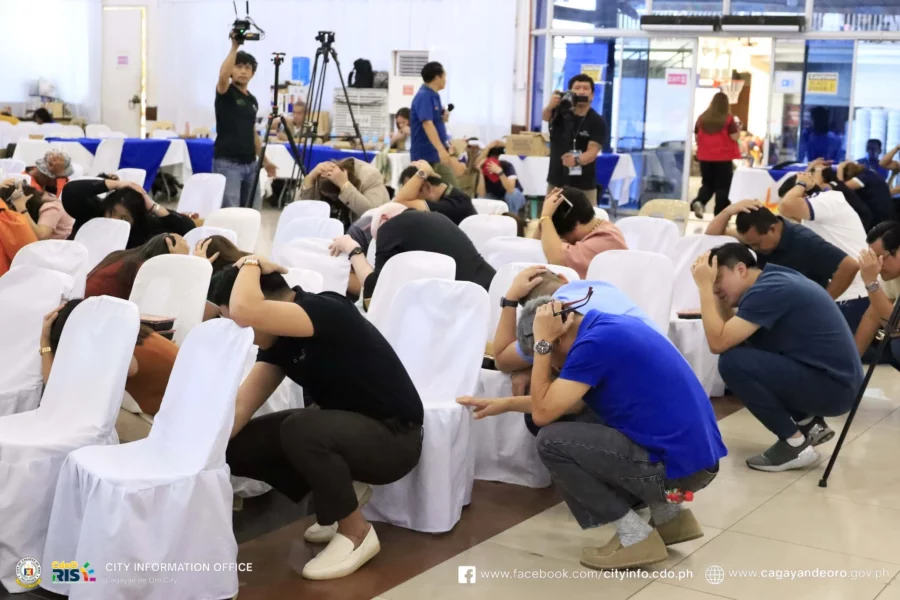
CAGAYAN DE ORO CITY — Disaster officials are encouraging residents to take part in community drills and preparedness activities, saying strong community cooperation can help save lives during earthquakes and other emergencies.
The call came after the second-quarter National Simultaneous Earthquake Drill (NSED) held on June 18, where participants in Cagayan de Oro practiced emergency response procedures during a simulated magnitude-7.8 earthquake.
The exercise tested how communities and emergency responders would handle collapsed structures, fire incidents, and evacuation operations during a large-scale disaster.
Authorities said the drill highlighted the importance of making disaster preparedness part of everyday life, especially in Northern Mindanao, which remains vulnerable to earthquakes and other geological hazards due to its proximity to active faults and trenches identified by the Philippine Institute of Volcanology and Seismology (PHIVOLCS).
The recent magnitude-7.8 earthquake that struck Region 12 earlier this month also renewed concerns over disaster readiness across Mindanao.
Officials stressed that preparedness is not only the responsibility of the government but also of communities and families.
Office of Civil Defense (OCD) Regional Director and Regional Disaster Risk Reduction and Management Council (RDRRMC) Chairperson Antonio B. Sugarol said communities must work together to improve disaster response and readiness.
He emphasized that preparedness and proper response during disasters depend on collective action and cooperation among residents, local governments, and emergency agencies.
Sugarol also reminded the public that disaster resilience requires a “whole-of-nation approach,” where communities actively participate in preparedness programs and emergency drills.
Mayor Rolando “Klarex” Uy echoed the call, saying that while disasters cannot be prevented, communities can reduce risks through preparation.
“We cannot stop earthquakes from happening, but preparedness gives us a fighting chance,” Uy said.
Disaster experts said joining civic organizations, neighborhood associations, and community preparedness programs can help families gain access to disaster training, emergency information, and support networks during crises.
Authorities encouraged residents to prepare emergency “go-bags,” identify evacuation routes, save emergency hotline numbers, and participate in local disaster drills to improve readiness.
Officials added that communities with stronger coordination and active participation are more likely to respond effectively and recover faster after disasters.