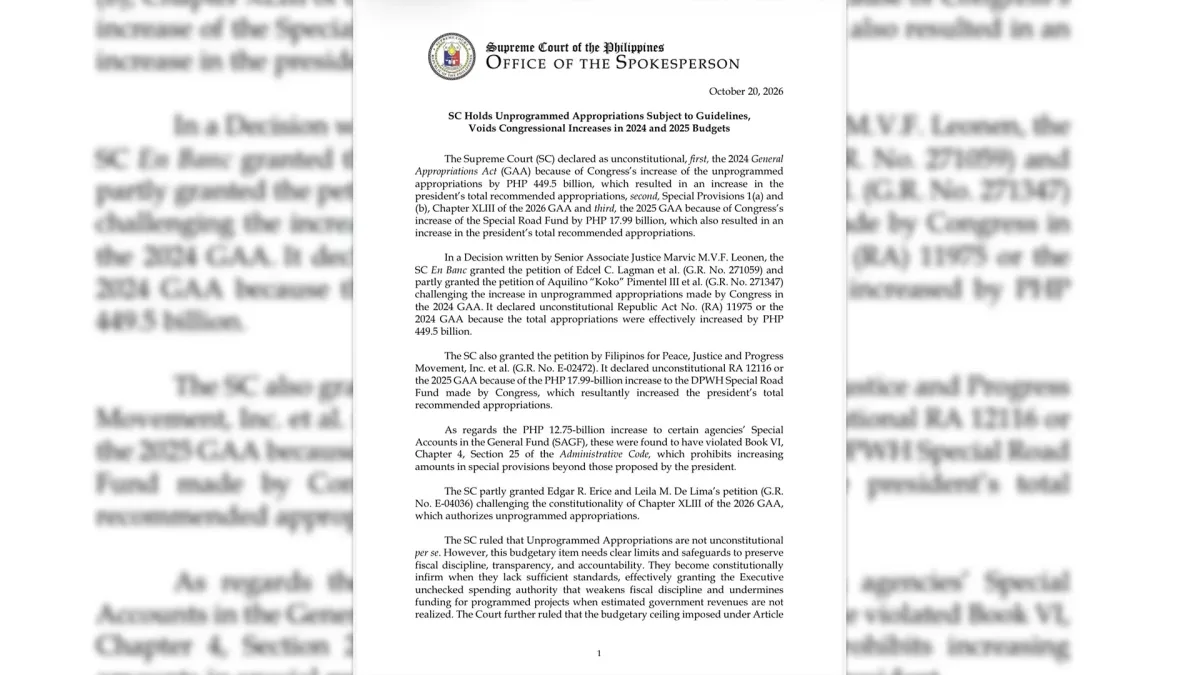
CAGAYAN de Oro City — The Supreme Court has declared the 2024 General Appropriations Act (GAA) unconstitutional after Congress added ₱449.5 billion in unprogrammed appropriations, while also striking down the 2025 GAA over a ₱17.99-billion congressional addition to the Special Road Fund.
In an announcement released Tuesday, Oct. 20, 2026, the High Court also invalidated Special Provisions 1(a) and (b), Chapter XLIII of the 2026 national budget authorizing unprogrammed funds, along with a ₱12.75-billion increase in certain agencies' Special Accounts in the General Fund (SAGF) for violating the Administrative Code.
The En Banc decision, penned by Senior Associate Justice Marvic M.V.F. Leonen, granted consolidated petitions filed by the late lawmaker Edcel C. Lagman (G.R. No. 271059), former Senator Aquilino "Koko" Pimentel III (G.R. No. 271347), the Filipinos for Peace, Justice and Progress Movement, Inc. (G.R. No. E-02472), and former lawmakers Edgar R. Erice and Leila M. De Lima (G.R. No. E-04036).
The landmark ruling places Congress’ bicameral deliberations under strict scrutiny, establishing firm constitutional boundaries on how lawmakers alter spending plans submitted by the Executive.
How the budget grew
Under the proposed 2024 budget, the Executive branch earmarked about ₱281.9 billion in unprogrammed appropriations. However, during bicameral conference committee hearings, lawmakers added ₱449.5 billion, pushing total unprogrammed allocations to roughly ₱731.4 billion.
Unprogrammed appropriations serve as standby funds released only when revenue targets are exceeded or foreign loans and grants are secured.
The Court affirmed that under Article VI, Section 25(1) of the 1987 Constitution, Congress is prohibited from increasing the total appropriations recommended by the President for government operations. By inflating unprogrammed allocations, Congress effectively breached the constitutional spending cap.
The ruling also questioned the extent to which the bicameral conference committee can alter budget line items beyond resolving actual conflicting provisions between Senate and House versions of the bill.
What the ruling means
The Supreme Court emphasized that unprogrammed appropriations are not unconstitutional per se. However, they become constitutionally flawed when they lack clear standards, contain lump sums, or grant unchecked executive spending authority.
To guide future budget legislation, the Court laid down strict conditions:
Unprogrammed allocations must contain no lump-sum amounts.
Clear line-item spending priorities must be specified.
Allocations must remain strictly within the national fiscal program.
The Court clarified that invalidating these budget acts does not automatically halt existing public works or void every prior expenditure. The doctrine of operative fact may protect actions previously carried out in good faith under the invalidated provisions.
Furthermore, the decision leaves open the possibility of accountability. While the ruling itself does not declare specific officials criminally liable, it does not shield authors, proponents, or implementors from administrative, civil, or criminal liabilities if independent legal proceedings determine bad faith or misconduct.
Public money, public accountability
The ruling leaves critical questions for fiscal managers and lawmakers: Which projects benefited from the unconstitutional increases, and were the funds spent as intended?
Detailed government records and Commission on Audit (COA) findings will now be crucial to track disbursements directed toward infrastructure, health programs, and social welfare schemes funded under the voided provisions.
For taxpayers, the Supreme Court's ruling underscores a foundational governance principle: public spending must strictly adhere to constitutional limits, and officials must account for every peso allocated.