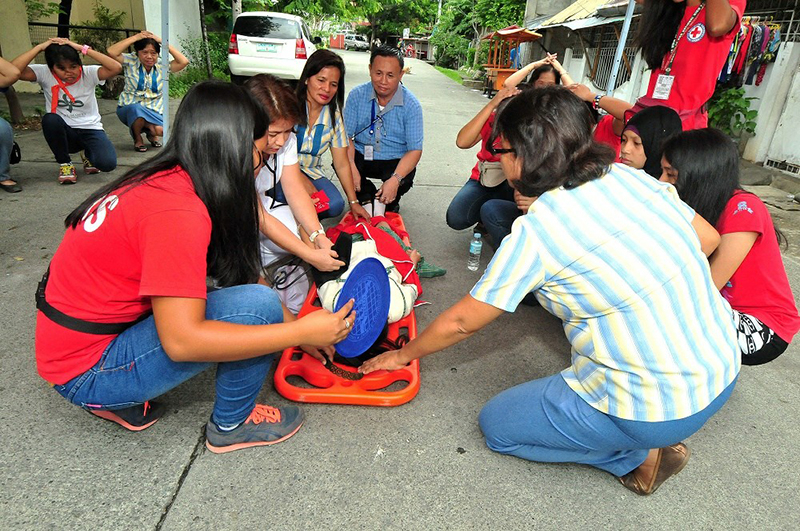
 Students and teachers apply first aid treatment on one of their own who acted as an injured victim during the drill. Local disaster officials say trees and electric poles pose dangers in case of a real earthquake. (photos by froilan gallardo)
CDRRMO spokesperson Virgil Lago said although the students of the Cagayan de Oro National High School in Barangay Nazareth were “guided safely” out from their classrooms by their teachers, this scenario will change during a major crisis.
“In a major earthquake, the teachers might not be there to guide the students out from the schools. They could be the first casualties,” he pointed out.
Lago, who is also chief of the weather monitoring of the City Disaster Risk Reduction Management Office, said he was dissatisfied with what he saw during the drill, adding that he feared that there would be many casualties in the campus if a real powerful earthquake hits the city.
Lago noted that classroom doors were narrow, and the possibility of a stampede is high in case a strong earthquake hits the city.
“Gitudlo-an lagi ang mga studyante asa sila modagan kon dunay linog, apan makahuna-huna pa kaha sila sa gitudlo nila kon duna na gyoy actual nga linog?” Lago asked rhetorically.
He pointed out the need for individuals to have a plan of their own even as he recommended regular revisions of the school’s safety plan. There must be a corresponding plan for every school building, he said.
“Kinahanglan gyud unta once a year dunay regular revision sa safety plan sa tanang building, private or government buildings, ” he said.
Lago said building entry and exit points should be inspected regularly.
Lago said the problem lies on the evacuation plan prepared by the teachers.
“It was the teachers who prepared the evacuation plan. They know it by heart but we doubt if the students can make a safe evacuation without their teachers,” he said.
Lago said a good evacuation plan should be jointly made by the students and the teachers so that the students will not forget the details.
Aside from the evacuation plan, Lago noted that the school has only one gate used for all of its students.
He said a major quake could cause a major stampede among the students who will be scrambling to get out from the school.
Lago noted that the streets around the school that served as evacuation areas for the students have so many electric posts and trees that could fall down during a major quake.
After typhoon “Sendong” ravaged Cagayan de Oro and neighboring Iligan City, killing over a thousand people in 2011, local officials have taken their responsibility in lowering disaster risks.
“Sendong was a major disaster for us but it also taught us the lessons of preparedness,” Lago said.
The Cagayan de Oro National High School participated in Wednesday’s earthquake drill conducted around the city and nationwide. The first was during the nationwide earthquake drill conducted in 2015.
It was the second time the school became “a laboratory” for a major quake that may occur in the city.
When the clock struck 9 am yesterday, the school buzzers sounded and a public address system told the students and teachers that a major earthquake has occurred.
Marlon Francis Seriña, the school’s principal, said another earthquake drill for 11th and 12th grade students would be conducted in the campus after two weeks. Only ninth and 10th graders participated in yesterday’s drill.
Students and teachers apply first aid treatment on one of their own who acted as an injured victim during the drill. Local disaster officials say trees and electric poles pose dangers in case of a real earthquake. (photos by froilan gallardo)
CDRRMO spokesperson Virgil Lago said although the students of the Cagayan de Oro National High School in Barangay Nazareth were “guided safely” out from their classrooms by their teachers, this scenario will change during a major crisis.
“In a major earthquake, the teachers might not be there to guide the students out from the schools. They could be the first casualties,” he pointed out.
Lago, who is also chief of the weather monitoring of the City Disaster Risk Reduction Management Office, said he was dissatisfied with what he saw during the drill, adding that he feared that there would be many casualties in the campus if a real powerful earthquake hits the city.
Lago noted that classroom doors were narrow, and the possibility of a stampede is high in case a strong earthquake hits the city.
“Gitudlo-an lagi ang mga studyante asa sila modagan kon dunay linog, apan makahuna-huna pa kaha sila sa gitudlo nila kon duna na gyoy actual nga linog?” Lago asked rhetorically.
He pointed out the need for individuals to have a plan of their own even as he recommended regular revisions of the school’s safety plan. There must be a corresponding plan for every school building, he said.
“Kinahanglan gyud unta once a year dunay regular revision sa safety plan sa tanang building, private or government buildings, ” he said.
Lago said building entry and exit points should be inspected regularly.
Lago said the problem lies on the evacuation plan prepared by the teachers.
“It was the teachers who prepared the evacuation plan. They know it by heart but we doubt if the students can make a safe evacuation without their teachers,” he said.
Lago said a good evacuation plan should be jointly made by the students and the teachers so that the students will not forget the details.
Aside from the evacuation plan, Lago noted that the school has only one gate used for all of its students.
He said a major quake could cause a major stampede among the students who will be scrambling to get out from the school.
Lago noted that the streets around the school that served as evacuation areas for the students have so many electric posts and trees that could fall down during a major quake.
After typhoon “Sendong” ravaged Cagayan de Oro and neighboring Iligan City, killing over a thousand people in 2011, local officials have taken their responsibility in lowering disaster risks.
“Sendong was a major disaster for us but it also taught us the lessons of preparedness,” Lago said.
The Cagayan de Oro National High School participated in Wednesday’s earthquake drill conducted around the city and nationwide. The first was during the nationwide earthquake drill conducted in 2015.
It was the second time the school became “a laboratory” for a major quake that may occur in the city.
When the clock struck 9 am yesterday, the school buzzers sounded and a public address system told the students and teachers that a major earthquake has occurred.
Marlon Francis Seriña, the school’s principal, said another earthquake drill for 11th and 12th grade students would be conducted in the campus after two weeks. Only ninth and 10th graders participated in yesterday’s drill. Students and teachers apply first aid treatment on one of their own who acted as an injured victim during the drill. Local disaster officials say trees and electric poles pose dangers in case of a real earthquake. (photos by froilan gallardo)
CDRRMO spokesperson Virgil Lago said although the students of the Cagayan de Oro National High School in Barangay Nazareth were “guided safely” out from their classrooms by their teachers, this scenario will change during a major crisis.
“In a major earthquake, the teachers might not be there to guide the students out from the schools. They could be the first casualties,” he pointed out.
Lago, who is also chief of the weather monitoring of the City Disaster Risk Reduction Management Office, said he was dissatisfied with what he saw during the drill, adding that he feared that there would be many casualties in the campus if a real powerful earthquake hits the city.
Lago noted that classroom doors were narrow, and the possibility of a stampede is high in case a strong earthquake hits the city.
“Gitudlo-an lagi ang mga studyante asa sila modagan kon dunay linog, apan makahuna-huna pa kaha sila sa gitudlo nila kon duna na gyoy actual nga linog?” Lago asked rhetorically.
He pointed out the need for individuals to have a plan of their own even as he recommended regular revisions of the school’s safety plan. There must be a corresponding plan for every school building, he said.
“Kinahanglan gyud unta once a year dunay regular revision sa safety plan sa tanang building, private or government buildings, ” he said.
Lago said building entry and exit points should be inspected regularly.
Lago said the problem lies on the evacuation plan prepared by the teachers.
“It was the teachers who prepared the evacuation plan. They know it by heart but we doubt if the students can make a safe evacuation without their teachers,” he said.
Lago said a good evacuation plan should be jointly made by the students and the teachers so that the students will not forget the details.
Aside from the evacuation plan, Lago noted that the school has only one gate used for all of its students.
He said a major quake could cause a major stampede among the students who will be scrambling to get out from the school.
Lago noted that the streets around the school that served as evacuation areas for the students have so many electric posts and trees that could fall down during a major quake.
After typhoon “Sendong” ravaged Cagayan de Oro and neighboring Iligan City, killing over a thousand people in 2011, local officials have taken their responsibility in lowering disaster risks.
“Sendong was a major disaster for us but it also taught us the lessons of preparedness,” Lago said.
The Cagayan de Oro National High School participated in Wednesday’s earthquake drill conducted around the city and nationwide. The first was during the nationwide earthquake drill conducted in 2015.
It was the second time the school became “a laboratory” for a major quake that may occur in the city.
When the clock struck 9 am yesterday, the school buzzers sounded and a public address system told the students and teachers that a major earthquake has occurred.
Marlon Francis Seriña, the school’s principal, said another earthquake drill for 11th and 12th grade students would be conducted in the campus after two weeks. Only ninth and 10th graders participated in yesterday’s drill.
Students and teachers apply first aid treatment on one of their own who acted as an injured victim during the drill. Local disaster officials say trees and electric poles pose dangers in case of a real earthquake. (photos by froilan gallardo)
CDRRMO spokesperson Virgil Lago said although the students of the Cagayan de Oro National High School in Barangay Nazareth were “guided safely” out from their classrooms by their teachers, this scenario will change during a major crisis.
“In a major earthquake, the teachers might not be there to guide the students out from the schools. They could be the first casualties,” he pointed out.
Lago, who is also chief of the weather monitoring of the City Disaster Risk Reduction Management Office, said he was dissatisfied with what he saw during the drill, adding that he feared that there would be many casualties in the campus if a real powerful earthquake hits the city.
Lago noted that classroom doors were narrow, and the possibility of a stampede is high in case a strong earthquake hits the city.
“Gitudlo-an lagi ang mga studyante asa sila modagan kon dunay linog, apan makahuna-huna pa kaha sila sa gitudlo nila kon duna na gyoy actual nga linog?” Lago asked rhetorically.
He pointed out the need for individuals to have a plan of their own even as he recommended regular revisions of the school’s safety plan. There must be a corresponding plan for every school building, he said.
“Kinahanglan gyud unta once a year dunay regular revision sa safety plan sa tanang building, private or government buildings, ” he said.
Lago said building entry and exit points should be inspected regularly.
Lago said the problem lies on the evacuation plan prepared by the teachers.
“It was the teachers who prepared the evacuation plan. They know it by heart but we doubt if the students can make a safe evacuation without their teachers,” he said.
Lago said a good evacuation plan should be jointly made by the students and the teachers so that the students will not forget the details.
Aside from the evacuation plan, Lago noted that the school has only one gate used for all of its students.
He said a major quake could cause a major stampede among the students who will be scrambling to get out from the school.
Lago noted that the streets around the school that served as evacuation areas for the students have so many electric posts and trees that could fall down during a major quake.
After typhoon “Sendong” ravaged Cagayan de Oro and neighboring Iligan City, killing over a thousand people in 2011, local officials have taken their responsibility in lowering disaster risks.
“Sendong was a major disaster for us but it also taught us the lessons of preparedness,” Lago said.
The Cagayan de Oro National High School participated in Wednesday’s earthquake drill conducted around the city and nationwide. The first was during the nationwide earthquake drill conducted in 2015.
It was the second time the school became “a laboratory” for a major quake that may occur in the city.
When the clock struck 9 am yesterday, the school buzzers sounded and a public address system told the students and teachers that a major earthquake has occurred.
Marlon Francis Seriña, the school’s principal, said another earthquake drill for 11th and 12th grade students would be conducted in the campus after two weeks. Only ninth and 10th graders participated in yesterday’s drill.