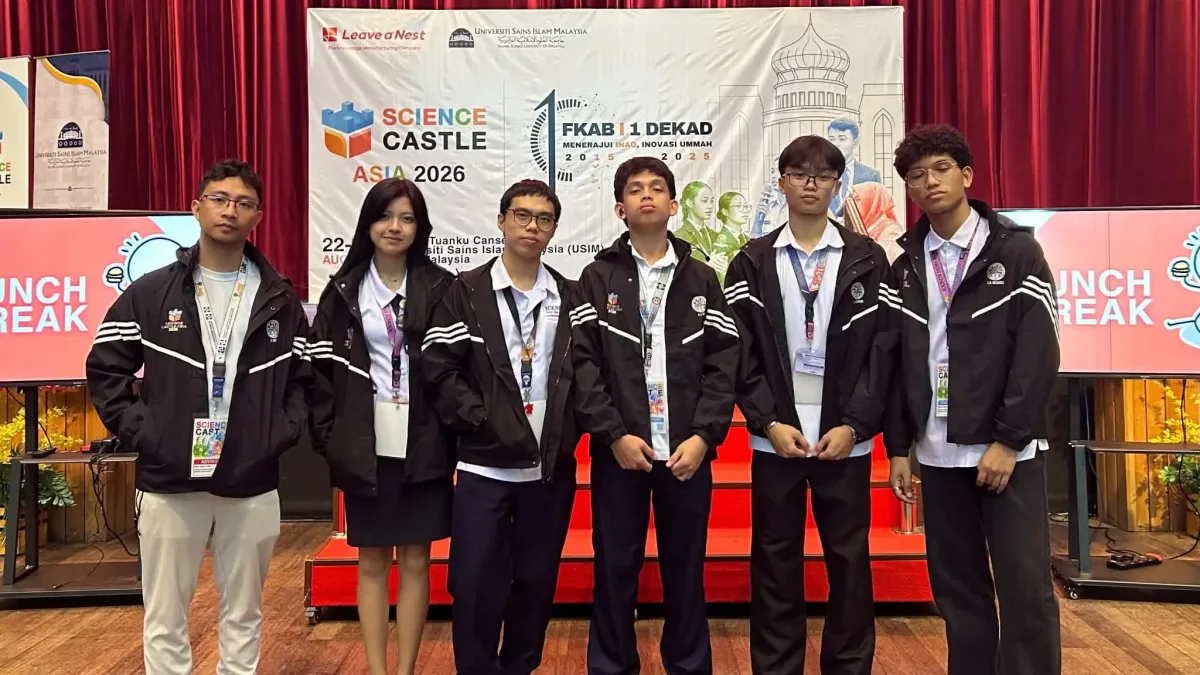
ILIGAN City — A health-monitoring device designed by Iligan students to help families check on elderly relatives at home has won a Gold Tier award at an international science competition in Malaysia.
The student researchers from Iligan City East National High School earned the award for PAGTULTOL, an AI-guided health tracker that monitors vital signs, including blood pressure, and sends alerts to local health centers even without an internet connection.
The project competed against more than 100 research projects from across Asia at the Science Castle Asia 2026 competition held Aug. 22–23 at Universiti Sains Islam Malaysia.
For the students, the project started with a problem familiar to many families: elderly relatives who need regular medical checks but have difficulty traveling to health facilities.
“Our device was inspired by a commonly observed complaint from hypertensive patients where they need to spend hours and kilometers driving and waiting just to have a checkup with their physician,” student researcher Lourd Kymane S. Mariquit said.
The team developed PAGTULTOL to make basic health monitoring more accessible at home.
No internet needed
One of the project's key features is its use of Long Range (LoRa) radio technology, allowing health information and alerts to travel between the device and local health centers without depending on an internet connection.
This is particularly useful in rural communities where internet access can be unreliable.
Research coach Jumari S. Sapio said the project was also inspired by families who have to leave elderly relatives at home while working.
“PAGTULTOL is a Filipino community-rooted solution to elders left inside their homes while the other members of the house work to make ends meet,” Sapio said.
But making the system work was not easy.
The team spent about three months debugging the software and ensuring that the LoRa system could transmit information across a wider area.
“For online-offline alerts, the biggest hurdle is the coding or building the software of the device,” Sapio said.
From Iligan to Malaysia
The project took nearly a year to develop, with technical assistance and prototype components from the Department of Science and Technology's iMake WeMake program.
The students also received technical guidance from the Mindanao State University–Iligan Institute of Technology Colleges of Engineering and Computer Studies.
Local government and community partners helped provide funding and logistical support for the team's trip to Malaysia. Field testing was conducted with residents in Barangays Sta. Filomena, Tibanga, Bagong Silang and Sto. Rosario.
Student researcher Keanne Jad L. Tare said the project began as an attempt to address a problem they personally saw in their own families.
“Starting out, we were just students trying to solve a personal problem we saw in our own homes with our grandparents,” Tare said.
Winning in Malaysia showed the students that a solution developed in Iligan could compete internationally, she added.
Young innovators gain confidence
For student researcher Zhein Nyel B. Ricardel, presenting the project abroad was itself a major milestone.
“It felt unreal. It was hard to believe that we were actually presenting our research project outside of the Philippines,” Ricardel said.
Judges also asked whether PAGTULTOL could be adapted for other healthcare fields, including dentistry.
The question made Ricardel realize that the technology could have applications beyond its original purpose.
Sapio said the Gold Tier recognition validated the team's months of work.
The award was announced on screen during the competition, placing PAGTULTOL among the Gold Tier projects selected from more than 100 studies.
For the Iligan students, the recognition showed how a practical idea addressing a local family problem can grow into a technology with wider potential.