CAGAYAN de Oro City — Camiguin is targeting Geographical Indication (GI) recognition for its lanzones by March 2027, hoping to protect the fruit’s identity and help farmers get better value for their harvest.
For growers, the move comes as a response to a familiar problem: when too much lanzones reaches the market at once, prices fall, leaving farmers with less income despite a good harvest.
Gov. Xavier Jesus Romualdo said oversupply remains a challenge for the province’s lanzones industry, which also depends on timely transport to get the highly perishable fruit to buyers outside the island.
“Isa gyud ka problem sa lanzones sa Camiguin kay subject gyud siya sa law of supply and demand nga kung daghan ra pud kaayo bunga, manaog pud ang presyo,” Romualdo said.
(One problem with Camiguin lanzones is that when there is an oversupply, prices also go down.)
The provincial government is pursuing GI recognition to establish standards that distinguish Camiguin lanzones from other products. If approved, the registration could give the fruit a clearer market identity, although it would not automatically guarantee higher farmgate prices or protect growers from oversupply.
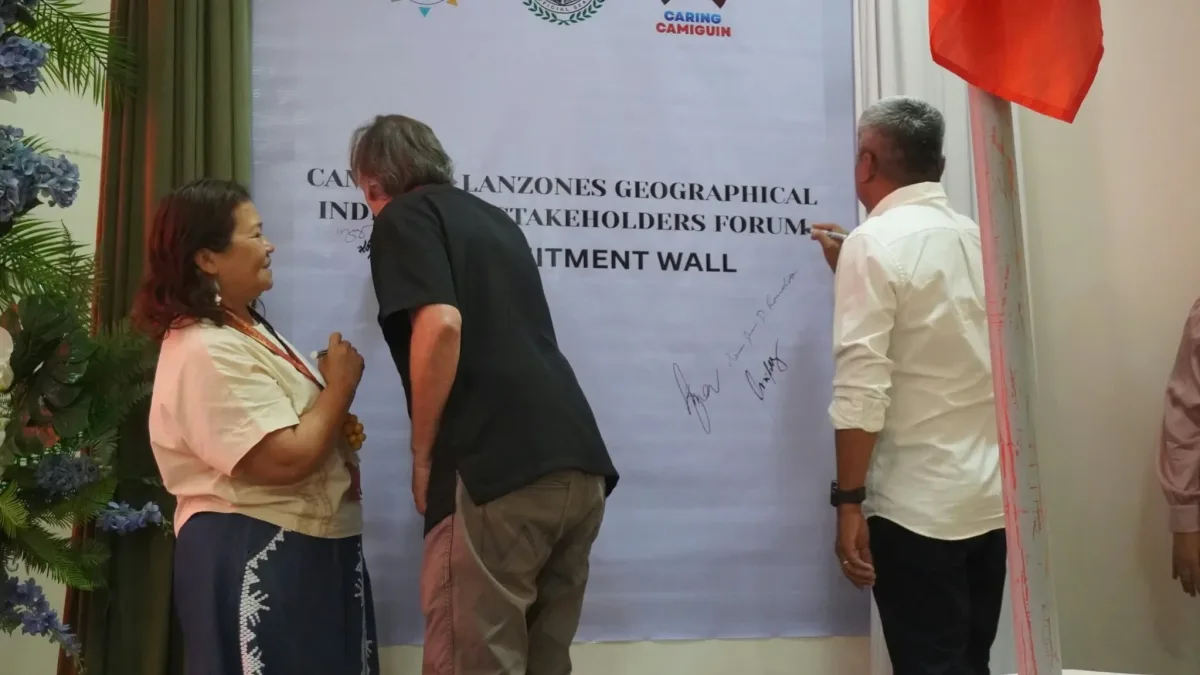
The government gathered farmers, officials and other stakeholders on Oct. 20 at Hibok-hibok Hall of the New Provincial Capitol in Mambajao to discuss the proposed product standards and registration requirements.
Quality rules from farm to market
The proposed specifications cover the fruit’s variety, size, appearance, flesh quality, seeds, orchard management, harvesting and post-harvest handling.
The fruit must be the Paete variety associated with Camiguin. The proposed standards also specify skin color and latex content, while the flesh should be translucent white to pearl-white, juicy and firm yet tender.
Harvesting would be limited to cooler hours, particularly from 5 a.m. to 10 a.m. or 3 p.m. to 5 p.m., and avoided during rainfall or immediately after heavy rain.
Another proposed requirement, called the “24-hour island exit” rule, would require fresh lanzones intended for markets outside Camiguin to leave the island within 24 hours after harvest. The goal is to preserve freshness and skin color before the fruit reaches buyers.
Producers and traders would have four years from the granting of GI recognition to adopt temperature-controlled handling, with transport and storage temperatures below 21 degrees Celsius.
Fruit that fails to meet the proposed standards for fresh GI-certified sales would have to be redirected to local markets or processing rather than sold as fresh GI-certified Camiguin lanzones.
These rules could help buyers identify fruit that meets the province’s standards. But their impact on farmers will depend on whether growers can comply without taking on costs they cannot afford and whether buyers are willing to pay more for certified produce.
Transport remains a challenge
Romualdo said improved transport connections are also needed to get lanzones to outside markets before it spoils.
The provincial government is improving the airport runway and the ports of Guinsiliban, Benoni and Balbagon. These facilities could provide more options when bad weather disrupts transport schedules and delays shipments.
For farmers, faster and more reliable transport could mean less fruit lost to spoilage and a better chance of reaching buyers in time. The actual benefit will depend on shipping availability, transport costs and whether traders can move the harvest quickly enough.
Peter Damary, lead consultant of Réseau Échanges et Développement Durable (REDD), cited France’s experience in using geographical indications to protect regional products, preserve food traditions and support rural economies.
“So, it's a very successful tool for rural development,” Damary said.
He said GI recognition could help sustain rural employment and protect the cultural value of locally produced food. However, he noted that the short shelf life of fresh lanzones could make exports to distant markets, including Europe, difficult.
Mambajao Sangguniang Bayan member Zita Abellare discussed the proposed product specifications, cultural heritage and governance measures for registration, emphasizing the connection between Camiguin lanzones and the province’s identity.
The provincial government is targeting the first quarter of 2027 for recognition.
For growers, the measure of success will be whether the standards help their fruit stand out, reduce losses and improve what they earn—not simply whether Camiguin secures a new product designation. (With a report from Recthie T. Paculba/PIA-10/Camiguin)