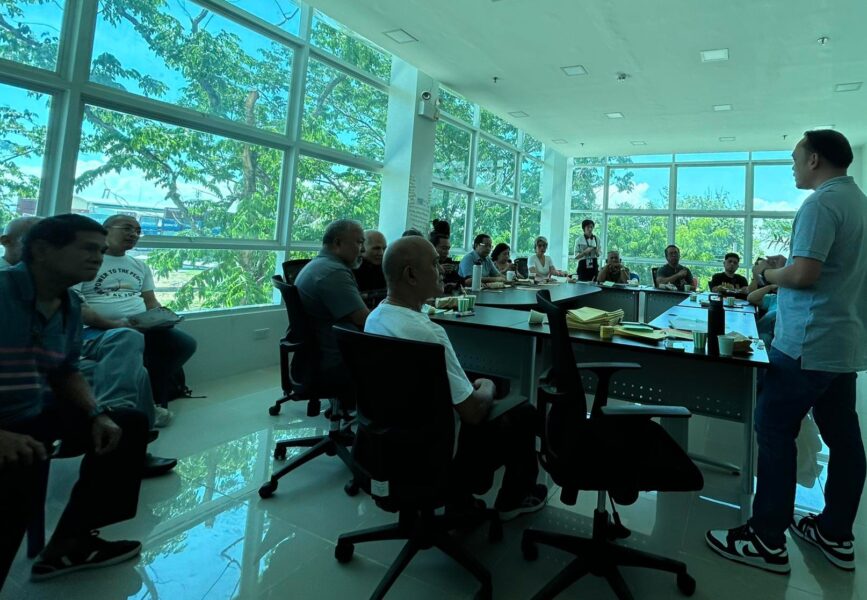
LAWYER Proculo Sarmen, the convenor and presiding officer of the Community Alliance on Water Security Action (CAWSA), addressed a complex and pressing issue during a recent focus group discussion: the morality of treating water as an ordinary commodity for the sole purpose of profit by oligarch businessmen.
Sarmen began by highlighting the human rights perspective. “Water is essential for life,” he said, referencing the stance of international organizations like the United Nations, which consider access to clean water a fundamental human right.
He argued that commodifying water in a way that restricts access based on the ability to pay is morally unjustifiable.
From an economic standpoint, the discussion explored the potential efficiency benefits of treating water as a commodity.
“In theory, commodification can lead to more efficient distribution and conservation,” Sarmen noted. However, he cautioned that this efficiency must not come at the cost of equity.
The focus group raised concerns that significant portions of the population might be unable to afford clean water if it were commodified, which would present serious moral issues.
The environmental perspective also featured prominently in the discussion.
Participants expressed worries that prioritizing profit could lead to over-extraction and depletion of water sources.
Sarmen emphasized the importance of sustainable management to avoid long-term environmental damage.
Social justice was another key theme. The focus group examined how inequitable profit from essential resources like water could exacerbate social inequalities.
“If commodifying water primarily benefits oligarch businessmen and disadvantages poorer communities, it widens the gap between the rich and the poor,” Sarmen said.
This, he argued, would be morally reprehensible and harmful to social cohesion.
The role of legal and regulatory frameworks was a point of debate. Effective regulation could mitigate some negative impacts of commodification.
Sarmen suggested that with fair pricing, prevention of monopolies, and environmental protections, it might be possible to balance profit motives with the public good.
Despite these regulatory possibilities, the overall sentiment in the discussion leaned towards the moral unjustifiability of commodifying water primarily for the profit of a few.
The group agreed that ensuring access to clean, safe, and affordable water for all should be the priority.
Sarmen concluded the discussion by reiterating that while there are arguments for commodifying water under certain conditions, doing so in a way that leads to inequitable access is generally considered morally wrong.
“Our focus should be on equity and sustainability, not just profit,” he stated.
The session ended with a call to action for policymakers and stakeholders to consider these ethical dimensions carefully.
The group urged that any plans to commodify water include robust measures to protect human rights, ensure social equity, and safeguard the environment.
The CAWSA focus group discussion underscored the complexity of the issue and the need for a balanced approach that prioritizes the public good over private profit.
One of the CAWSA members even called oligarch businessmen "benevolent scammers."
“These people will scam the public without knowing it. I’m one of the victims, and those who should protect us, being powerful company figures, turn a blind eye,” he lamented.
He claimed that these oligarchs have made significant profits from such schemes.
He noted that these businessmen can utilize many tools, like hiring good lawyers and using their financial might, to their advantage.
“We like it or not, the water system is a business enterprise. There is no room for incompetence, corruption, mismanagement, and nepotism. And I’m brutally honest that CDO has encountered water crises because of some of these factors,” he stressed.
The only way to uncover anomalies—whether financial, technical, mismanagement, or corruption—is by examining all the feasibility studies conducted before funding was obtained, he stressed.
These studies include socio-economic, financial, and technical analyses. They define all aspects, such as profit calculations, organization and management, maintenance, and the basis of water rates.
Without access to these studies, it’s still possible to analyze based on the number of consumers, operating costs, manpower, and equipment.
This includes office work, maintenance, collection, and design drawings of both old and new installations.
He suggested introducing methods or strategies to solve the water crisis, such as public-private partnerships, reward systems to discourage water wastage and theft, policy-making, and third-sector partnerships with entities like churches and schools.
“We, as a group, can present to the public that what we do makes sense. We can make comprehensive studies and recommendations and present them as a position paper of CAWSA," he said, adding, this can be given to the mayor, city council, media outlets, and even popular bloggers, knowing it’s a hot issue and of public interest."