THE Regional Trial Court of Misamis Oriental has ruled that water supply company must continue providing water to the residents of Cagayan de Oro City.
This ruling is a significant victory for the local community, ensuring their uninterrupted access to essential water services amidst ongoing legal and contractual disputes.
The court's decision was prompted by several urgent petitions filed by local residents and the Cagayan de Oro City Water District (COWD).
Petitioners Irene Grace Arbolonio and Clarita Reyes Daculos, among others, expressed concerns that Cagayan de Oro Bulk Water, Inc. (COBI) and Rio Verde Water Consortium, Inc. might cut off the water supply, leaving many without access to clean, potable water.
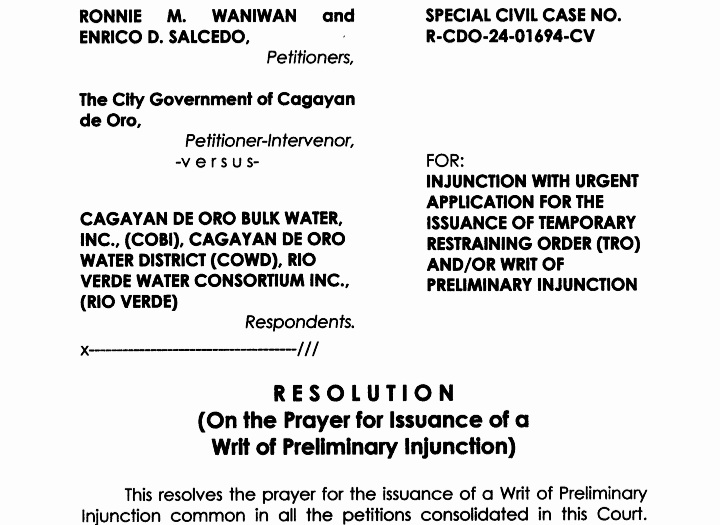
Judge Jeofare W. Acebido, who presided over the case, emphasized the necessity of issuing a writ of preliminary injunction.
The court found that the petitioners had provided sufficient grounds for the issuance of the writ. The potential negative impact on the residents if the water supply were cut off was clearly expressed by petitioner Ronnie M. Waniwan.
This legal order requires the respondents to maintain the status quo and refrain from any actions that might disrupt the city's water supply until the case's merits are fully evaluated.
"The issuance of the Writ of Preliminary Injunction (WPI) is a victory for the people and a protection against the violation of their right to water and the rule of law," said Mayor Rolando "Klarex" Uy.
He highlighted the significance of the 13-page court order, which ensures that residents continue to have access to safe and affordable water.
City Hall lawyer Melanie Cabanlas explained that with the issuance of the WPI, COBI cannot cut off the bulk water supply, as it did on May 13, 2024, until the case seeking mandatory prohibition against the water firm owned by Metro Pacific Waters is resolved.
"Tungod ani, dili na mahimo nga putlon sa COBI ang supply sa tubig samtang gi-resolba pa ilang issue ni COWD," Cabanlas stated.
The court noted COBI's promise not to disconnect the bulk water supply to COWD, as it did on May 14, 2024, following interventions by the President and the City Mayor.
However, the court recognized that this promise was contingent on future negotiations between COBI and COWD, creating ongoing uncertainty for the petitioners.
In its ruling, the court underscored the potential for grave and irreparable harm to the petitioners and many residents if the water supply was interrupted.
The court dismissed COBI's claims of potential future business losses as speculative, noting that COWD continues to pay the rate of P16.60 per cubic meter, which does not currently result in losses for COBI.
The court's decision also referenced the United Nations International Covenant on Economic, Social, and Cultural Rights (UN-ICESCR), which recognizes access to water as a fundamental human right.
The Supreme Court of the Philippines has similarly acknowledged the essential role of water for life and development.
To ensure compliance with the ruling, the court ordered COWD to post an injunction bond of P20 million.
This bond is intended to cover any damages the respondents might incur due to the issuance of the writ. However, individual petitioners and the City Government of Cagayan de Oro were exempted from posting this bond.
The ruling mandates that COBI, Rio Verde, and Metropac Water Investments Corporation maintain the water supply for Cagayan de Oro City.
These companies and their agents are instructed to refrain from any actions that might disrupt water distribution.
Mayor Uy expressed his gratitude for the court's decision, which he believes will protect the residents' right to water.
"Ang WPI kadaugan sa katawhan ug proteksyon batok sa violation sa katungod sa katawhan sa tubig and the rule of law," he reiterated.
As the case continues to unfold, the residents of Cagayan de Oro City can rest assured that their water supply is protected by the court's order.
The court will further examine the merits of the petitions to reach a final resolution, but for now, the essential service remains safeguarded.
This decision highlights the critical importance of water as a fundamental human right and the necessity of protecting it amidst legal and contractual challenges. (With a report from CIO)