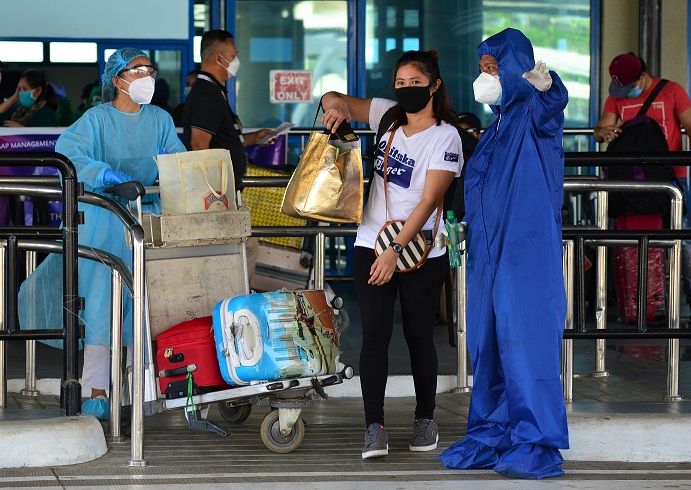
SOME 333 overseas Filipino workers (OFWs) stranded in Luzon as a result of the imposition of the lockdown arrived via “sweeper flights” in Mindanao Monday.
The workers arrived at the Laguindingan Airport in Misamis Oriental on two separate flights, said Job de Jesus, manager of the Civil Aviation Authority of the Philippines (Caap) in the region.
The Air Asia Airbus A320 planes that brought 155 OFWs landed at 3:35 pm while the 10:15 pm flight had 178 workers, de Jesus said.
The passengers had their temperatures checked and went through sanitation before stepping into the airport terminal, he said.
No one in the afternoon flight showed symptoms of Covid-19 such as fever, chills, and cough, he added.
De Jesus said that while in Metro Manila, the OFWs were advised to proceed to the Ninoy Aquino International Airport where they were processed by health and overseas welfare personnel before taking the flight.
The returning OFWs are from Caraga, Northern Mindanao, Zamboanga Peninsula, and the Bangsamoro Autonomous Region in Muslim Mindanao regions, said Petrona Bergado, Overseas Workers Welfare Administration (Owwa) regional director.
She said more than 500 OFWs from all over Mindanao, including Monday’s arrivals, passed through the region’s ports of entry at the Macabalan wharf and Laguindingan Airport since April.
Bergado said the returning OFWs have gone through the required 14-day quarantine while staying in Manila and were already tested for coronavirus.
“They have with them their RT-PCR test results and they have already complied with the quarantine procedure,” she said, although it is up to the local governments if they will still subject their returning residents to a quarantine once they get home.
RT-PCR refers to the real-time reverse transcription-polymerase chain reaction, a method used by health specialists to detect the presence of coronavirus in a person’s body.
Bergado said Owwa has paid for the plane tickets of the returning OFWs.
Martin Visabella Jr., 47, from Dipolog City, said he arrived in the Philippines on March 16 after being told to go home by his employer.
Visabella works as a hotel crew of a cruise ship based in San Francisco, California.
He said his annual leave was supposed to be on May 24 but he was ordered to return to the country before his scheduled vacation.
Visabella said he and other OFWs stayed at the New Clark City Athletes Village in Capas, Tarlac for two weeks, and was made to undergo another 14-day quarantine once they arrived in Metro Manila.
“I stayed in Luzon for more than two months. I am very happy to be with my family, finally,” he said.
He said he had to fight the boredom while on quarantine. “It was very strict. We just stayed in our rooms, but we followed the rules.”
Bergado said many of the overseas workers affected by the spread of the coronavirus have also availed of the labor department’s financial aid.
In Northern Mindanao, at least P16 million was already given out to the OFWs who were displaced due to the Covid-19 pandemic.
She said there are around 24,000 OFWs who are still in quarantine facilities all over the Philippines, as the government is waiting for the return of 40,000 more from other countries.
Bergado said more workers from abroad are expected to arrive in the region’s ports before proceeding to their destinations in other parts of Mindanao until tomorrow.
She said 29 OFWs from the city and 35 from Misamis Oriental were turned over to their respective local government authorities while those from other areas outside the region have to stay in Cagayan de Oro for the night while waiting for the transport vehicles to take them home.
Marie Elaine Unchuan, Department of Tourism (DOT) regional director, said their participation in the repatriation of the arriving OFWs is part of the agency’s international humanitarian efforts.
Unchuan said DOT-10 is also facilitating the outbound flights of foreign tourists stranded in Mindanao.
Jeffrey Saclot, the Misamis Oriental provincial tourism officer, said all the OFWs from the province were fetched by municipal governments who provided transportation and other services. (Jigger J. Jerusalem)