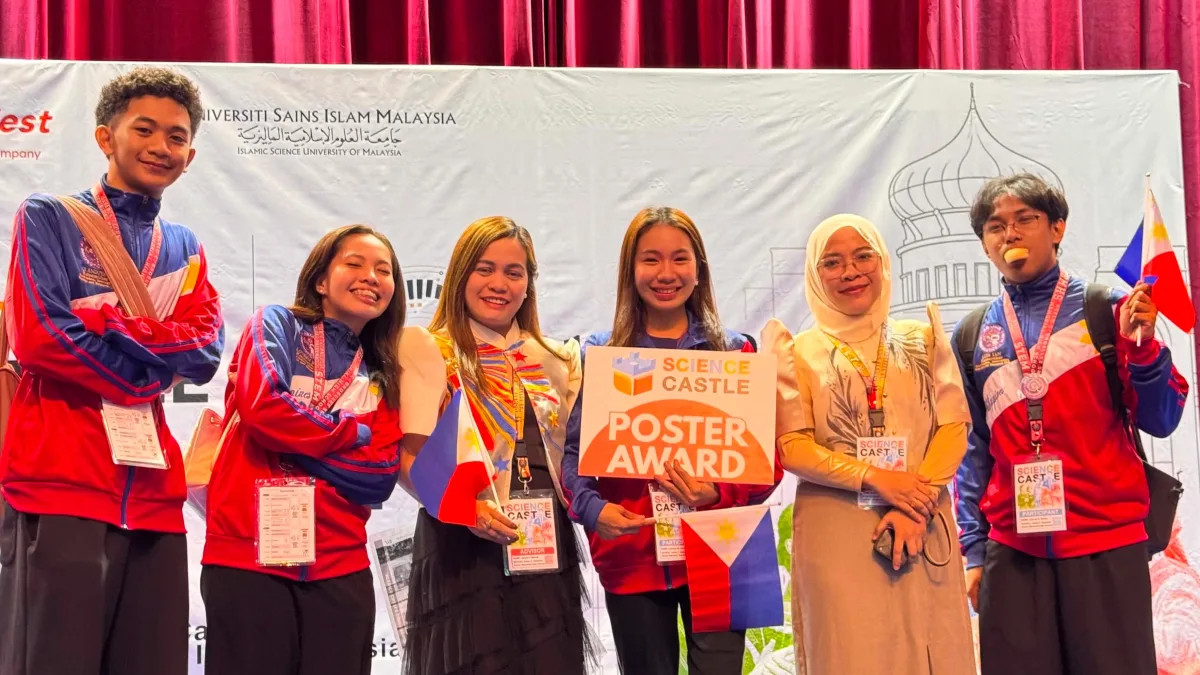
CAGAYAN de Oro City — Four student research teams from Acelo C. Badelles Sr. Memorial High School (ABMHS) in Iligan City won Gold, Silver and Bronze awards at the Science Castle Asia 2026 competition in Kuala Lumpur, Malaysia, for inventions aimed at solving problems in their communities.
The Iligan delegation competed against more than 150 student teams from across the region during the Aug. 28 competition at Universiti Sains Islam Malaysia.
Leading the delegation was Leishlyn M. Lucero, who won the Gold Tier and Tenchijin Award for W.I.S.E.F.L.O.W., an automated water-testing device developed with Dennies Mai L. Sarino, Elyka G. Monsanto, Francis B. Dave Alferez and Aaron Suarez.
The device uses low-cost sensors and automated valves to test drinking water in real time. It was designed for communities in Barangays Abuno, Upper Panul-iran and Mirador that rely on deep wells and rainwater.
W.I.S.E.F.L.O.W. previously won Silver at the Philippine qualifiers at Mapúa University in January before advancing to the Gold Tier in the Asian competition.
Lead coach Josevi D. Macas said the project could help underserved communities monitor water safety while generating data that may eventually support broader water-resource management.
“More importantly, it provides an affordable, long-term way to keep drinking water safe in underserved areas,” Macas said.
Other student inventions also win
Luis Ian E. Roxas represented B.L.I.N.D., a wearable GPS and voice-guide device developed with Precious Lara C. Boncales, Ilyl D. Murillo and Apple A. Villarete. The project won Silver and is designed to help visually impaired residents navigate streets more safely.
Two other ABMHS projects won Bronze.
Chrisjosh Anthony V. Aduyan presented HALO-Bata, a portable digital tracker developed with Redjane D. Lariosa, Andrei M. Pelvera and Jecris N. Agcang. The device is designed to help village health workers monitor infant growth while reducing paperwork.
Meanwhile, Lovern Kim A. Talisic represented B.A.N.T.A.Y., a smart sensor developed with Ashleah Aira P. Tangian and Gemar L. Bonghanoy. The prototype is designed to alert coastal fishermen in Barangay Tambacan to changes in water acidity and pollution.
From school projects to field testing
Three of the four winning projects have already undergone initial field testing with their intended users.
W.I.S.E.F.L.O.W. was tested in Abuno, Upper Panul-iran and Mirador, while HALO-Bata was evaluated at the Abuno Barangay Health Center.
The B.L.I.N.D. device was also developed and validated with members of Iligan City’s visually impaired community, including blind masseurs and support organizations.
B.A.N.T.A.Y. remains in the prototype and technical validation stage, with plans for future coastal deployment in Tambacan.
The researchers and technical evaluators said all four projects still need further calibration, additional sensor integration and expanded field trials before they can be considered for wider community use.
Students seek support to scale projects
The student teams and their advisers are now looking for partnerships with local governments, private sponsors, research institutions and innovation agencies to further develop their prototypes.
No formal patents or citywide deployments have been finalized, but the teams are exploring intellectual property registration, scientific publication and funding for product improvements.
Macas said sustained funding and technical support will be needed to move the inventions beyond competition prototypes and toward possible community applications in Iligan and neighboring areas.
Two years of work behind the awards
The international recognition capped two years of prototyping, coding and field testing by the students and their mentors.
Macas said balancing teaching, family responsibilities, finances and mentoring was among the biggest challenges.
“The biggest challenge was balancing time, finances, and commitment over two years,” he said.
The teams initially built their prototypes using components provided by the Department of Science and Technology.
Travel expenses to Malaysia were supported through family savings and donations from Iligan City Mayor Frederick Siao, Vice Mayor Ernest Oliver Uy, Congressman Celso Regencia, the school’s Parents-Teachers Association and local leaders from Barangays Tipanoy, Tubod and Hinaplanon.
For the students, the awards highlight how school-based research can address problems faced by their own communities while giving young innovators a chance to compete on an international stage.