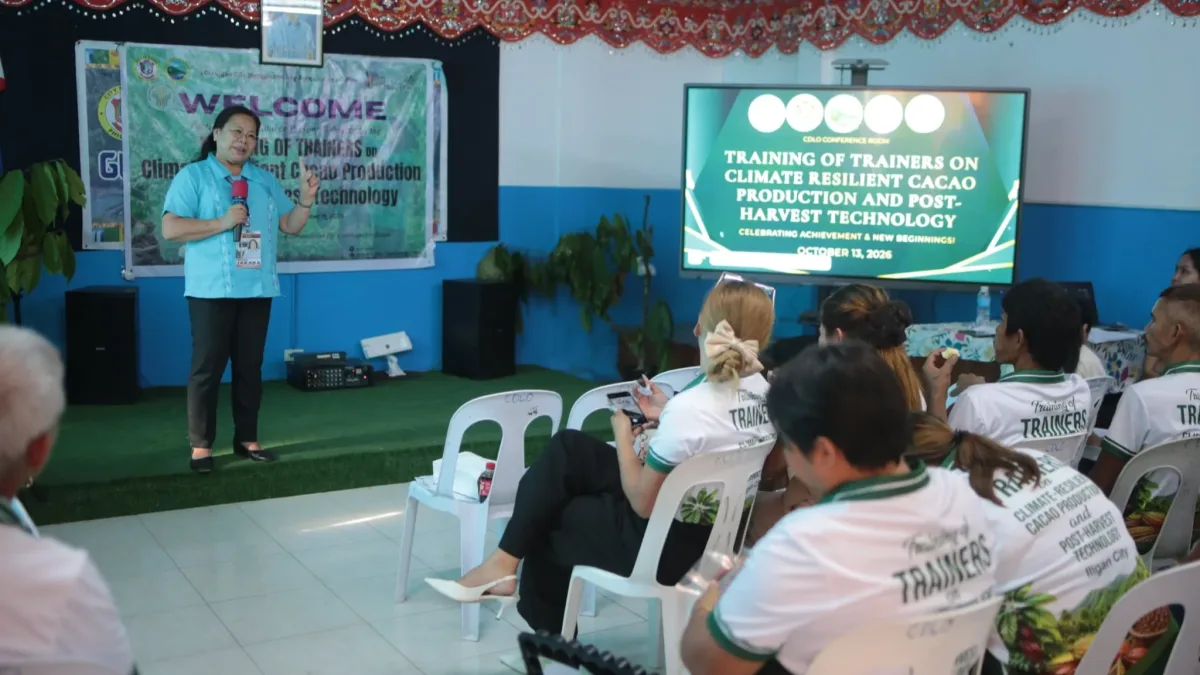
ILIGAN City — Cacao farmers in Iligan could get better guidance on growing and processing their crops after 19 agricultural extension workers and farmer-leaders completed an eight-week training on climate-resilient production and postharvest technology.
Organized by the City Agriculturist Office, the training ended Oct. 13 and covered cacao varieties, pest and disease management, farm technologies and practices for producing quality beans.
Acting City Agriculturist Teodosia D. Jaraba said the participants are expected to share what they learned with local growers to help improve cacao production and bean quality.
“So with this technology nga atong gitudlo sa ilaha, matudloan ang mga farmers sa Cacao nga maka-produce syag insakto nga kalidad sa Cacao,” she said.
(Through the technology we introduced, we can teach cacao farmers how to produce quality cacao.)
The training also comes as the city government works toward a partnership with Meiji Chocolate Japan to expand market opportunities for local cacao growers. However, details of the proposed partnership, including its requirements for farmers and the volume of cacao it may purchase, have yet to be established in the report.
Jaraba said another batch of training and Farmer Field Schools would be conducted next year to reach more farmers.
For the 19 graduates, the next challenge is bringing the lessons from the training to farms and helping other growers apply them.
Mery-An C. Alivio, an agricultural extension worker for four years, said the training improved her ability to assist farmers.
“Nagpasalamat ko sa City Agri nga nadugangan gyud ang akong kahibalo kay dili lang para ni sa akoa, kon dili para ni sa tanan farmers nga nanginahanglan og tabang sa amoa,” she said.
(I am thankful to the City Agriculturist’s Office for the additional knowledge I gained because this is not only for me but also for all the farmers who need our help.)
Elsie N. Sabuero, a farmer-leader from Barangay Abuno, said the training introduced her to new technologies and methods of growing cacao.
She also credited the city agriculture office for guiding farmers throughout the program.
“Daghan kaayo ko’g nakat-unan, labi na sa teknolohiya, nga ingon ani diay ang pagtanom sa cacao,” she said.
(I learned a lot, especially about the technology and the proper methods of growing cacao.)
Artemio Beley, owner of Madem KaCao Integrated Farm in Barangay San Roque, said establishing a Learning Site for Agriculture would give growers a place to learn and practice improved production methods.
He said the participants could share their knowledge with farmers, from setting up cacao farms to harvesting and processing beans.
“Malipayon kaayo mi nga nahuman ra gyud ang training. Nag-anticipate mi nga mo-share sa among mga natun-an sa training, gikan sa establishment sa cacao paingon sa pag-harvest ug pag-process sa cacao, aron matabangan ang atong farmers didto sa kabukiran,” he said.
(We are glad to have completed the training. We look forward to sharing what we learned, from establishing cacao farms to harvesting and processing cacao, to help farmers in upland communities.)
Whether the training will translate into better harvests and higher incomes will depend on how widely the participants share the lessons, the continued support available to growers and the market opportunities that eventually open to them. (With a report from Rachel Ala/PIA-10/Lanao del Norte)