CAGAYAN DE ORO CITY — Building an award-winning robot usually sounds like a project requiring hundreds of thousands of pesos, high-tech laboratories, and specialized university gear. The LaNorte Autobots from Maigo National High School (MNHS) in Lanao del Norte just proved otherwise.
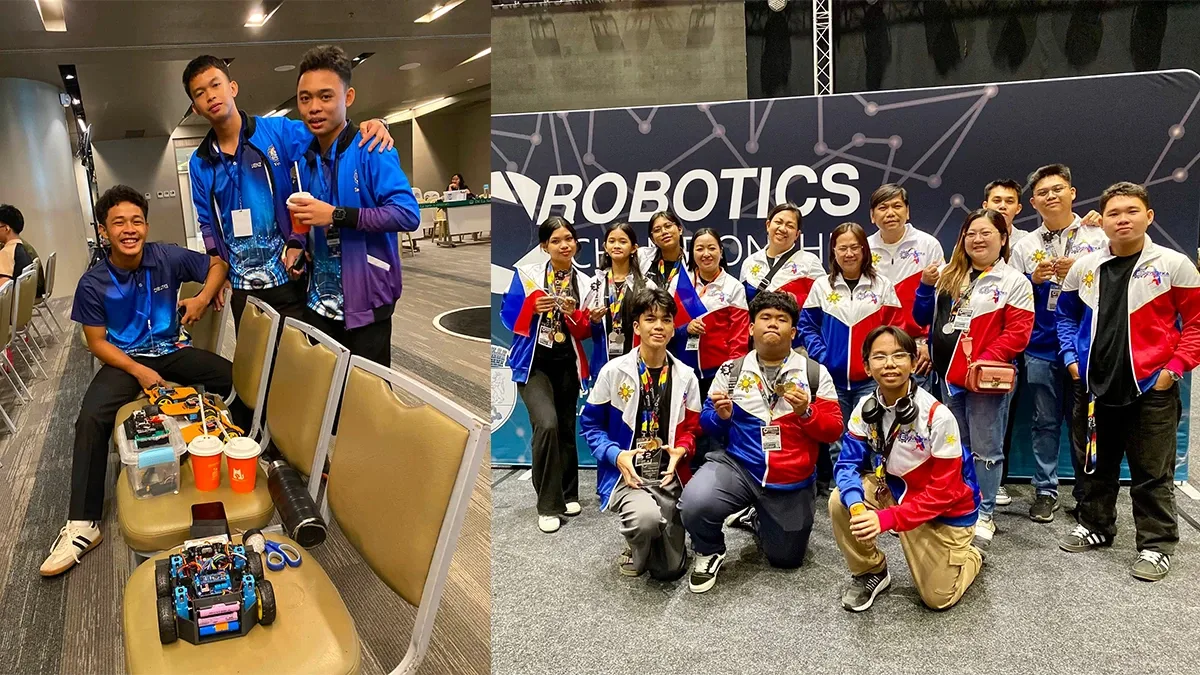
At the 5th Robolution Manila 2026 held at De La Salle University, the school's junior team secured fourth place overall, bringing home two Silver Medals, two Bronze Medals, and the Special Inspiring Innovation Award. The national milestone follows the success of the school's senior team, which represented the Philippines at an international championship in Oradea, Romania.
Their secret lies in a simple philosophy: real engineering happens through creative problem-solving, not expensive equipment.
The cardboard classroom
For coach Marichu Miscala, a physics graduate from Mindanao State University-Iligan Institute of Technology, robotics education belongs in everyday classrooms. She emphasizes that teachers can introduce core engineering concepts using simple classroom materials.
"As a Physics and Robotics teacher, I believe robotics can be integrated into regular classrooms without expensive laboratory setups," Miscala said. "Robotics is really an application of physics, mathematics, logic, and problem-solving, so teachers can start with concepts they are already teaching."
Instead of waiting for high-cost kits, Miscala guides her students using household items. Learners use cardboard, straws, bottle caps, and rubber bands to examine force, motion, friction, and simple machines. Math concepts like geometry and ratios are applied to calculate how basic mechanisms work, while everyday items like automatic doors illustrate input-process-output systems.
"For me, the goal is not to build expensive robots right away. It is to develop students' problem-solving, computational thinking, creativity, and engineering mindset," Miscala explained.
Practical habits for young builders
For aspiring student innovators, senior team members Cris Sergie M. Amores, Rainier Y. Alvarico, and Lean D. Ponce offer direct advice on how to start building from scratch.
Amores stresses the importance of mastering core fundamentals through free YouTube tutorials and learning platforms before jumping into complex builds. "Always read data sheets," Amores advised, adding that beginners do not need advanced subjects to start practicing.
When technical failures occur under competition pressure, Alvarico explains how systematic diagnostic thinking keeps the team focused during sudden malfunctions. "If our robots malfunction, we always stay calm, and check the robots major and minor problems from the components to the program," Alvarico said.
Above all, the team's journey demonstrates that resource limitations do not dictate what young minds can achieve on the global stage. "Your location or background does not limit on what you can achieve," Ponce said.