IN the absence of mass testing, city hall is taking its fight against Covid-19 to the grassroots level, specifically the barangays where health authorities said would be the main battleground between the city and the dreaded virus.
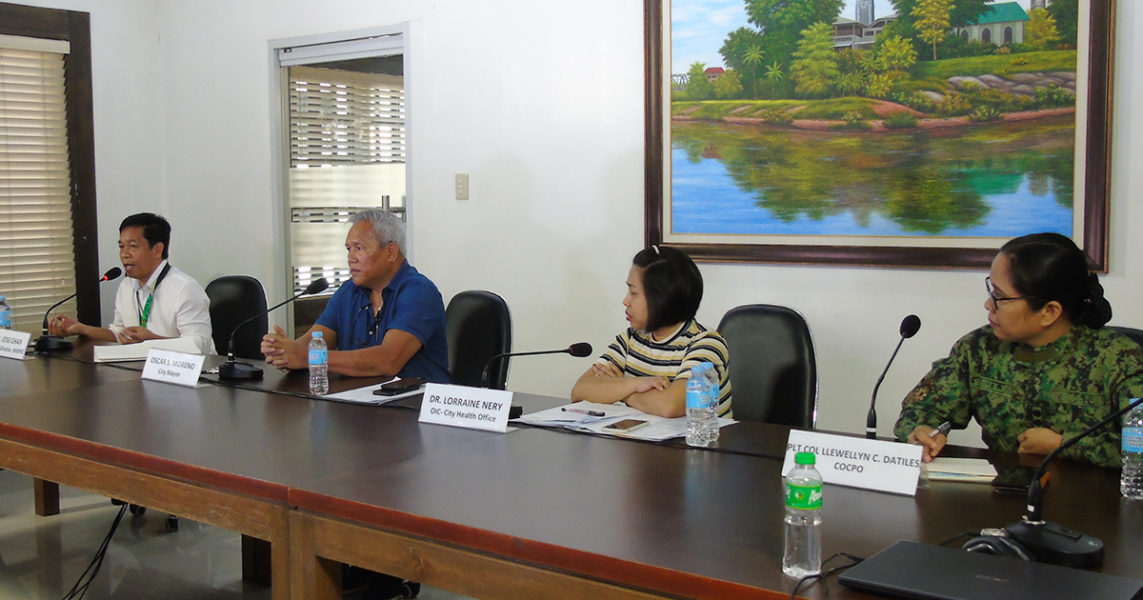
As the number of “persons under investigation” and person under monitoring” declined sharply, Mayor Oscar Moreno ordered the City Health Office to field teams that would conduct house-to-house investigation of residents to determine whether any of them have or know someone who experienced symptoms of influenza-like illnesses and acute respiratory illnesses.
On April 3, the teams led by CHO epidemiologist Joselito Retuya covered over 3,006 houses and found 227 cases of influenza-like illnesses and acute respiratory illnesses.
“We will make further investigations on them to know whether they have travel history or contact with a Covid positive person to determine whether they are PUIs or PUMs,” Retuya said.
Validated information from the DOH, Cagayan de Oro City has so far registered only one confirmed Covid-19 case--Patient No. 597, a 71-year old male who came from Greenhills, San Juan and was admitted at the NMMC. According to NMMC medical director Dr. Jose Chan, subsequent tests turned negative and he is classified as recovering as of April 6, 2020.
CHO data showed that from Jan. 3 to April 6, the number of PUMs dropped sharply from 1,337 to only 12 after 1,314 of them completed their two-week quarantine with no lingering illnesses.
Of the 38 PUIs recorded by CHO for the same period of Jan. 3 to April 3, about 35 fully recovered after completing their two-week quarantine and three are still undergoing quarantine and four other patients from the city are confined at the NMMC awaiting results of their Covid-19 swab test as of this writing.
Despite the initial findings, Moreno said figures are encouraging, but he doesn’t want to be complacent given the rising number of Covid-19 cases around the world and so he ordered house-to-house visits to ramp up City Hall’s tracing of potential carriers of the deadly virus.
City health officer Lorraine Nery said they won’t rule out the possibility that their intensified surveillance may result in more PUMs and/or PUIs with mild to moderate symptoms of influenza-like or respiratory illness. The important thing, she said is that they will be isolated and given medications.
At the same time Dr. Retuya said the Luzon-wide enhanced community quarantine (ECQ) that took effect March 15 barred the arrival of more travelers from their area into Cagayan de Oro, narrowing down their tracing to those now staying in the city. But the task remains gargantuan, he said.
Retuya said they have to investigate over 160,000 households but the burden on them is eased somewhat since their teams who included community volunteers already conducted a previous polio immunization coverage on the same number of households.
Frontliners in the barangays have been given basic protective gears like face masks. They have also been given ample supply 70-percent rubbing alcohol. Dr. William Bernardo, department head of the City Health Insurance Office and head of the logistics group of the EOC the barangay frontlines have been given the second batch or supplies.
At the city government-owned JR Borja Memorial General Hospital, a separate triage has been set up for those with influenza-like illnesses and acute respiratory illnesses where medical frontliners wear personal protective gears.
City hall is helping in decongesting NMMC -- non-Covid-19 cases like normal birth deliveries are coursed to the barangay health centers and even to the JR Borja hospital.
“Cagayan de Oro is the host of the region’s hospital for Covid-19 patients. This is a responsibility we have to live with and deal with. Avoiding this responsibility will cause more harm to everybody,” Moreno said in one letter.
While the numbers of Covid-19 PUIs and and PUMs have sharply declined, there is no let-up in the fight against the dreaded virus.
Dr. Nery said they prepared over 70 barangay isolation units in sites that are easily accessible to families of PUIs with mild symptoms to complement the city quarantine centers in undisclosed areas.
“Currently our BIU has a total bed capacity of 180, and the city quarantine center currently has 40 beds,” she said.
City tourism officer Charmaine Dulguime, who heads the Humanitarian Cluster of the Covid 19 Emergency Operation Center, said they are looking for more facilities like classrooms to be converted into isolation centers. Those enrolled in isolation centers will occupy one room each and be provided with basic necessities. Their health vital signs will be monitored regularly for 14 days. The JRB hospital is also being prepped to yave its own isolation unit in case the bed capacity at the Northern Mindanao Medical Center, the regional referral for Covid-19 cases.
Moreno declared a citywide quarantine on March 19 but three days earlier, he ordered the temporary closure of malls and businesses engaged in non-essential services and goods as well as recreational facilities to discourage the influx of more visitors to the city.
“Our calibrated response is to limit the people going into the city. Closing malls and stores eliminates the reason for people to visit the city,” he said.
The daytime population of Cagayan de Oro City, a major port city long established as the prime economic hub of northern Mindanao, could go as high as 1.6 million. The latest census placed the city’s population at 750,000. The community quarantine kept most of the populace at home.
The Roads and Traffic Administration (RTA) said public transportation was cut by 90-95 percent while the number of private vehicles and taxis remained the same. While there are no travel restrictions, the temporary closure of major businesses and the physical distancing policy imposed on jeepneys and motorelas reduced the number of public utility vehicles (PUVs) plying the busy highways and streets. Angkas or pilion riding is prohibited.
Curfew was also escalated from 10 pm to 5 am to 9 pm to 5 am. Public market are only allowed to operate from 5 am to 7 pm, from the usual 20-24 hour operations. When closed, teams from city hall disinfect the public markets. City hall has organized disinfecting teams to go going around the city with their barangay counterparts and the Bureau of Fire Protection.
At the city’s borders with Misamis Oriental, the Cagayan de Oro City Police Office, the Army’s Task Force Oro, personnel from the CHO and the City Disaster Risk Reduction Department work with their counterparts from the Provincial Capitol.
At the borders with Bukidnon, Police Regional Office-10 has unified checkpoint operations.
Moreno placed Cagayan de Oro City under community quarantine on March 19, 2020. Bukidnon declared province-wide or general community quarantine on March 20, Misamis Oriental on March 24, 2020.
Interestingly, bitter political rivals Moreno and Misamis Oriental Gov. Yevgeny Vincente Emano agreed to have harmonized border control operations.
Oliver Egypto, Office of Community Affairs chief who heads the governance cluster of the EOC, said they are targeting to deliver food packs to over 100,000 households right at their doorsteps.
Knowing full well that it is going to be a day-to-day struggle, Moreno said he will not get tired repeatedly reminding city residents to stay at home, exercise social distancing, even as he ensured that the city government is having all cylinders firing 24/7 to fight the virus.
“Hopefully, we will not come to further escalation of action, but we are getting ready. I do not want to be popular in this battle, I just want to do my best,” Moreno said in last Saturday's press briefing, and before going to a late lunch with key city officials involved in Covid 19 response. ((BenCyrus Ellorin, and Stephen Capillas, CIO)
- The authors are former senior editors at the Inquirer Publication’s Cebu Daily News. Ellorin is now into PR consultancy while Capillas is a writer at the City Information Office.