TO whom do we assign blame now that some have started calling it the Cagayan de Oro River?
Perhaps the culpability lies with social media, the advent of which gave birth to armchair publishers. The cyber age is also the age of random creativity, where digital creators inhabit the earth abundantly — sometimes too abundantly.
Has the name of our river changed? There was only one way to check.
Only one government agency is tasked with the hydrographic mapping of the Philippines. It goes by the acronym Namria, assigned a rather elongated nomenclature: the National Mapping and Resource Information Authority. Mapping is the science of cartography.
Namria is the central government agency responsible for producing, maintaining, and distributing official maps, nautical charts, and crucial geospatial information for national development. It is an agency attached to the Department of Environment and Natural Resources.
I asked Namria: Is it mandated to name rivers and creeks? Has the name “Cagayan River” in Northern Mindanao changed to the “Cagayan de Oro River”? I added that I have not seen any map confirming a name change.
But how did our river acquire its name? Answering that requires a brief academic briefing before we get to Namria’s reply.
The name “Cagayan” comes from the Proto-Philippine language of 4,000 years ago, the ancestor of modern Philippine languages. I learned this by interacting with two linguistics scholars who possessed exemplary first-hand research knowledge of Northern Mindanao and ancient Philippine linguistics.
Linguist Richard Elkins came to Mindanao in 1953 and conducted the most comprehensive study of the Western Bukidnon Manobo (a.k.a. Kerenteken), with whom he lived for decades and for whom he developed an alphabet system.
Lawrence Reid is a distinguished American linguist and Professor Emeritus at the University of Hawai’i at Manoa, renowned for his extensive research on Austronesian linguistics, particularly the morphosyntax and historical linguistics of Philippine languages.
Both agreed that the name Cagayan came from the Proto-Philippine language that later evolved into most of the 170 languages Filipinos use today. From that word, the Ilocano derived karayan for river, and the Central Cagayan Agta of northeastern Luzon derived keheyan for river.
How did an ancient language reach Northern Mindanao? It didn’t just reach us; it was spoken here because this was the period before Austronesian diversification.
When Austronesian arrivals came from southern Taiwan around 2,200 BC, the equation became: Proto-Philippine plus Austronesian resulted in diversification into subgroups that migrated south and developed linguistic cultures in isolation.
The late John Burton, an American professor of history at Xavier University, called it “geographical twinning”—the existence of two Cagayan Rivers and two Cagayans, each with its own Camiguin island off the coast (both volcanic). This is not a coincidence; there was a linguistic phenomenon behind it.
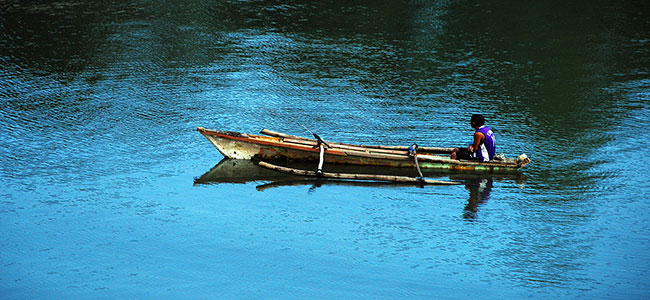
Has anyone seen the Cagayan River of Luzon? I have. The terrain is akin to our river: mighty, chiseling its way through vertical karstic (limestone) cliffs.
People tend to take pains to contrive myths and legends about the name Cagayan that are not contextual to proto-history and certainly not scientifically linguistic. I call them “fakelore.”
Can the name change? There is no precedent for cultural praxis. In Northern Luzon, the Spanish colonizers named the Cagayan River’s longest tributary the Rio el Chico de Cagayan — the Little Cagayan River — to distinguish it from the Rio Grande de Cagayan.
The Chico River is associated today with the national hero Macli-ing Dulag, the pangat (leader) of the Butbut indigenous peoples of Kalinga who opposed the Chico River Dam Project of the Marcos dictatorship. Macli-ing was shot in his home in Bugnay, Kalinga, by soldiers led by Lt. Leodegario Adalem.
In our Cagayan, the river’s name has resisted change for more than a century. In the Hispanic era, references to Cagayan town would change — Cagayancito, Cagayan el Chico, Cagayan de Misamis, Cagayan de Oro — but never the river’s. (Rio Cagayancito?) I have seen these various names in archival documents in Manila; the name Cagayan de Oro existed in student enrollment forms at the Ateneo de Manila and UST in the 1890s. It certainly was not coined in 1950.
So how did Namria attend to my query? Their response was consistently and impressively scientific:
“We would like to clarify that the Cartography Division, under the Mapping and Geodesy Branch (CD-MGB) of Namria, is not charged with nor has the authority to officially name rivers and creeks.
“The Division is responsible for the updating and production of topographic base maps at a scale of 1:50,000, which includes standardizing the names of geographic features. As part of these efforts, it implements the ‘Philippine Gazetteer Project,’ which seeks to consolidate and update geographical names across the country…
“While the Division ensures consistency and accuracy in the representation of geographic names on maps, any official naming or renaming of rivers and creeks is beyond its mandate.”
Who, then, has the mandate to change it to Cagayan de Oro River? Namria offered a suggestion:
“We kindly recommend coordinating with the National Historical Commission of the Philippines (NHCP).”
I believe local media can help bring light to the Cagayan de Oro public. For instance, the Cagayan de Oro Press Club can adopt the name “Cagayan River” as a matter of editorial style.
It is about time Cagayan de Oro uses depth and scholarship to develop the truth-telling of history. History is neither a work of crowdsourcing nor of bogus historians extrinsic to the scientific discipline.
It is also not the work of local politicians who make historians out of the unschooled as a reward to those partisanly loyal to them.
What suffers? This historical truth. Who suffers? The education of our youth and our public.
Note from the editor: The author is a true blue Kagay-anon, social anthropologist, and ethnohistorian. A dedicated heritage advocate, he writes extensively on the history, culture, and preservation of Cagayan de Oro and Northern Mindanao.