By JIGGER J. JERUSALEM
Correspondent
ENVIRONMENTAL group Ecowaste Coalition on Sunday expressed hope that with the return of the last two batches of trash from South Korea, the Philippines would no longer see garbage from overseas being dumped into the country.
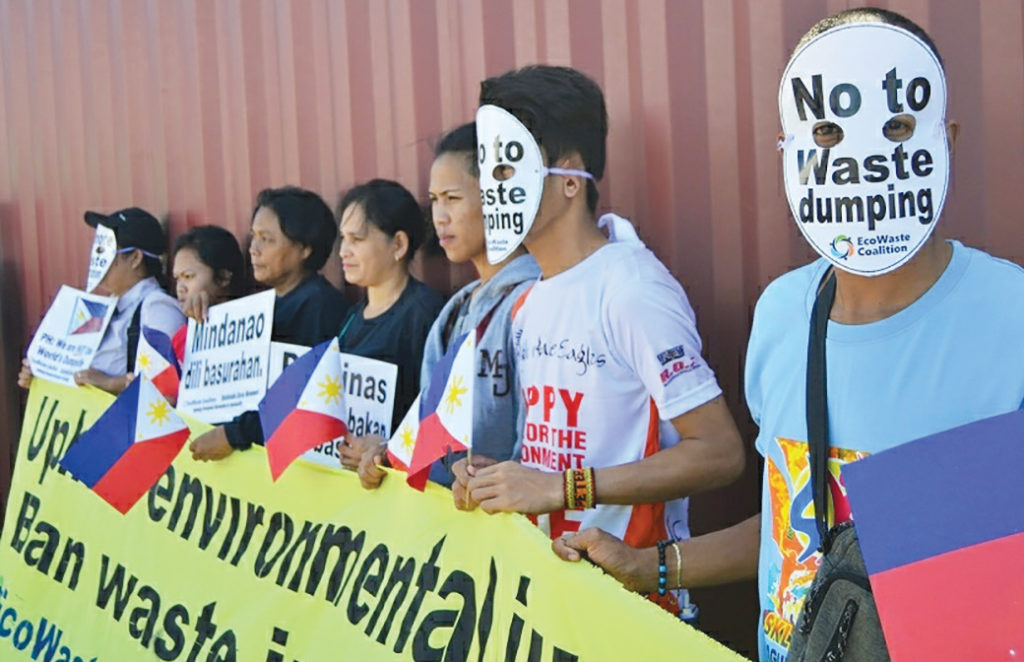
On Sunday, some of the South Korean trash were shipped back, and the last shipment is scheduled Feb. 23.
The South Korean trash, weighing about 6,500 metric tons, arrived in northern Mindanao in July and October 2018.
The garbage was imported by VNS Verde Soko Philippines Industrial Corp. allegedly to be used as materials for a plastic recycling facility but these were seized by the Bureau of Customs (BOC) when the company wrongfully declared it, as it has also failed to secure an import permit from the Department of Environment and Natural Resources.
Because of this, the Verde Soko plant, located at the Phividec Industrial Estate in Sitio Buguac, Barangay Sta. Cruz, Tagoloan town in Misamis Oriental, has been ordered closed by the government.
“The re-exportation of the remaining wastes and the cleanup of the storage site in Tagoloan, Misamis Oriental, which factually became an open dumpsite for South Korean rubbish, will help in bringing this dumping controversy to a close,” said Aileen Lucero, Ecowaste Coalition national coordinator.
To deter the illegal trafficking of waste in the future, Lucero said, “all those responsible for this mess should be fully held accountable in accordance with the rule of law.”
She said there is also a need for the government to impose a no-nonsense ban on waste importations and to ratify the Basel Ban Amendment, an international law banning the transfer of hazardous waste from developed to developing countries.
“Those environmental justice measures will protect our country and our people from the negative consequences of global waste trade,” she added.
John Simon of BOC-10 said 50 container vans were shipped back to Pyeongtaek City, South Korea, on Feb. 16, while the last 50 container vans would be sent back on Feb. 23.
Last month, 101 container vans were shipped back, bringing the total number of re-exported containers to 201.
“The re-exportation of the remaining wastes from South Korea this month signifies our nation’s steadfastness to protect public health and the environment from the deceptive trade in hazardous waste disguised as plastic waste for recycling,” Simon said.
He added, “As guardians of our ports, we are committed to curb illegal trade and halt all forms of customs fraud, including the practice of falsely declaring hazardous waste and other wastes as recyclables.”
Two container ships, Vivaldi and Nordmarsh, have been commissioned to bring the remainder of the trash to its country of origin.
On Sunday, Vivaldi shipped 50 container vans of the Korean trash.
The international cargo ship left the Mindanao Container Terminal sub-port in Tagoloan Sunday afternoon, Simon said.