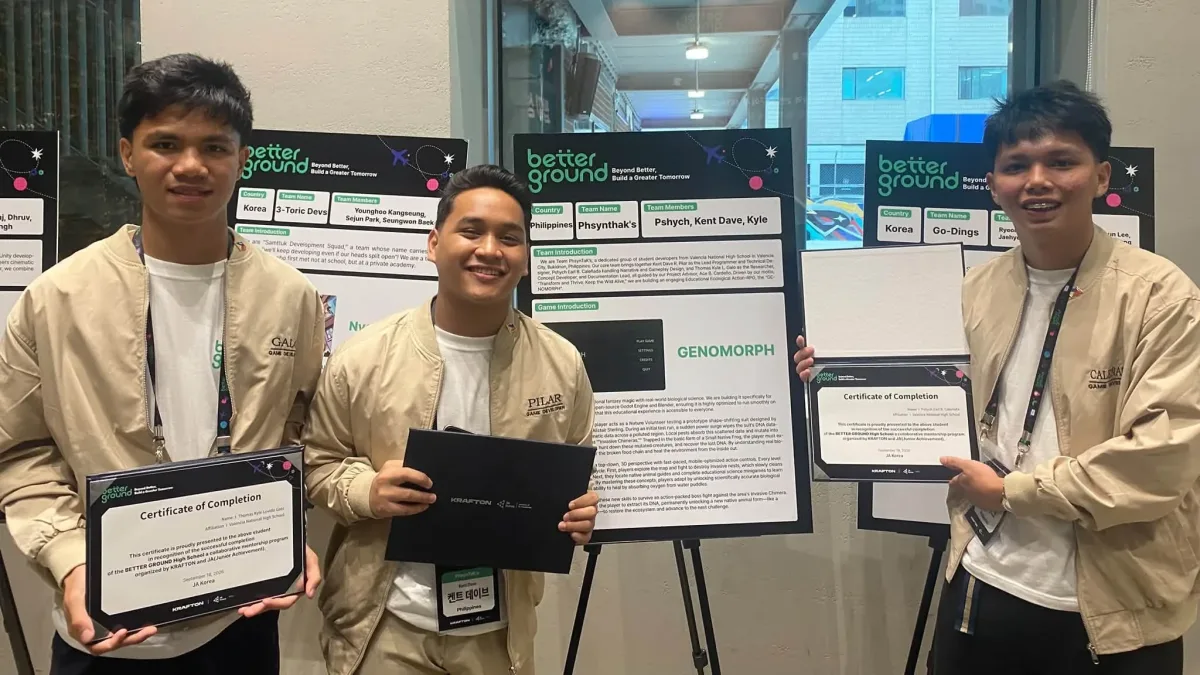
CAGAYAN DE ORO CITY — Three student developers from Valencia City, Bukidnon, represented the Philippines on the global stage, showcasing an original eco-themed mobile game at Krafton’s BETTER GROUND 2026 international summit in Seoul.
Team PhsynTak—composed of Valencia National High School students Kent Dave R. Pilar, Pshych Earl B. Caleñada, and Thomas Kyle L. Galo—was among 17 finalist teams selected from more than 1,000 applicants across Asia.
Guided by project advisor Ace B. Cardeño, the Bukidnon trio presented "GENOMORPH," a mobile action role-playing game that trades traditional fantasy magic for real-world biological science.
Science over fantasy
Built using Godot Engine and Blender, the game puts players in the role of a nature volunteer testing a shape-shifting suit. When a power surge scatters the suit's genetic database, local pests mutate into massive "Invasive Chimeras."
Trapped in the form of a small native frog, players must explore polluted wilderness, clean habitats, and recover lost DNA to restore the local ecosystem.
"The ultimate reward was seeing everyday players light up, engage with the mechanics, and walk away with a genuine understanding of the science behind it," Cardeño said. "Watching the team transform abstract scientific ideas into dynamic gameplay wasn't just a technical achievement—it was an act of translation."
To make educational elements feel natural, Galo, the team's researcher and concept developer, integrated conservation directly into gameplay.
"Players clean habitats by removing trash and eliminating invasive species," Galo said. "While the transformation system is fictional, the animals are based on real science and the habitats where they actually belong."
Designing for the small screen
Translating this vision to mobile screens required clever design choices. Pilar, the lead programmer, noted that playing as a tiny frog immediately puts the player in an underdog role.
"To make it fun and powerful, the team gave it explosive leap physics, a snappy tongue mechanic, and fluid momentum chaining," Pilar said. "While you're technically the smallest creature in the ecosystem, you're always the fastest and smartest thing on screen."
When facing giant bosses on a smartphone screen, Caleñada, who handled narrative and gameplay design, utilized camera framing to build tension.
"When a creature takes up a significant portion of your phone screen and has sharp, readable action animations, it automatically feels a lot more dangerous," Caleñada explained.
A test of teamwork
Organized by South Korean video game developer Krafton—the studio behind PUBG—and Junior Achievement (JA) Korea, the BETTER GROUND initiative mentors aspiring teenage game creators. Throughout the summer, the Valencia students received direct technical coaching and code reviews from Krafton industry professionals.
To prepare for the showcase at PUBG Seongsu in Seoul, Cardeño enforced strict milestones to prevent developer burnout, ensuring the students were rested and ready for unexpected technical stress tests.
That preparation paid off on the showcase floor. Pilar managed the high-stakes environment by tuning out the noise.
"What kept me locked in was knowing my team needed a calm anchor," he said. "If I stayed composed, we had the steady foundation to trust our training and perform without fear."
For Cardeño, the true victory was watching his students operate as a professional game studio.
"What makes me proudest is seeing them evolve from individual student coders into a self-reliant development unit," Cardeño said. "When something broke or a concept didn't translate well into gameplay, they didn't wait around for step-by-step instructions—they collaborated, adapted, and resolved it themselves."