CAGAYAN de Oro City — A court injunction blocking a Metro Manila minimum wage increase has raised concerns among labor groups that similar legal challenges could delay future pay hikes in Cagayan de Oro and other parts of Northern Mindanao.
The dispute involves Wage Order No. NCR-27 and a Pasig Regional Trial Court (RTC) order that has kept the wage increase on hold.
Labor groups are challenging the court’s authority to stop the implementation of a wage order issued under the regional wage-setting system.
The case has drawn attention in Northern Mindanao, where minimum wage rates are also determined through a regional wage board. However, whether the dispute will affect future wage increases in the region remains uncertain and will depend on the courts’ rulings and the circumstances of any similar cases.
Records provided by labor lawyer Atty. Sonny Matula show that 11 NAGKAISA affiliates and allied workers’ organizations filed an urgent motion for leave to intervene in the Pasig RTC proceedings on Aug. 3, 2026.
Matula is also the national president of the Federation of Free Workers (FFW).
The court granted their request on Oct. 20, more than two months after the filing, according to the information provided.
A separate motion involving RTC Branch 287 in Navotas City was filed on Aug. 6.
NAGKAISA maintains that the Pasig court granted the request to intervene only after the workers had brought their petition before the Supreme Court.
The coalition argues that the timing raises concerns about the opportunity for workers’ organizations to participate in the proceedings.
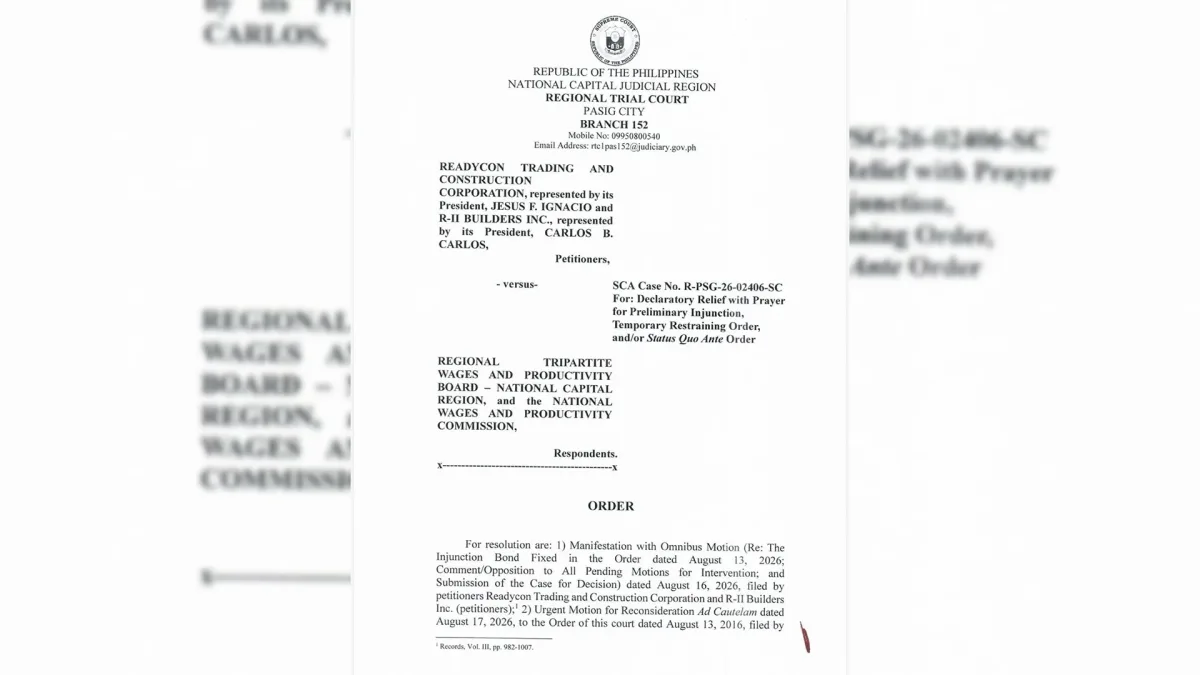
In its Oct. 20 order, the court kept the wage injunction in place; Pasig RTC Branch 152, presided over by Judge Marie Joyce P. Manongsong, allowed the labor groups to intervene but kept the injunction against implementing Wage Order NCR-27 in place.
The court also reduced the bond required from employer petitioners Readycon Trading and R-II Builders Inc. from ₱10 billion to ₱5 billion and gave them 30 days to post the amount, according to the details of the order provided for this report.
The court also denied a motion for reconsideration filed by the Office of the Solicitor General (OSG).
The injunction continues to prevent the implementation of the disputed wage increase while the legal challenge remains unresolved.
NAGKAISA spokesperson Rene Magtubo has argued that the delayed approval of the labor groups’ intervention does not undo the financial impact on workers.
The coalition is seeking payment of wage differentials withheld because of the injunction.
SENTRO Deputy Secretary General Nicey Coronacion has also questioned the trial court’s authority to halt the wage order, maintaining that reducing the bond does not resolve the issue of jurisdiction.
These statements reflect the labor groups’ position in the dispute.
The legal questions remain subject to the applicable court proceedings and rulings.
Why the case matters to Northern Mindanao
The dispute is being watched by labor advocates in Cagayan de Oro and other parts of Northern Mindanao because a ruling on the authority of trial courts to suspend wage orders could provide guidance for future wage disputes.
Under Wage Order No. RX-24, the daily minimum wage in Category I areas, including Cagayan de Oro, Iligan, Malaybalay and Valencia, is ₱500, based on the figures provided for this report.
Wage Order NCR-27 would raise the daily minimum wage in Metro Manila to ₱755.
Labor advocates fear that employers in other regions could pursue similar legal challenges against future wage orders, potentially delaying increases intended to help workers meet their living expenses.
However, the possibility of similar cases in Northern Mindanao is a concern raised by labor groups, not an established outcome of the Pasig proceedings.
The dispute centers on the interpretation of Republic Act No. 6727, or the Wage Rationalization Act, and Article 126 of the Labor Code.
Labor groups cite these provisions in arguing that wage adjustments must follow the statutory wage-setting framework and that trial courts should not block the implementation of wage orders.
The extent of a trial court’s authority to issue an injunction in this type of dispute remains a legal question that must be resolved through the appropriate judicial proceedings.
Labor groups question timing of intervention
The dates of the intervention request have become another point of concern for NAGKAISA.
According to the records described by Atty. Matula, the 11 organizations filed their motion in the Pasig RTC on Aug. 3, but the court granted permission to intervene only on Oct. 20.
The separate Aug. 6 filing concerns proceedings before the Navotas RTC and is distinct from the Pasig case.
NAGKAISA argues that the Pasig court’s action came after the workers had already brought their petition before the Supreme Court.
The coalition maintains that the delay did not prevent the wage injunction from remaining in effect.
The chronology establishes the interval between the filing and the court’s action.
It does not, by itself, establish that the delay was unlawful or determine the validity of the injunction.
Court action awaited NAGKAISA and the Federation of Free Workers have pursued a challenge before the Supreme Court over the dispute involving Wage Order NCR-27.
The precise status of the petition and the relief currently being sought should be confirmed from the latest court records.
For affected Metro Manila workers, the immediate issue is the continued suspension of the wage increase.
For workers in Cagayan de Oro and other parts of Northern Mindanao, the proceedings could offer guidance on the legal limits of challenges to future wage orders.
Until the courts resolve the dispute, the potential effect on regional wage increases remains uncertain.