CAGAYAN de Oro City — About 1.07 million people in Northern Mindanao remained poor in 2025, despite a decline in the region’s poverty rate, raising questions about how economic gains can translate into lasting improvements in household living conditions.
The Philippine Statistics Authority-10 (PSA-10) reported that poverty incidence fell to 20.3% in 2025 from 25.3% in 2023, equivalent to about 241,890 fewer people classified as poor.
Poverty incidence among families also declined, from 18.4% to 14.4%. The number of poor families dropped from about 227,000 to 195,000, according to the agency.
But Northern Mindanao’s poverty rates remained more than twice the national estimates of 9.7% among the population and 6.4% among families.
The figures mean roughly one in five people in the region still lived below the poverty threshold in 2025.
Bukidnon had the region’s highest poverty incidence, with 27.7% of its population and 21% of its families classified as poor. Camiguin recorded the lowest rates, at 8.2% among the population and 5.3% among families.
Among the highly urbanized cities, family poverty incidence stood at 8% in Iligan and 4.5% in Cagayan de Oro.
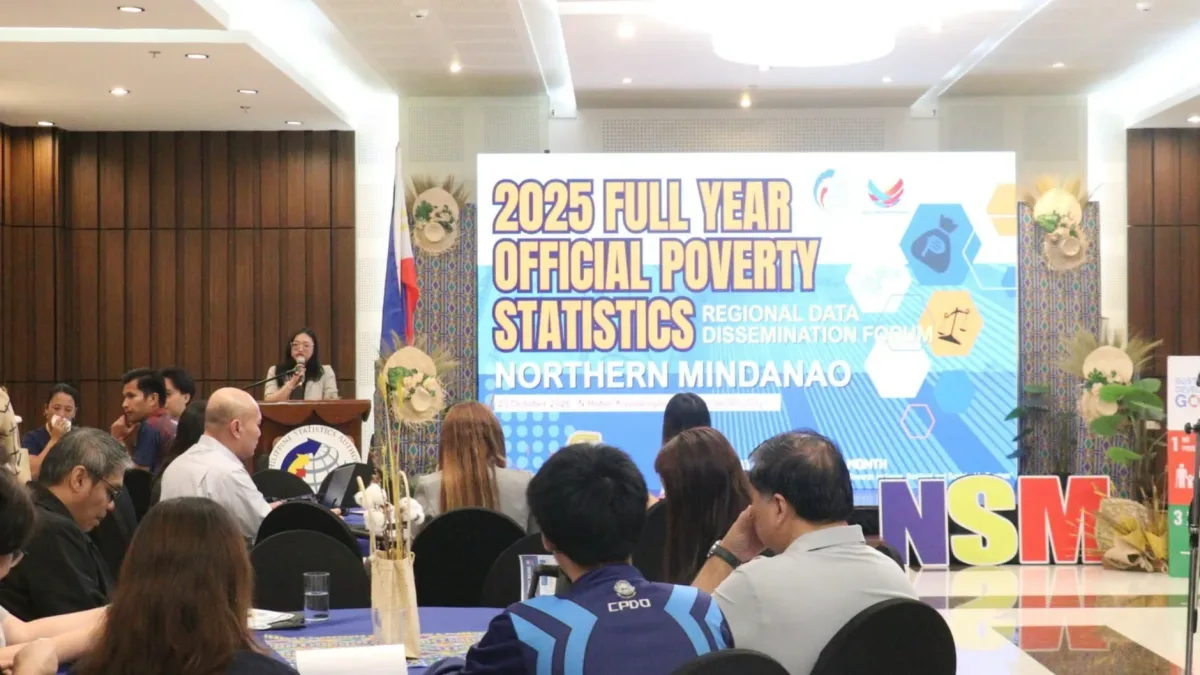
Janith C. Aves, PSA-10 regional director, presented the figures during a dissemination forum on the 2025 Family Income and Expenditure Survey and poverty statistics.
The agency also reported that subsistence poverty — the inability to afford basic food needs — declined during the same period.
In 2025, about 314,000 people and 51,000 families remained food-poor, down from 394,000 people and 59,000 families in 2023. Subsistence incidence stood at 6% among the population and 3.8% among families.
Mylah Faye Aurora B. Cariño, regional director of the Department of Economy, Planning and Development-Northern Mindanao (DEPDev-10), described the decline as encouraging but warned against complacency.
She said geopolitical tensions, energy constraints and climate risks could threaten economic growth and household incomes.
“Our economy continues to be strong; it has expanded, but we want a MAS ASENSO Northern Mindanao, where our economic gains really translate into substantial reductions in poverty,” Cariño said.
She said government resources were being directed toward programs intended to create opportunities, increase incomes and protect families.
However, the figures presented did not specify which interventions contributed most to the decline in poverty or how much each program improved household incomes. Further breakdowns of the results could help identify which communities and groups continue to need the most support.
Spending grows faster than income
Preliminary results of the 2025 Family Income and Expenditure Survey showed that family income and spending both increased, but expenditure grew at a faster rate.
Total annual family income in Northern Mindanao rose by 23.2%, from ₱366.37 billion in 2023 to ₱451.35 billion in 2025.
Total annual family expenditure, meanwhile, climbed by 37.9%, from ₱250.32 billion to ₱345.21 billion.
Average annual family income increased by 12.6% to ₱333,730, while average annual expenditure rose by 26% to ₱255,250.
The figures show that households spent a larger amount of money in 2025 than two years earlier. However, the aggregate data alone do not establish whether families could afford more goods and services, particularly after accounting for inflation and differences in household needs.
Wages and salaries remained the biggest source of family income, accounting for 52.6% of total income. Entrepreneurial activities contributed 17.9%.
Food and non-alcoholic beverages took the largest share of household expenditure at 37.1%, followed by housing, water, electricity, gas and other fuels at 18.8%.
Sarah B. Balagbis, PSA-10 chief statistical specialist, said lower-income families devoted a larger proportion of their budgets to food, while higher-income households allocated relatively larger shares to transport, health and other services.
She said the poverty statistics could guide policymakers, planners and other stakeholders in developing programs aimed at reducing poverty and building more inclusive and resilient communities.
The results point to a continuing challenge for regional planners: sustaining the decline in poverty while ensuring that rising incomes and economic activity lead to better living conditions for families still struggling to meet their basic needs. (With a report from Apipa Bagumbaran /PIA-10)