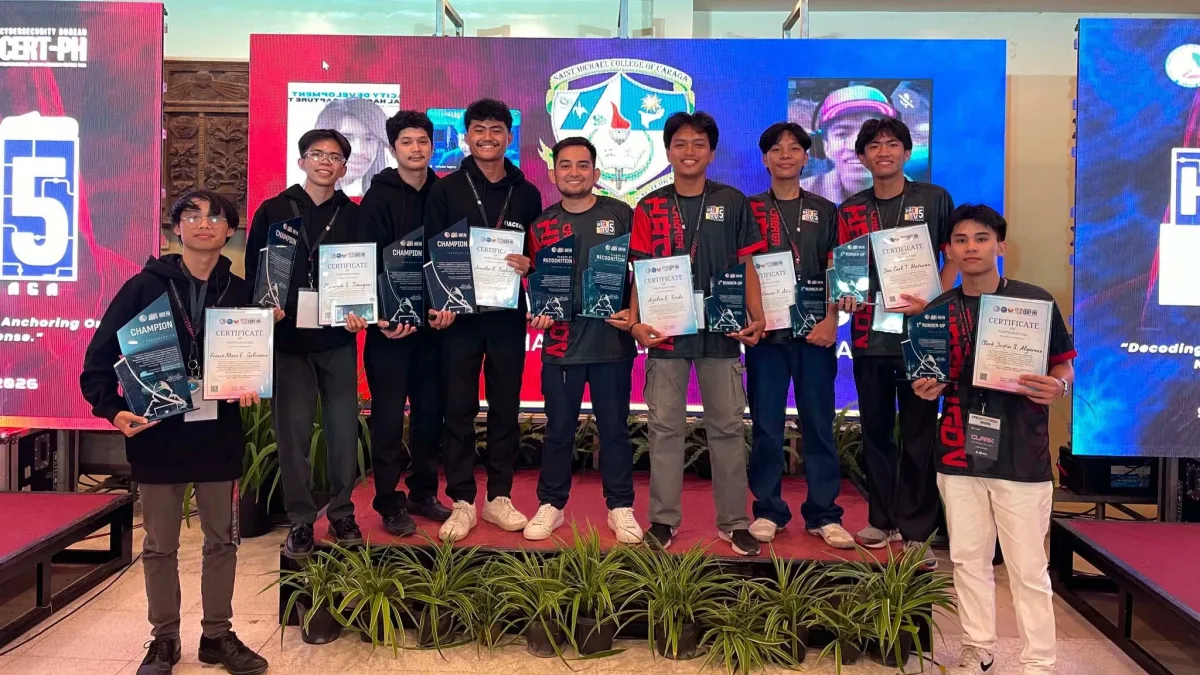
CAGAYAN DE ORO CITY — Saint Michael College of Caraga (SMCC) swept the top two spots at the HackforGov 2026 Region 13 cybersecurity competition at Almont Inland Resort on Sept. 2, securing a berth to represent the region in the national finals in Metro Manila this December.
Organized by the Department of Information and Communications Technology (DICT) Region 13 under the theme “Decoding Youth Innovation, Anchoring One Nation’s Digital Defense,” the event gathered 60 student competitors across 15 teams representing 14 schools.
Teams competed in a simulated environment requiring real-time threat investigation, vulnerability analysis, and system defense to capture digital "flags."
Regional sweep
SMCC’s Team Michaelinian Tech Knights took the championship, while SMCC’s second entry, Team Un!N$P3CT3d, earned first runner-up. Team Xavier Knights of St. Francis Xavier College finished second runner-up.
"This remarkable achievement highlights the growing excellence of our students in the field of cybersecurity," SMCC's College of Computing and Information Sciences said in a statement.
Led by team leader Arnolex R. Taghoy, the championship squad featured Frenzel RG T. Ferrer, Christian S. Timogan, and Franz Marc E. Gelicame. The runner-up team comprised Clark Justin Algarme, Jancarl Maturan, Aijalon Sindo, and Mike Denver Avis. Both teams were coached by Ronel A. Falo.
In individual honors, SMCC's Taghoy and Ferrer were recognized alongside Ralph Vincent P. Tajantajan (Caraga State University) and Lee Mark E. Escobal (Surigao Del Norte State University). Escobal also clinched a national Wildcard slot for the Manila finals.
Tactical pivots under pressure
Coach Ronel A. Falo noted that the regional competition becomes more demanding every year.
"The pressure was even greater because we were competing against very strong teams, including former Hack4Gov champions," Falo said, adding that he instructed students to move on if they could not make progress on a challenge within an hour. "Seeing them work together under pressure showed me how much they have grown."
When initial attempts hit a wall, team members reassessed their tactics mid-game.
"It's not always about who can find the answer fastest—it’s about how well a team can adapt, communicate, and stay calm when the first approach fails," Timogan said.
Endurance and manual workarounds
As the hours dragged on, mental fatigue became a major hurdle.
"I just kept telling myself to push and focus on one challenge at a time instead of thinking about how tired I was," Ferrer said.
Technical hurdles also tested the team's resourcefulness. When faced with a complex problem named "Counterfeit" that exceeded their basic scripting knowledge, two members spent two hours manually entering flag entries one by one until they found the correct sequence.
"From that challenge, we learned that bash scripting and automation are vital for our knowledge as cybersecurity students," Gelicame said.
Real-world impact & national finals
For team captain Taghoy, combining individual strengths made the difference. "We all had our own strengths," Taghoy said. "We combined our ideas and helped each other to solve the challenges."
The experience reinforced the real-world responsibility of digital defense. "Behind every vulnerability is a potential impact on real people, organizations, and public services," Timogan noted.
With the regional win, the Tech Knights are now preparing a structured multi-day weekly training regimen for the Metro Manila national finals this December.
"We will just prepare, improve our skills, and explore more things so we can be ready for the national stage and bring home the victory for Caraga," Taghoy said.