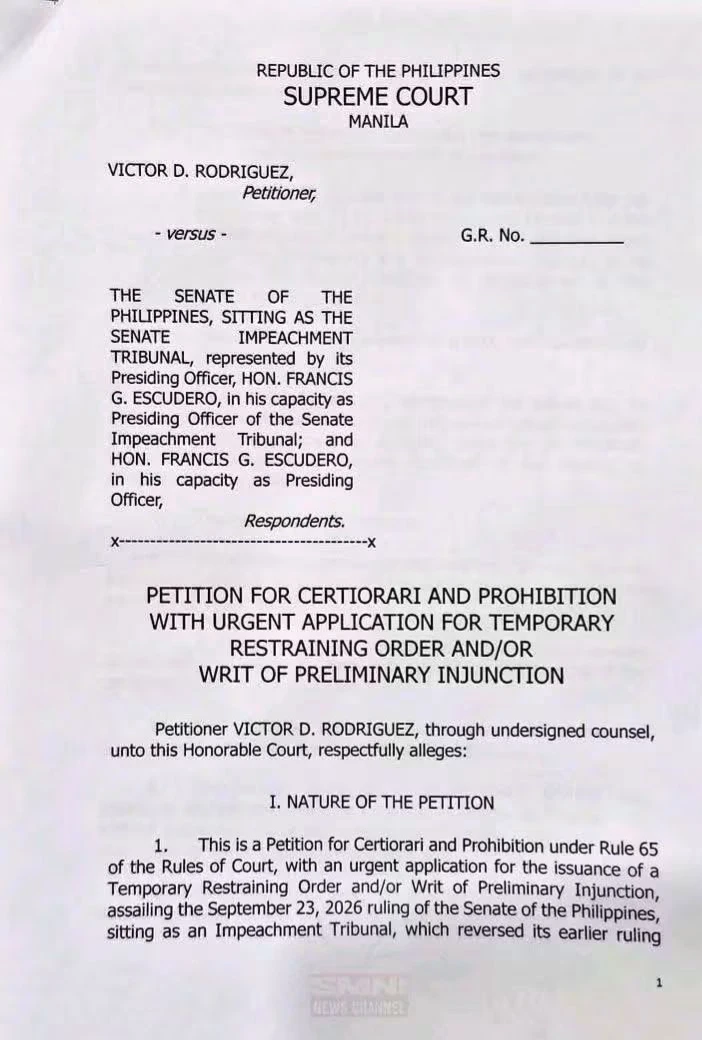
CAGAYAN de Oro City- The constitutional dispute over how many Senate votes are needed to convict Vice President Sara Duterte in her impeachment trial has reached the Supreme Court, with former Executive Secretary Victor Rodriguez asking the high court to nullify the Senate Impeachment Court’s latest ruling.
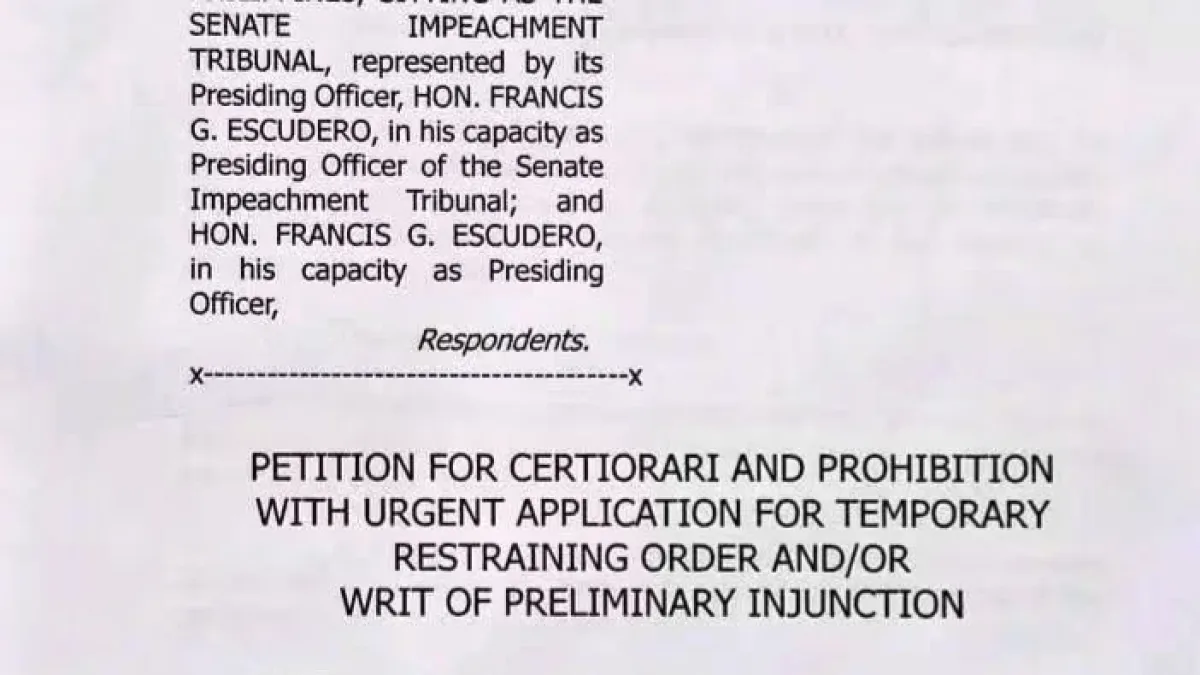
Rodriguez filed a petition for certiorari and prohibition on Thursday, Sept. 24, along with an urgent request for a temporary restraining order (TRO) and/or writ of preliminary injunction. He is challenging the Sept. 23 ruling that changed the basis for computing the two-thirds conviction requirement.
The Senate Impeachment Court had ruled that the phrase “two-thirds of all the Members of the Senate” under Article XI, Section 3(6) should be based on senators who are legally and factually capable of participating in the proceedings.
With 20 senator-judges currently considered capable of participating, the resulting threshold is 14 votes, instead of the earlier 16-vote requirement based on the full 24-member Senate.
The Sept. 23 ruling reversed Presiding Officer Francis “Chiz” Escudero’s July 6 ruling setting the threshold at 16 votes.
Rodriguez: Senate cannot change constitutional denominator
Rodriguez argues that the impeachment court’s ruling effectively changes the constitutional basis for determining the required votes.
He maintains that the Constitution expressly requires the concurrence of two-thirds of all Senate members for conviction and that the Senate currently has 24 members, making 16 votes the corresponding two-thirds.
He further argues that a senator’s absence, non-participation, temporary inability to participate or inability to be reached by the Senate does not, by itself, remove that senator from the constitutional membership of the Senate.
According to Rodriguez, the Senate’s authority under Article XI, Section 3(8) to promulgate its impeachment rules does not include the power to amend or revise a constitutional provision.
He also invokes Article XVII, which provides the constitutionally prescribed mechanisms for amending or revising the 1987 Constitution, arguing that an impeachment court ruling is not among those mechanisms.
Public-interest issue
The dispute has implications beyond Duterte’s impeachment trial because the interpretation could affect how the constitutional voting requirement is applied in future impeachment proceedings.
Rodriguez also argues that changing the denominator could raise equal-protection concerns involving all officials subject to impeachment under Article XI, Section 2, including the President, Vice President, Supreme Court members, members of the Constitutional Commissions and the Ombudsman.
The Senate Impeachment Court, however, has defended its Sept. 23 action.
Its spokesperson, Reginald Tongol, said the senator-judges went through oral arguments, deliberations and consultations with retired Supreme Court justices and amici curiae before reaching their decision.
He said a challenge before the Supreme Court would have to establish grave abuse of discretion resulting in lack or excess of jurisdiction.
The Supreme Court has yet to rule on Rodriguez’s petition or his request for injunctive relief.
The case therefore places a constitutional question before the high court: whether the Senate Impeachment Court may determine the two-thirds requirement using only senators capable of participating in the proceedings, or whether the Constitution requires the calculation to remain based on all 24 members of the Senate.
For the public, the outcome could determine not only the voting rule in the Duterte impeachment trial but also how a key constitutional safeguard is interpreted in future impeachment cases.