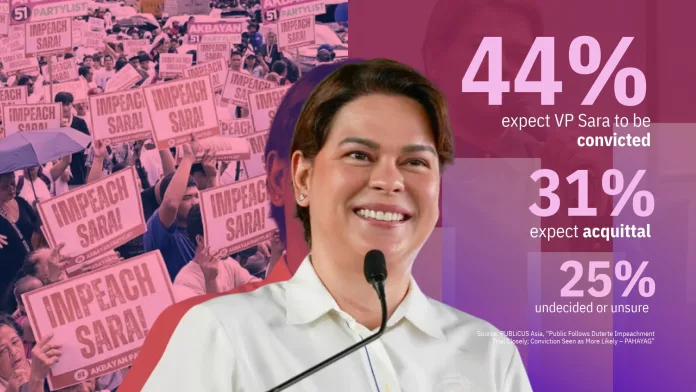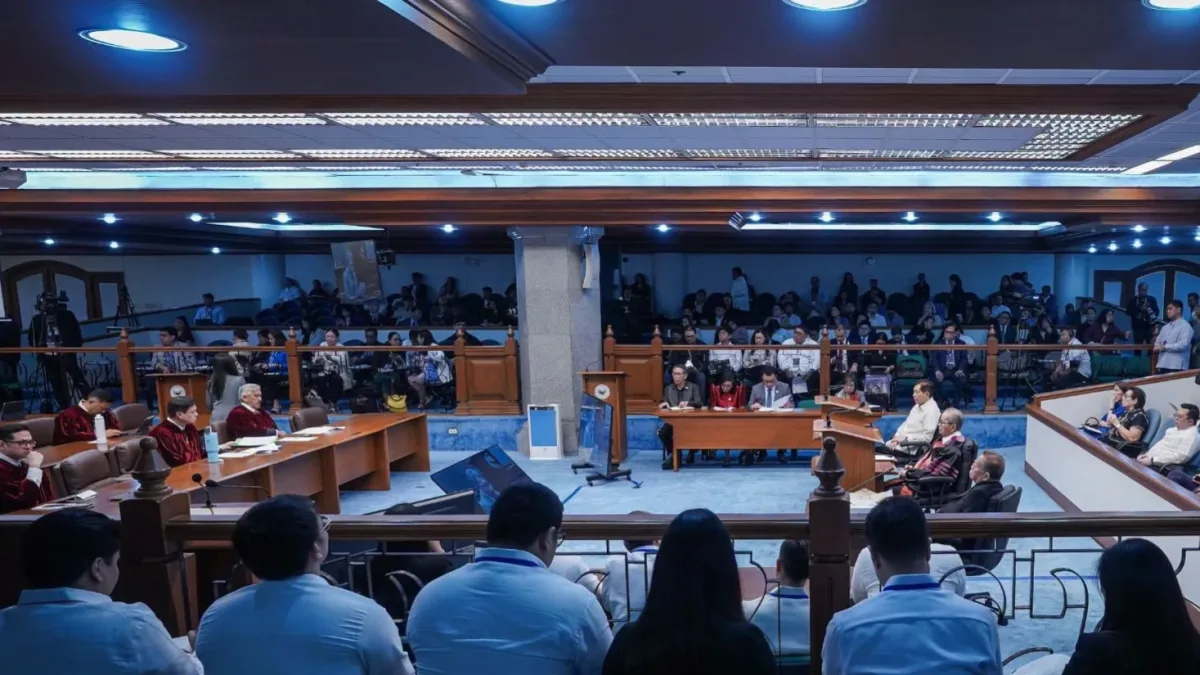
CAGAYAN de Oro City - The 16 votes needed to convict Vice President Sara Duterte are not necessarily fixed, according to three retired Supreme Court chief justices who appeared before the Senate impeachment court Wednesday.
Azcuna took the contrary view, saying the threshold must be “fixed, not variable” and that all sitting senators should remain part of the denominator.
The four former magistrates were invited as amici curiae, or friends of the court, as the senator-judges reconsider Presiding Officer Sen. Francis “Chiz” Escudero’s earlier ruling that 16 votes, or two-thirds of the full 24-member Senate, are required to convict Duterte.
The court asked them to address who should be counted among “all the Members of the Senate” in computing the two-thirds vote; whether the 1949 Supreme Court ruling in Avelino v. Cuenco applies in determining who should be counted; and whether a senator-judge who did not attend or substantially participate in the trial may still cast a final vote.
Davide, who submitted a memorandum after he was unable to personally appear, said the denominator should be based on senators qualified to vote rather than automatically on the full 24-member Senate. “Clearly then, the basis of computing the two-thirds must be the number of senators who are qualified to vote, not the 24 in the present Senate,” Davide said.
He said senators who had resigned or been expelled, were incapacitated, were outside Philippine jurisdiction or whose whereabouts were unknown, or were prevented by legal restraints from exercising their functions should not be included.
Panganiban acknowledged that two-thirds of the constitutionally prescribed 24-member Senate is mathematically 16, but said the calculation does not necessarily hold under all circumstances.
“Therefore, 24 multiplied by two-thirds is always 16 in the abstract. But not always in reality,” Panganiban said.
“Reality sometimes, Your Honors, changes the denominator in mathematics,” he added.
Panganiban said constitutional interpretation must consider the provision's purpose and the circumstances under which it operates, stressing that the Senate’s constitutional duty “cannot always be reduced to abstract arithmetic.”
He also emphasized active participation by senator-judges, questioning whether those who are abroad, in hiding, legally detained, sick or hospitalized and unable to examine evidence or hear testimony should be allowed to vote.
Puno similarly said a strictly literal interpretation would make the 16-vote threshold “fixed and immutable,” which he said was not necessarily what the Constitution intended.
He noted that the Constitution uses the fraction two-thirds rather than specifying an absolute number of votes.
“By using two-thirds, the number of votes to convict will have to move depending on certain factors,” Puno said.
Puno favored what he called a “contextual and functional” interpretation that would allow the Senate to consider circumstances legally preventing a senator from functioning as a member.
He said such an approach would allow the impeachment court to determine whether senators who are dead, resigned or expelled, as well as those legally incapacitated, should still be counted. Azcuna differed from the three retired chief justices, maintaining that the constitutional phrase “all the Members of the Senate” refers to the entire Senate membership.
“As long as they are members of the Senate, they constitute the denominator in computing the threshold of two-thirds. Because all means all,” Azcuna said.
He argued that allowing the denominator to fluctuate according to participation could weaken the supermajority safeguard built into the impeachment process. “A threshold must be fixed, not variable.
It must be determinable from the start,” Azcuna said. Azcuna said the two-thirds requirement was intended to require broad, cross-factional support for conviction rather than allow a temporary legislative majority to remove an impeachable official.
The amici also differed on the relevance of Avelino v. Cuenco, which involved the Senate quorum and a member beyond the chamber’s coercive jurisdiction.
Davide said the Avelino case was not directly applicable to impeachment but could provide guidance by analogy, while Puno said it was not a “perfect precedent” but its treatment of a senator beyond the Senate’s coercive jurisdiction could still be considered.
Azcuna said the case was not applicable because it dealt with the constitutional requirement for a quorum rather than the two-thirds vote required for an impeachment conviction.
The four also differed on whether senator-judges who missed or did not substantially participate in the proceedings may still cast a final vote.
Panganiban emphasized active participation and independent evaluation of the evidence, while Puno and Azcuna said senator-judges could evaluate evidence through the trial record even without personally observing every witness.
Davide said a senator-judge who never attended or performed any duties in the trial should be considered a non-participant, but stressed that failure to ask questions of witnesses does not by itself establish non-participation.
The threshold issue arose after Senator-Judge Erwin Tulfo sought clarification on who should be counted among “all the Members of the Senate” when some senator-judges are unable to participate in the proceedings.
Escudero’s ruling requiring 16 votes remains in effect unless the impeachment court overturns it. The House prosecution and Duterte’s defense are scheduled to present their respective arguments on Sept. 23 before the senator-judges resolve the threshold question.